Our Products
 Loans
Loans
 Cards
Cards
 Insurance
 Investment
 Stock Market
 Electronics Mall
 CIBIL Score
 Knowledge Centre
 Calculators
Our Services

 Do not call
 En
En
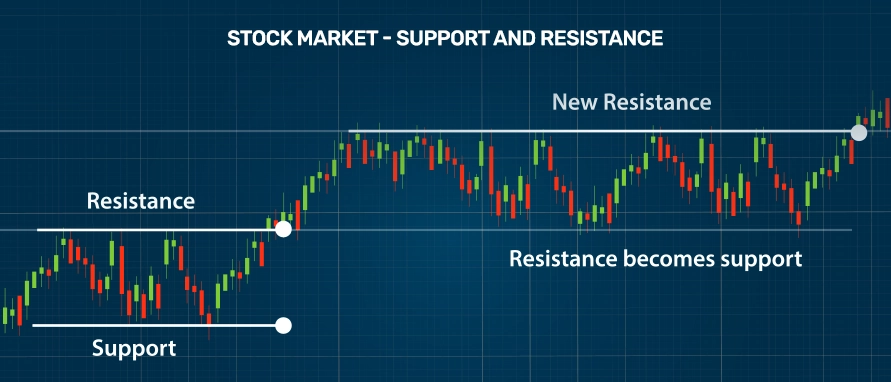
Support and resistance are foundational concepts in technical analysis that help traders and investors identify critical price levels in the market. These zones indicate where prices tend to pause or reverse due to supply and demand forces. Understanding these levels helps participants study price reactions and assess risk zones.
Support refers to a price level where buying interest is strong enough to prevent the price from falling further. It acts like a floor. Resistance, on the other hand, is a level where selling pressure tends to limit further price increases, acting like a ceiling.
These levels form due to trader psychology—investors tend to remember past price levels where reversals occurred, leading to recurring reactions around those zones.
Prices tend to react to support and resistance levels in three ways: bounce, breakout, or reversal. A bounce occurs when the price touches the level and reverses. A breakout happens when price moves through the level with volume support, indicating a possible trend continuation. A role reversal is when a broken support becomes new resistance, or vice versa.
For example, if a stock repeatedly finds buyers at ₹500, this forms a support zone. If it breaks below that, ₹500 may now act as resistance.
Here’s why support and resistance levels are commonly observed in market analysis:
Entry/Exit Timing: Provides reference points for analyzing trade timing.
Risk Management: Stop-losses are often observed around these levels as part of risk management practices.
Confidence: Provides reference points for executing trades with higher conviction.
Confirmation: Supports other indicators or chart patterns during decision-making.
There are two primary types:
1. Static Levels (Horizontal)
Trendlines: Sloped lines drawn between highs or lows.
Swing Highs/Lows: Historical turning points.
Round Numbers: Psychological zones (e.g., ₹1000).
2. Dynamic Levels (Moving)
Moving Averages: Act as rising/falling zones of S/R.
Pivot Points: Daily/weekly support-resistance projections.
Fibonacci Levels: Retracement zones based on mathematical ratios.
Each has its place and is selected based on the trader’s strategy.
Here’s how to spot key support and resistance zones:
Draw Horizontal Lines at areas where price reversed multiple times.
Connect Peaks or Troughs using trendlines.
Look for Round Numbers as psychological anchors.
Use Indicators such as moving averages or pivot points.
Volume Confirmation strengthens the reliability of levels.
The more times a level is tested without breaking, the stronger it is considered.
Several technical tools help traders pinpoint S/R levels more precisely:
Moving Averages (MA): 50/200-day MAs often act as dynamic support/resistance.
Pivot Points: Used in intraday trading to predict key levels.
Fibonacci Retracements: Identifies correction levels in trends.
Ichimoku Cloud: Offers dynamic S/R zones based on future projections.
Support and resistance levels are often examined alongside price action and indicators for added context.
Imagine a stock previously bounced from ₹120 multiple times, establishing it as strong support. Eventually, it broke below ₹120, and when price retraced back, it faced selling pressure at the same level—now acting as resistance. This role reversal illustrates how market participants anchor decisions to prior price reactions, reinforcing the level’s significance.
Support and resistance are not foolproof:
False Breakouts: Price may briefly cross a level and reverse.
Overreliance: Ignoring other indicators can reduce trading accuracy.
Misplaced Zones: Drawing inaccurate levels leads to poor signals.
Lack of Volume Consideration: No volume spike = unreliable breakout.
Always validate with price action, volume, and additional tools before acting.
Support and resistance levels highlight zones where price movement has historically shown reactions. These levels are typically derived using historical price data, trendlines, and indicators to study market structure. These levels are commonly used in technical analysis to study price behaviour.
This content is for informational purposes only and the same should not be construed as investment advice. Bajaj Finserv Direct Limited shall not be liable or responsible for any investment decision that you may take based on this content.
Support and resistance levels are identified by examining historical price highs and lows, drawing horizontal lines at reversal points, or using technical indicators like pivot points and moving averages.
Support and resistance levels provide useful guidance when confirmed by volume, historical patterns, and multiple timeframes, but they are not foolproof and can fail during volatile market conditions.
Moving averages, such as the 50-day or 200-day, often act as dynamic support in uptrends and resistance in downtrends, influencing price reactions around these levels.
A break of support or resistance, especially with high volume, can signal a trend reversal or continuation, with previous support turning into resistance and vice versa.
Some view support as potential buying interest and resistance as selling pressure, but outcomes depend on broader market conditions and confirmations.
Price reactions around strong support and resistance are often monitored by investors to understand potential market direction, usually in combination with indicators like volume or candlestick patterns.
.jpeg)












 Academy


.jpeg "image not found")