Our Products
 Loans
Loans
 Cards
Cards
 Insurance
 Investment
 Stock Market
 Electronics Mall
 CIBIL Score
 Knowledge Centre
 Calculators
Our Services

 Do not call
 En
En
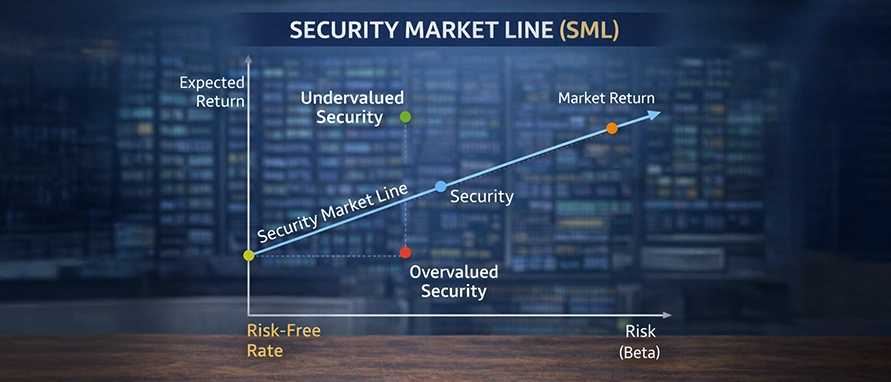
Understand what the Security Market Line is, how it works, and why it is an important concept in modern finance.
The Security Market Line, commonly referred to as SML, is a graphical representation used in finance to show the relationship between the expected return of an investment and its level of systematic risk. It plays a key role in asset pricing and helps investors evaluate whether a security is fairly valued based on its risk.
The Security Market Line is a straight line that represents the expected return of a security in relation to its systematic risk, measured by beta. It is derived from the Capital Asset Pricing Model (CAPM) and applies to individual securities as well as portfolios.
In simple terms, the SML shows the minimum return an investor should expect for taking on a certain level of risk. If a security offers a return higher than what the SML indicates, it may be considered undervalued, while a lower return may suggest overvaluation.
The Security Market Line works by plotting expected returns on the vertical axis and systematic risk, or beta, on the horizontal axis. The line begins at the risk-free rate, which represents the return on a risk-free investment, and slopes upward as risk increases.
Each point on the SML represents the fair expected return for a given level of risk. Securities are compared against this line to assess whether they are providing adequate compensation for the risk involved. This helps investors make more informed comparisons between different investment options.
The Security Market Line is expressed using the following formula:
Expected Return = Risk Free Rate + (Beta × Market Risk Premium)
The risk-free rate represents the return on an investment with no risk, such as a government security.
Beta measures the sensitivity of a security’s returns to overall market movements and reflects its systematic risk.
The market risk premium is the additional return investors expect for taking on market risk instead of investing in a risk-free asset.
Together, these three components explain how much return an investor should reasonably expect from a security for a given level of market risk.
The Security Market Line is often compared with the Capital Market Line, but they serve different purposes as illustrated below:
| Aspect | Security Market Line | Capital Market Line |
|---|---|---|
Focus |
Individual securities and portfolios |
Efficient portfolios only |
Risk Measure |
Systematic risk (beta) |
Total risk (standard deviation) |
Origin |
Derived from CAPM |
Derived from modern portfolio theory |
Application |
Pricing of assets |
Portfolio optimisation |
Both lines are important, but they are used in different contexts within financial analysis.
The Security Market Line is defined by three key components that explain the relationship between risk and expected return.
Risk-free rate
This is the return from a risk-free investment, usually based on government securities.
Beta
Beta shows how sensitive a security is to overall market movements and represents its systematic risk.
Market risk premium
This is the extra return investors expect for taking market risk over the risk-free rate.
Together, these components determine the slope and position of the SML and help estimate expected returns for different risk levels.
The Security Market Line is used in several practical ways:
Evaluating whether a security is fairly priced based on risk
Comparing expected returns across different investments
Supporting portfolio construction decisions
Assessing performance relative to market risk
These applications make SML a useful analytical tool for investors and analysts.
The Security Market Line is important because it provides a clear framework for understanding the trade-off between risk and return. It helps investors identify securities that may be mispriced and supports rational investment decision-making.
By focusing on systematic risk, SML also highlights the importance of diversification, as unsystematic risk is not rewarded in expected returns.
Despite its usefulness, the Security Market Line has certain limitations:
Relies on assumptions of the CAPM
Assumes a constant risk-free rate and market premium
Focuses only on systematic risk
May not fully reflect real-world market behaviour
These limitations mean that SML should be used alongside other analytical tools.
The Security Market Line is a foundational concept in finance that explains how expected returns relate to systematic risk. By linking risk and return through a clear framework, SML helps investors assess whether securities are appropriately priced. While it has limitations, it remains an important tool for understanding asset pricing and risk evaluation.
This content is for informational purposes only and the same should not be construed as investment advice. Bajaj Finserv Direct Limited shall not be liable or responsible for any investment decision that you may take based on this content.
The security market line illustrates the relationship between expected return and systematic risk for individual securities. It is based on the Capital Asset Pricing Model and helps compare whether assets are fairly priced relative to market risk.
The slope of the security market line represents the market risk premium. It reflects the additional return investors expect for bearing systematic risk compared to a risk-free investment.
A stock positioned above the security market line indicates that its expected return exceeds the return required for its level of systematic risk. This positioning suggests potential undervaluation under the CAPM framework.
The security market line is not the same as CAPM. CAPM is a theoretical model explaining asset pricing, while the security market line is the graphical representation derived from that model.
The security market line is used by investors, analysts, and financial professionals to assess whether securities offer appropriate returns for their level of market risk and to support asset pricing evaluations.
.jpeg)












 Academy


.jpeg "image not found")