Our Products
 Loans
Loans
 Cards
Cards
 Insurance
 Investment
 Stock Market
 Electronics Mall
 CIBIL Score
 Knowledge Centre
 Calculators
Our Services

 Do not call
 En
En
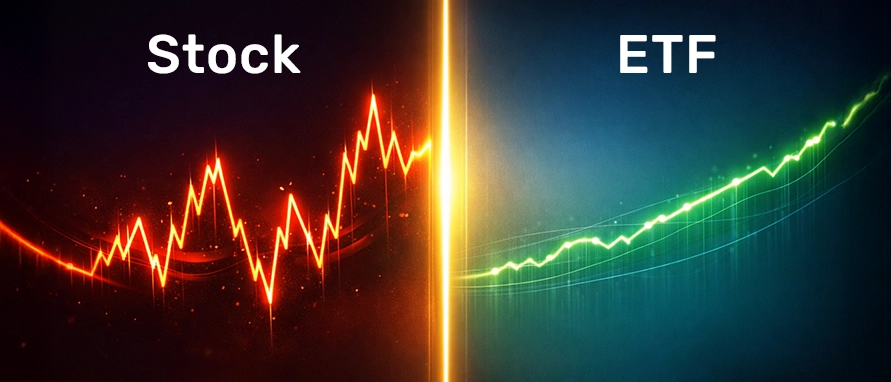
Learn how volatility behaves in stocks and ETFs during market corrections and how they differ in risk and price movement.
Volatility in the stock market refers to the degree of variation in the price of a financial asset over a period of time. When prices move sharply within a short period, the asset or market is considered highly volatile.
High volatility reflects greater uncertainty and wider price fluctuations, whereas low volatility indicates more stable and gradual price movements.
Volatility reflects the level of variation in price movements and is often associated with risk. It does not indicate direction but rather the speed and magnitude of price movement.
Volatility in the Indian stock market arises due to multiple internal and external factors, including:
Changes in economic indicators such as inflation and GDP
Corporate earnings announcements and company news
Global market trends and geopolitical events
Interest rate changes by central banks
Investor sentiment and market speculation
Foreign institutional investor (FII) activity
These factors create uncertainty, which leads to frequent price movements and contributes to market volatility.
A market correction refers to a decline of around 10% or more from recent highs. During corrections, volatility tends to increase because:
Investors react quickly to falling prices
Stop-loss triggers and panic selling increase
Market sentiment shifts from optimism to caution
Trading volumes may rise significantly
This environment leads to sharper and more frequent price movements across stocks and indices.
The following table outlines the differences:
| Aspect | Market Correction | Market Crash |
|---|---|---|
Price Decline |
Around 10%–20% |
More than 20% |
Duration |
Short to medium term |
Sudden and severe |
Frequency |
More common |
Less frequent |
Investor Sentiment |
Cautious |
Panic-driven |
Market Impact |
Moderate |
Severe |
A correction is generally a temporary decline, while a crash is a more abrupt and severe fall in prices.
Stocks tend to experience higher volatility during market corrections because:
Individual company fundamentals vary widely
Stock prices react quickly to news and sentiment
Lower liquidity in certain stocks can amplify price movements
Speculative trading increases during uncertain times
As a result, stock prices can fall or rise sharply within short timeframes, making them more sensitive to market conditions.
Certain sectors are known for higher volatility due to their cyclical or sensitive nature:
Information Technology (IT)
Banking and Financial Services
Energy and Oil & Gas
Metals and Mining
Small-cap and mid-cap segments
These sectors often react strongly to economic changes and global cues.
Exchange-Traded Funds (ETFs) represent a basket of securities and are designed to track an index or sector. During market corrections:
ETFs also decline, but the movement is usually less extreme
Diversification reduces the impact of individual stock fluctuations
Index-linked ETFs mirror overall market performance
Lower concentration risk leads to smoother price movement
This structure helps in spreading risk across multiple securities, reducing the impact of volatility.
In most cases, ETFs tend to be less volatile than individual stocks because they include multiple securities.
If one stock within the ETF declines, others in the portfolio may offset the impact. However, ETFs still follow the overall market trend, so they are not completely immune to volatility during corrections.
A volatility ETF is a type of fund that aims to track the volatility index or instruments related to market volatility.
These ETFs do not track traditional asset prices like stocks or bonds but instead focus on measuring market uncertainty.
Volatility ETFs typically:
Track volatility indices such as the VIX
Use derivatives like futures and options
Reflect expected future market volatility rather than current prices
May increase in value when market volatility rises
These instruments are complex and are often used for short-term strategies or hedging purposes.
Explore examples of ETFs related to volatility or market indices:
| ETF Name | Index or Asset Tracked | Expense Ratio |
|---|---|---|
Nippon India ETF Nifty BeES |
Nifty 50 Index |
~0.05% |
SBI ETF Nifty 50 |
Nifty 50 Index |
~0.07% |
ICICI Prudential Nifty ETF |
Nifty 50 Index |
~0.09% |
Note: India does not have a direct VIX-based volatility ETF widely available; most ETFs track equity indices instead.
Compare how stocks and ETFs behave during market corrections:
| Factor | Stocks | ETFs |
|---|---|---|
Volatility Level |
High |
Moderate |
Diversification |
Low |
High |
Price Movement |
Sharp and individual |
Smoothed by index |
Risk Exposure |
Concentrated |
Spread across assets |
Reaction to News |
Immediate |
More balanced |
Stocks show higher volatility due to concentration risk, while ETFs provide diversification, which helps reduce overall price fluctuations.
Volatility is often addressed through approaches such as:
Maintaining a long-term investment approach
Using systematic investment plans (SIPs)
Diversifying across assets and sectors
Avoiding panic selling during market declines
Keeping a balanced asset allocation
Common behaviours observed during volatile periods include:
Making impulsive buy or sell decisions
Ignoring long-term financial goals
Overreacting to short-term market news
Lack of diversification
Attempting to time the market
For beginners, volatility can appear concerning due to frequent price fluctuations. However, it is a normal part of market behaviour.
Over time, markets tend to recover and grow, which helps reduce the impact of short-term volatility. A long-term perspective, combined with disciplined investing, helps manage the effects of market fluctuations.
This content is for informational purposes only and the same should not be construed as investment advice. Bajaj Finserv Direct Limited shall not be liable or responsible for any investment decision that you may take based on this content.
Volatility in the stock market refers to the degree of price fluctuation in a stock or index over a period of time.
Volatile means that the price of a stock or market moves up and down rapidly within a short time.
Volatility increases during corrections due to panic selling, changing sentiment, and rapid price adjustments.
Yes, ETFs are generally less volatile because they hold a diversified basket of securities.
A volatility ETF tracks market volatility using indices or derivatives and reflects changes in market uncertainty.
Investors can reduce risk by diversifying portfolios, using SIPs, and maintaining a long-term investment horizon.
.jpeg)












 Academy


.jpeg "image not found")