Our Products
 Loans
Loans
 Cards
Cards
 Insurance
 Investment
 Stock Market
 Electronics Mall
 CIBIL Score
 Knowledge Centre
 Calculators
Our Services

 Do not call
 En
En
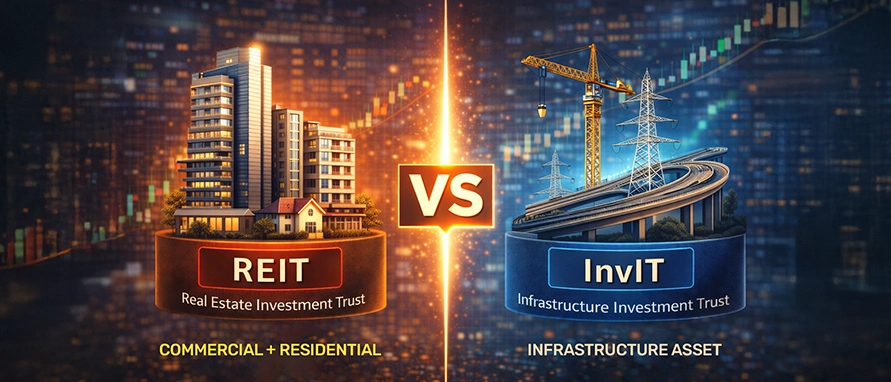
Understand the difference between REITs and InvITs, including how they work, what assets they hold, and how they generate returns.
Real Estate Investment Trusts (REITs) and Infrastructure Investment Trusts (InvITs) are two popular investment vehicles that allow investors to participate in the income generated by large-scale real estate and infrastructure projects, without having to own the assets themselves. Both have distinct characteristics.
However, while both structures share similarities, there are notable differences in their focus and operation. This article explores the differences between REITs and InvITs, including their characteristics, similarities, and how they operate in India.
A Real Estate Investment Trust (REIT) is a company that owns, operates, or finances income-producing real estate. REITs pool funds from investors to purchase and manage a diversified portfolio of real estate properties, such as office buildings, shopping malls, hotels, and residential complexes. Investors in a REIT earn income through the rental or lease income generated from these properties, and the gains from the sale of properties.
REITs are designed to provide a regular income stream to investors while offering diversification across a variety of property types and geographical regions. They are similar to mutual funds but focus specifically on the real estate sector.
An Infrastructure Investment Trust (InvIT) is a similar investment vehicle, but instead of focusing on real estate, InvITs invest in infrastructure projects. These could include roads, bridges, power transmission systems, or telecom towers. InvITs work in a similar way to REITs by pooling funds from investors and using these funds to invest in income-generating infrastructure projects.
InvITs aim to offer high yields and provide a regular source of income through the cash flow generated from infrastructure assets. As with REITs, they allow investors to access large-scale infrastructure projects that might otherwise be out of their financial reach.
In India, both REITs and InvITs have gained significant attention due to their potential for offering regular income streams. The Indian government has introduced various regulations to promote these vehicles, creating a favorable environment for their growth.
REITs in India: The first REIT in India was launched in 2019, and since then, more have been introduced. India’s real estate market, with its significant demand for commercial and residential properties, presents opportunities for REITs to grow and provide income to investors.
InvITs in India: InvITs were introduced in India in 2014 with the primary aim of raising funds for infrastructure development. InvITs have witnessed growth as infrastructure development has been a key focus for the Indian government.
Also Read: Loss Ratio vs Combined Ratio
Consider the following table:
| Aspect | REIT | InvIT |
|---|---|---|
Asset Type |
Real estate assets (commercial, residential, etc.) |
Infrastructure assets (roads, bridges, power plants, etc.) |
Income Source |
Income primarily from rental/lease of properties |
Income primarily from tolls, power generation, or operational fees from infrastructure |
Risk Profile |
Market risks related to property values and demand for space |
Risks related to infrastructure maintenance, government policies, and usage rates |
Regulatory Framework |
Governed by SEBI (Securities and Exchange Board of India) under the SEBI (Real Estate Investment Trusts) Regulations, 2014 |
Governed by SEBI under the SEBI (Infrastructure Investment Trusts) Regulations, 2014 |
Distribution Structure |
At least 90% of income must be distributed as dividends |
At least 90% of income must be distributed as dividends |
Despite their differences, REITs and InvITs share many common features:
Legal Structure: Both REITs and InvITs are set up as trusts under Indian law and are governed by the Securities and Exchange Board of India (SEBI).
Dividend Distribution: Both require that at least 90% of their income be distributed to investors in the form of dividends.
Regulatory Oversight: Both are regulated by SEBI, which ensures that they comply with the regulations meant to protect the interests of investors.
Trading: Both REITs and InvITs are listed on stock exchanges, offering liquidity to investors.
Income Generation: Both structures generate income by holding large-scale assets that produce cash flows, which are then distributed to investors.
There are different categories of REITs and InvITs, each with its own investment focus:
REITs:
Equity REITs: These REITs invest in physical properties and earn revenue through rental income.
Mortgage REITs: These invest in real estate debt, such as mortgage-backed securities.
Hybrid REITs: These invest in both properties and real estate debt.
InvITs:
Public InvITs: These are InvITs listed on public exchanges and open to all investors.
Private InvITs: These are typically limited to institutional investors and are not listed on public exchanges.
Both REITs and InvITs benefit from favorable tax treatment in India to encourage investment in infrastructure and real estate.
Taxation of REITs:
Certain income streams of REITs and InvITs may receive pass-through treatment under Indian tax laws, subject to applicable conditions.
Dividend income from REITs is taxable in the hands of the investors.
Taxation of InvITs:
Similar to REITs, InvITs are tax-exempt on income from infrastructure projects as long as they distribute at least 90% of the income to investors.
Dividend income from InvITs is taxable in the hands of the investors.
REITs and InvITs are listed and traded on stock exchanges such as the National Stock Exchange and the Bombay Stock Exchange. Through exchange trading, investors can gain exposure to large-scale commercial real estate or infrastructure assets without directly owning or managing the underlying properties or projects.
The liquidity of these instruments may vary depending on market conditions and trading activity. REITs and InvITs are listed and traded on stock exchanges such as the National Stock Exchange and the Bombay Stock Exchange. Trading volumes may differ from those of traditional equity shares, and liquidity can fluctuate based on market participation.
In summary, both REITs and InvITs offer a unique way for investors to gain exposure to large-scale income-generating assets in India. While REITs focus on real estate, InvITs offer opportunities in infrastructure. Both provide investors with regular income through dividends and are regulated by SEBI to ensure transparency and investor protection.
Understanding the differences and similarities between these two structures provides clarity on how they function and the types of assets they hold.
This content is for informational purposes only and the same should not be construed as investment advice. Bajaj Finserv Direct Limited shall not be liable or responsible for any investment decision that you may take based on this content.
The primary difference is in the assets they focus on: REITs invest in real estate, while InvITs invest in infrastructure projects such as roads, bridges, and power plants.
No, they are different. REITs focus on real estate, while InvITs focus on infrastructure.
REITs generate income through rental income from real estate, while InvITs generate income from infrastructure operations such as tolls and fees.
Both REITs and InvITs are tax-exempt on income from their underlying assets as long as they distribute at least 90% of their income to investors. However, the income received by investors is taxable.
.jpeg)












 Academy


.jpeg "image not found")