Our Products
 Loans
Loans
 Cards
Cards
 Insurance
 Investment
 Stock Market
 Electronics Mall
 CIBIL Score
 Knowledge Centre
 Calculators
Our Services

 Do not call
 En
En
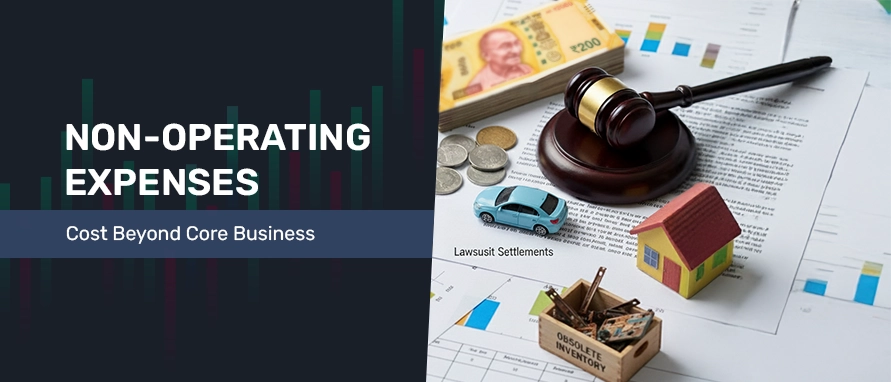
Explore non-operating expenses to learn how these incidental costs arise outside core operations and impact a company’s overall financial performance.
Non-operating expenses are an important part of financial analysis because they help distinguish between costs related to core business operations and those arising from secondary or incidental activities. Understanding these expenses allows investors, analysts, and business owners to evaluate a company’s true operating performance without distortions caused by non-recurring or unrelated costs.
Non-operating expenses are costs that a company incurs from activities not directly related to its main operations. These expenses come from financial, investing, or incidental activities rather than the company’s primary business functions.
They are reported below operating income on the income statement and do not affect operating profitability metrics such as gross profit or operating income.
Not related to the central business operations
Often irregular or non-recurring
Recorded after operating income
May negatively impact net income
Non-operating expenses help reveal a clearer picture of a company’s core operational efficiency by isolating costs unrelated to its main business.
Understanding them is important for:
Identifying factors affecting net income outside normal operations
Assessing true operating performance
Making accurate comparisons between companies
Improving financial forecasting and valuation models
They are especially important in industries with large financing or investing activities, where non-operating items can significantly distort profitability.
Non-operating expenses in the Income Statement:
Non-operating expenses are presented below operating profit on the income statement. They appear after gross profit, operating expenses, and operating income. This placement separates routine business costs from financial or incidental items. It also helps analysts understand the effect of these expenses on pre-tax profit and net income without mixing them with operational performance.
Non-operating expenses can take several forms depending on the company’s financial activities. The most common examples include:
Interest Expense – Cost of borrowing money through loans, bonds, or credit lines.
Loss on Asset Sale – Loss incurred when selling property, equipment, or marketable securities.
Foreign Exchange Loss – Losses resulting from currency fluctuations in international transactions.
Impairment Losses – Write-downs of asset values, such as goodwill or investments.
Loss from Discontinued Operations – Costs or losses arising from shutting down a business unit.
Lawsuit Settlements and Penalties – Legal damages, fines, or non-recurring settlement expenses.
Restructuring Costs – Expenses related to reorganisation, layoffs, or strategic shifts.
These expenses differ from operating costs such as salaries, rent, utilities, and production expenses, which arise from core business activities.
Non-operating expenses can generally be categorised into several types:
Financing-related expenses: These include interest payments on loans, bond amortisation, or other borrowing costs. They arise from a company’s capital structure rather than its core operations.
Investment-related losses: These occur when a company sells investments or assets below their carrying value. Such losses reflect the outcome of financial or disposal decisions, not regular business activities.
Market and economic losses: These result from currency fluctuations, commodity price movements, or other external economic factors. They can vary widely across periods and often introduce volatility in reported earnings.
Compliance and penalty costs: These include fines, legal settlements, and regulatory penalties. They arise from non-compliance or legal disputes and do not relate to routine business processes.
Strategic restructuring losses: These emerge from shutdowns, divestitures, or organisational restructuring. They are usually linked to one-time strategic decisions and may not recur regularly.
Each type affects the bottom line differently and may or may not be recurring.
Although non-operating expenses are listed individually on the income statement, they can be summarised using a simple formula:
Non-operating Expenses = Total Expenses Not Related to Core Operations
More specifically:
Non-operating Expenses = Interest Expense + Losses on Asset Sales + FX Losses + Impairment Losses + Penalties/Fines + Other Non-operating Costs
This calculation helps analysts separate operating performance from incidental financial impacts.
Non-operating expenses reduce pre-tax and net income, even though they do not reflect operational performance.
Key impacts include:
Lower net profit despite strong operational results
Potential misinterpretation of company performance
Increased volatility in earnings due to irregular expense patterns
Complications in comparing profitability across periods
For accurate analysis, many financial models (like EBITDA or operating profit) exclude non-operating items.
Adjusting Non-operating Expenses:
Analysts often adjust financial statements to isolate operating performance. Metrics such as EBITDA, operating profit, and adjusted earnings exclude non-operating items to present a clearer view of ongoing business activities. These adjustments help remove irregular or incidental costs and make comparisons across periods or companies more consistent.
Non-operating expenses represent costs that occur outside a company’s core business activities. While they influence the bottom line, they do not indicate how effectively a company operates.
By distinguishing between operating and non-operating costs, investors and analysts can assess operational strength, profitability, and long-term financial health.
Key points to remember:
These expenses arise from financing, investing, or incidental activities.
They are reported below operating income on the income statement.
Common examples include interest expenses, foreign exchange losses, legal penalties, and asset sale losses.
They help reveal the true operating performance of a business.
This content is for informational purposes only and the same should not be construed as investment advice. Bajaj Finserv Direct Limited shall not be liable or responsible for any investment decision that you may take based on this content.
Non-operating expenses are costs that arise from activities outside a company’s main business operations, typically linked to financing, investing, or incidental events such as interest charges or losses on asset disposals.
Operating expenses relate to the routine costs of running core business activities, whereas non-operating expenses come from secondary or unrelated activities, including financing costs and irregular losses.
Common examples include interest expense, foreign exchange losses, impairment charges, legal settlement costs, and losses from selling assets that are not part of regular operations.
Non-operating expenses are calculated by summing all cost items that do not stem from core operations, using the formula: Non-operating Expenses = Total of all non-operating cost components.
.jpeg)












 Academy



.jpeg "image not found")