Our Products
 Loans
Loans
 Cards
Cards
 Insurance
 Investment
 Stock Market
 Electronics Mall
 CIBIL Score
 Knowledge Centre
 Calculators
Our Services

 Do not call
 En
En
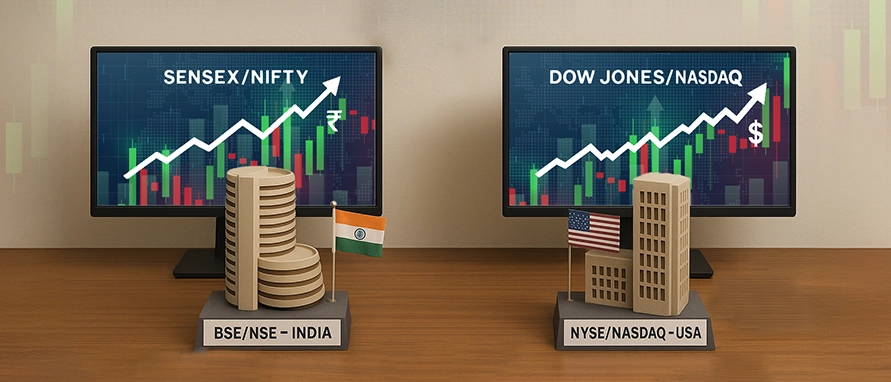
The stock markets in India and the United States are both dynamic financial ecosystems that play critical roles in their respective economies. However, they differ vastly in scale, regulatory structure, operational mechanisms, and investor behaviour. These differences are crucial for investors, analysts, and even policy-makers looking to navigate or understand international investing. In this guide, we delve deep into these distinctions—from market capitalisation and trading hours to regulatory frameworks and investment culture.
Here’s how the size and scale of of the Indian and US stock markets compare:
The US stock market is the largest in the world, contributing over 40% to the global market capitalisation. In contrast, India ranks among the top 5 globally but still holds a much smaller share. As of early 2024:
US Market Cap: ~$46 Trillion (combined NYSE & NASDAQ)
Indian Market Cap: ~$4 Trillion (combined NSE & BSE)
This disparity reflects differences in economic size, market maturity, and investor participation.
NYSE and NASDAQ: ~6,000 combined listings
NSE and BSE: ~7,500 combined listings
India has a higher number of listed companies, but the average size and liquidity of US-listed firms are significantly larger.
Here’s a comparison of the main stock exchanges and benchmark indices:
United States: NYSE (New York Stock Exchange), NASDAQ
India: NSE (National Stock Exchange), BSE (Bombay Stock Exchange)
While NYSE is known for established blue-chip firms, NASDAQ is tech-heavy. In India, NSE is volume-dominant, while BSE is older but less active.
US: S&P 500, Dow Jones Industrial Average, NASDAQ Composite
India: Nifty 50, Sensex
These indices reflect the economic sectors and market strengths of each country, e.g., technology in the US vs. banking and IT services in India.
Following are the standard trading hours in both countries:
| Company | Local Time | IST Equivalent |
|---|---|---|
India |
9:15 AM – 3:30 PM |
9:15 AM – 3:30 PM |
US |
9:30 AM – 4:00 PM (EST) |
7:00 PM – 1:30 AM (IST) |
Here’s a key difference:
US: Offers extended trading hours (Pre-market: 4:00 AM – 9:30 AM; After-hours: 4:00 PM – 8:00 PM EST)
India: No such sessions; trading is confined to regular hours.
This allows more flexibility in the US, especially for institutional and global investors.
Below is a snapshot of the regulatory bodies and their rules:
US: Securities and Exchange Commission (SEC)
India: Securities and Exchange Board of India (SEBI)
US companies adhere to GAAP (Generally Accepted Accounting Principles), while Indian firms follow IND-AS (Indian Accounting Standards). The disclosure norms are rigorous in both, but the SEC’s enforcement mechanism is perceived to be more stringent.
The following are the investor demographics and investment products available:
US: High retail participation (~55% of adults own stocks)
India: Growing retail base (~10% adult participation as of 2023)
India is seeing a digital surge, with mobile-based platforms democratising market access. The US, meanwhile, has a more mature investing population with access to pension plans, 401(k)s, and brokerage accounts.
Common Instruments: Stocks, Bonds, Mutual Funds, ETFs, Derivatives
US-Specific: Options trading is more liquid and widely used; REITs and SPACs are also common.
India-Specific: Sovereign Gold Bonds, ULIPs, and tax-saving instruments like ELSS.
Here’s how stable and liquid these markets are:
US markets are relatively less volatile due to deeper liquidity and broader institutional participation. Indian markets exhibit higher short-term volatility, impacted by domestic policy shifts and global fund flows.
The average daily turnover on NASDAQ alone surpasses that of both NSE and BSE combined. This high liquidity makes the US market more efficient for high-frequency trading.
Below is how taxes and regulations affect investors in both markets:
Short-Term Capital Gains: 15% (for equities held <1 year)
Long-Term Capital Gains: 10% above ₹1 Lakh without indexation
Short-Term Capital Gains: Taxed at ordinary income tax rates (up to 37%)
Long-Term Capital Gains: 0%, 15%, or 20% depending on income level
NRIs investing in India must comply with RBI's Portfolio Investment Scheme (PIS), while foreign investors in the US follow FATCA and other IRS disclosures.
Both markets are highly automated but the US is more advanced in terms of:
Algorithmic trading
Dark pools and electronic communication networks (ECNs)
Real-time trade execution
India is catching up with increased adoption of AI-driven platforms and smart order routing, led by innovations from fintech startups and digital brokers.
These are factors affecting investments across borders:
Investing across geographies involves forex exposure. INR is more volatile compared to USD, which can impact returns for investors not hedging currency risk.
US: Global economic driver, with influence over commodity prices and interest rates
India: Emerging market status; more sensitive to FII flows, oil prices, and monsoon performance
Here’s how returns and growth compare:
Historical average returns (not adjusted for inflation or currency risk): S&P 500 has delivered ~10–11% CAGR over the last 30 years, whereas Nifty 50 has averaged ~12–13% CAGR over 20 years. Past performance is not indicative of future results. The securities quoted are for illustration only and are not recommendatory.
India’s market is younger and offers higher growth potential driven by rising GDP, digital penetration, and demographic dividend. The US is mature but stable, ideal for conservative wealth-building.
While both the Indian and US stock markets provide diverse investment opportunities, they operate under distinctly different structures and philosophies. Understanding these differences—whether it's trading hours, regulatory mechanisms, or market depth—is vital for investors evaluating global equity exposure. While the US offers size and stability, India offers growth and innovation. Each market, therefore, serves different risk appetites and investment goals.
This content is for educational purposes only and the same should not be construed as investment advice. Bajaj Finserv Direct Limited shall not be liable or responsible for any investment decision that you may take based on this content.
The US market is larger in size, has more liquidity, extended trading hours, and deeper institutional participation. India offers high growth potential and increasing retail participation.
The US taxes short-term gains as ordinary income while India charges a flat 15%. Long-term rates also vary significantly.
Yes, through the Liberalised Remittance Scheme (LRS) and global investing platforms registered with SEBI.
No, India does not have pre-market or after-hours sessions like the US.
India’s tax and regulatory framework is relatively streamlined for domestic investors, which may appeal to those beginning their investment journey. However, investors should assess their goals and consult a qualified advisor before making cross-border investment decisions.
.jpeg)



 47202
47202

Navigate the tax maze with ease! Uncover Income Tax 101, demystify jargon with Terms for Beginners, and choose between Old or New Regimes.
 165541
Unlock the world of credit! From picking the perfect card to savvy loan management, navigate wisely.
 97880
97880
Money Management and Financial Planning covers personal finance basics, setting goals, budgeting...
 28605
28605
Explore the investment cosmos! From beginner's guides to sharp-witted strategies, explore India's treasure trove of options.
 18764
18764
Discover essential insights on various types of insurance in India.
 4584
4584
Welcome to Tech in Finance, where we explore the exciting intersection of technology and finance...












 Academy


.jpeg "image not found")