Our Products
 Loans
Loans
 Cards
Cards
 Insurance
 Investment
 Stock Market
 Electronics Mall
 CIBIL Score
 Knowledge Centre
 Calculators
Our Services

 Do not call
 En
En
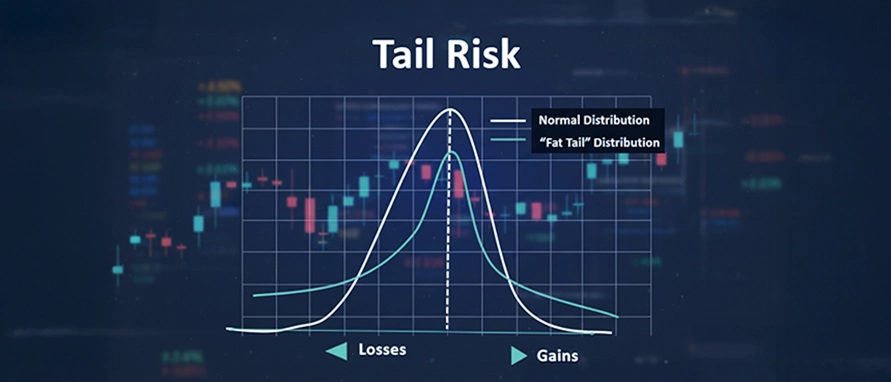
Tail risk captures the possibility of rare, extreme market events that can lead to outsized losses across financial markets. These events occur infrequently, but when they do, their impact can be disproportionate compared to normal market movements. Tail risk is commonly discussed in the context of unexpected shocks, such as abrupt financial disruptions or geopolitical developments, that fall outside routine market behaviour.
Tail risk meaning refers to the likelihood of extreme market outcomes that appear at the far ends, or “tails,” of a return distribution. In simple terms, ‘what is tail risk’ relates to low-probability events that can trigger unusually large market movements.
Such events may arise from economic shocks, policy shifts, or geopolitical crises that significantly alter market conditions. Due to their scale and unpredictability, tail risk is an important consideration within risk management, particularly when assessing exposure to severe but infrequent market disruptions.
Measuring tail risk helps quantify how a portfolio might behave during rare but severe market events. Since these outcomes fall outside normal market movements, specialised tools are used to estimate potential losses and understand exposure under extreme conditions.
What it measures
Estimates the maximum potential loss of a portfolio over a specified time period at a given confidence level.
For example, a one-month VaR of ₹10,000 at a 95% confidence level implies that losses are expected to exceed ₹10,000 only 5% of the time.
Why it matters
Provides a standardised way to summarise downside risk.
Helps compare risk levels across portfolios or strategies under normal market conditions.
What it measures
Calculates the average loss assuming the loss has already crossed the VaR threshold.
Focuses on outcomes in the extreme tail of the distribution rather than typical losses.
Why it matters
Offers deeper insight into potential severity during extreme events.
Addresses VaR’s limitation of not showing how large losses could be beyond the cutoff point.
What it measures
Evaluates how a portfolio performs under simulated extreme but plausible market conditions, such as sharp market crashes or macroeconomic shocks.
Why it matters
Helps assess portfolio resilience during market disruptions.
Useful for understanding vulnerabilities that may not appear under normal conditions.
What it measures
Models the impact of specific hypothetical events, such as a sudden 30% decline in stock prices or a sharp shift in interest rates, to evaluate portfolio outcomes under defined conditions.
Why it matters
Allows targeted evaluation of known risk scenarios.
Supports comparison of portfolio outcomes across different extreme situations.
Consider a portfolio valued at ₹10,00,000. Under a stress-testing scenario where market prices decline by 30%, the portfolio value would fall to ₹7,00,000, resulting in a potential loss of ₹3,00,000. This tail risk example illustrates how stress testing can highlight exposure to extreme market movements and quantify potential losses during such events.
Tail risk mitigation examines how portfolio structures respond during extreme market conditions.
Diversification:
Exposure spread across asset classes, sectors, or geographies can reduce concentration risk, as extreme events may not affect all assets in the same way.
Hedging with Derivatives:
Instruments such as options or futures may provide asymmetric payoffs during sharp market declines, which can partially offset losses under stressed conditions.
Safe-Haven Assets:
Assets like government bonds, gold, or cash have historically shown different behaviour during periods of market stress, helping moderate overall portfolio drawdowns.
Tail Risk Funds:
A tail risk fund is structured to respond to extreme market events, often using volatility-linked or asymmetric strategies that perform differently from traditional assets during market stress.
Portfolio value: ₹500,000 in equities
Hedge cost: ₹20,000 spent on protective put options
Market movement: Equity prices decline by 30%
Outcome: The hedge offsets a portion of the loss, reducing the portfolio’s downside compared to an unhedged position
Evaluating tail risk hedging helps assess how different risk-mitigation approaches behave during rare but severe market disruptions and what trade-offs they introduce during normal market conditions.
What it is:
Protective puts involve purchasing put options on an existing equity position, giving the holder the right to sell the asset at a predetermined price.
How it works during extreme events:
During sharp market declines, the put option increases in value as the underlying asset falls, offsetting part of the portfolio’s losses by setting a minimum exit value.
What it is:
A tail risk fund is a specialised investment vehicle structured to respond positively during extreme market stress, typically through exposure to volatility-linked instruments, asymmetric payoff strategies, or defensive assets such as treasury bills to preserve capital during periods of heightened uncertainty.
How it works during extreme events:
In periods of heightened volatility or abrupt market sell-offs, these funds are positioned to benefit from sharp price movements, helping counterbalance losses in traditional equity holdings.
What it is:
Volatility strategies use instruments such as volatility futures or options that are linked to market volatility indices.
How it works during extreme events:
Market stress is often accompanied by spikes in volatility. These strategies gain value when volatility rises sharply, providing an indirect hedge against equity market declines.
Portfolio value: ₹500,000 invested in equities listed in the stock market
Hedge cost: ₹10,000 spent on put options with a strike value of ₹450,000
Market movement: Equity markets decline by 30%, reducing portfolio value to ₹350,000
Outcome: The put option allows the investor to sell at ₹450,000 instead of the market value of ₹350,000, limiting the effective loss after hedge cost to ₹60,000
Tail risk reflects the presence of rare but high-impact events that can significantly influence market outcomes. Tools such as value-at-risk measures, stress testing, and scenario analysis are commonly used to assess exposure to such events. Approaches like derivatives-based hedging and tail risk funds illustrate how portfolios may respond differently under extreme conditions. Evaluating tail risk therefore forms part of a broader framework for understanding market behaviour beyond normal volatility.
This content is for informational purposes only and the same should not be construed as investment advice. Bajaj Finserv Direct Limited shall not be liable or responsible for any investment decision that you may take based on this content.
A tail risk fund is an investment vehicle designed to respond to extreme market movements, typically through strategies linked to volatility or asymmetric return profiles.
No. Tail risk relates to rare, extreme events with significant impact, while systemic risk refers to structural vulnerabilities that can affect the entire financial system.
Tail risk relates to rare, extreme market movements, while normal market volatility refers to frequent, smaller price fluctuations that occur during regular trading conditions.
Extreme market events are the primary drivers of tail risk, as they cause sudden and outsized price movements that fall outside typical market expectations.
Yes. Macroeconomic shocks such as financial crises, abrupt policy changes, or global disruptions can trigger tail risk by causing sharp and widespread market reactions.
Tail risk focuses on low-probability, high-impact events, whereas systematic risk represents ongoing market-wide risk that affects all assets to varying degrees.
Leverage amplifies exposure to price movements, which can significantly increase losses when extreme market events associated with tail risk occur.
Tail risk appears in the far ends, or “tails,” of a return distribution curve, representing outcomes that deviate significantly from average returns.
Yes. Severe market crashes are commonly classified as tail risk events due to their rarity and disproportionate impact on asset values.
Regular market risk reflects expected fluctuations in asset prices, while tail risk involves unexpected and extreme outcomes that lie beyond normal market behaviour.
.jpeg)












 Academy


.jpeg "image not found")