Our Products
 Loans
Loans
 Cards
Cards
 Insurance
 Investment
 Stock Market
 Electronics Mall
 CIBIL Score
 Knowledge Centre
 Calculators
Our Services

 Do not call
 En
En
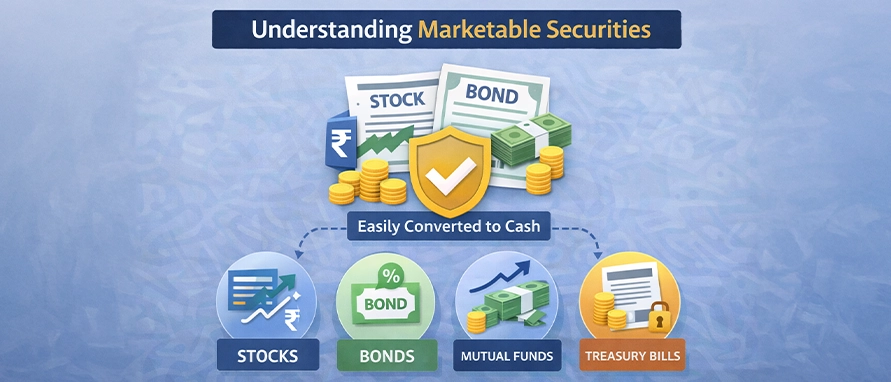
Understand what marketable securities are, their common types and characteristics, and how they are used in financial and liquidity management.
Marketable securities are financial instruments that can generally be bought or sold in an active market and converted into cash relatively easily. They include certain short-term debt instruments as well as actively traded securities such as listed equity shares. Their liquidity and marketability make them relevant to cash management, investment portfolios, and financial reporting.
Marketable securities are financial instruments that can be easily bought or sold in active financial markets. The meaning of marketable securities centres on their liquidity and marketability, which allow them to be converted into cash through sale, subject to prevailing market conditions. These securities may include short-term debt instruments issued by governments, financial institutions, or eligible companies, as well as actively traded equity shares of listed companies.
From an investor perspective, marketable securities can form part of a portfolio because they can generally be bought or sold through established markets. For businesses, certain marketable securities may be held as liquid financial assets that can be converted into cash to meet short-term funding or operational requirements, depending on the company's financial management practices.
From an accounting and financial reporting perspective, the classification of marketable securities depends on the nature of the financial asset, its intended holding period, and the applicable accounting framework. Securities that meet the relevant criteria may be presented as current assets when they are expected to be realised within the applicable period. Companies may hold these securities as part of managing surplus or temporarily available funds.
The value of marketable securities may fluctuate based on market conditions. Securities traded in active markets can generally be sold through established market mechanisms, although the ease of sale and prevailing price may vary by security and market conditions. This liquidity can support short-term cash and financial asset management.
Marketable securities generally share the following characteristics:
High liquidity due to trading in established markets
Relatively easy transferability through recognised markets or mechanisms
Availability of observable market prices for actively traded securities
Ability to be converted into cash through sale, subject to market conditions
Varying levels of risk and price volatility depending on the type of security
The liquidity, maturity, risk and marketability of a security depend on its specific characteristics and the market in which it is traded.
Marketable securities can be grouped into different categories based on their structure and issuer. Each type has different characteristics related to liquidity, maturity, and risk.
Common types of marketable securities include:
Treasury bills: Treasury bills are short-term government securities with fixed maturities, issued at a discount and redeemed at face value on maturity.
Commercial paper: These are unsecured short-term instruments issued by eligible companies and other entities to meet short-term funding requirements.
Certificates of deposit: Issued by eligible banks and financial institutions, these are negotiable money market instruments with specified tenures.
Money market instruments: This category includes various short-term debt instruments, generally with maturities of up to one year, such as Treasury bills, commercial paper, and certificates of deposit.
Equity shares of listed companies: Actively traded equity shares listed on recognised stock exchanges can generally be bought or sold through the secondary market, although their prices may fluctuate based on market conditions.
Different types of marketable securities have varying levels of liquidity, maturity, risk, and price volatility.
Beyond the general categories above, here are examples of marketable securities commonly used or traded by companies and investors in India:
91-day, 182-day, and 364-day Treasury Bills issued by the Government of India through the RBI
Commercial paper issued by eligible companies and other entities under the applicable RBI framework for short-term funding requirements
Certificates of deposit issued by eligible banks, with specified tenures ranging from 7 days to 1 year
Actively traded equity shares of companies listed on recognised stock exchanges such as the NSE or BSE
Listed debt securities that are traded through established secondary markets
These examples illustrate that marketable securities can include government, corporate, and listed financial instruments, with their liquidity and marketability depending on the specific security and prevailing market conditions.
Consider the following comparison between marketable and non-marketable securities:
| Aspect | Marketable Securities | Non-Marketable Securities |
|---|---|---|
Liquidity |
Generally higher |
Generally lower |
Transferability |
Generally easier to transfer or sell through established markets |
May have restrictions on transfer or lack an active secondary market |
Market Availability |
Usually traded or capable of being traded in an established market |
Generally not traded in an active secondary market |
Price Availability |
Market prices may be available through trading markets |
Market prices may not be readily observable |
Maturity |
May be short-term or have no fixed maturity, depending on the security |
May have varying maturities or no active secondary market |
Companies may hold certain marketable securities as part of their management of surplus or temporarily available funds. These holdings can provide a liquid asset that may be converted into cash when required, subject to market conditions. They are also used as a buffer for operational expenses, debt repayments, and unforeseen financial requirements.
The presentation of marketable securities on a company's balance sheet depends on the nature of the financial asset, its classification and the applicable accounting framework. Securities that meet the relevant criteria for classification as current assets may be presented under current assets when they are expected to be realised within the entity's operating cycle or within the applicable period.
The measurement of financial assets also depends on their accounting classification. Under Ind AS, financial assets classified as fair value through profit or loss are measured at fair value, with changes in fair value generally recognised in profit or loss. Other financial assets may be subject to different measurement requirements.
Therefore, the accounting treatment of marketable securities is determined by the characteristics and classification of the individual financial asset rather than by its marketability alone.
Marketable securities offer several advantages:
Generally higher liquidity than non-marketable securities
Easier access to established secondary markets
Availability of observable market prices for actively traded securities
Can form part of short-term liquidity management, depending on the instrument
Provides flexibility when managing liquid financial assets
These benefits explain their widespread use in corporate finance.
Despite their usefulness, marketable securities have certain limitations:
Market prices can fluctuate
Liquidity can vary across securities and market conditions
Selling a security may result in a price different from its purchase price
Certain instruments may have restrictions or limited secondary-market activity
Understanding these limitations helps set realistic expectations.
Marketable securities are financial instruments that can generally be bought or sold through established markets and converted into cash relatively easily. They include instruments such as Treasury bills, commercial paper, certificates of deposit and actively traded listed equity securities. Their liquidity, maturity, price volatility and risk characteristics vary depending on the type of security. For companies, certain marketable securities may form part of short-term liquidity and cash management, while for investors they may form part of a broader portfolio of financial assets.
Marketable securities are financial instruments that can generally be bought or sold through established markets and converted into cash relatively easily. Examples include Treasury bills, commercial paper, certificates of deposit, and actively traded listed equity securities.
Certain marketable securities may be classified as current assets when they meet the applicable accounting criteria, such as being expected to be realised within the relevant period. Classification depends on the nature of the financial asset and the applicable accounting framework.
The term "marketable securities" generally refers to financial securities that can be bought or sold through established markets. Depending on the context and type of security, some may also be described as liquid investments or short-term investments, but these terms are not necessarily interchangeable.
Marketable securities are financial instruments that can generally be bought or sold through established markets and converted into cash relatively easily. Their liquidity and price behaviour depend on the type of security and prevailing market conditions.
Common examples of marketable securities include Treasury bills, commercial paper, certificates of deposit and actively traded listed equity or debt securities. The characteristics of these securities, including maturity, liquidity and price volatility, vary by instrument.
Marketable securities that meet the applicable criteria for current-asset classification may be presented under current assets. Their exact presentation depends on the nature and accounting classification of the financial asset and the applicable accounting framework.
.jpeg)












 Academy


.jpeg "image not found")