Our Products
 Loans
Loans
 Cards
Cards
 Insurance
 Investment
 Stock Market
 Electronics Mall
 CIBIL Score
 Knowledge Centre
 Calculators
Our Services

 Do not call
 En
En
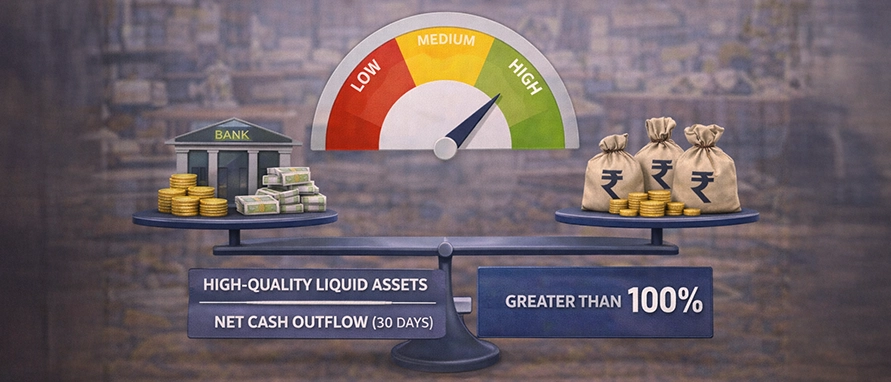
Understand what the Liquidity Coverage Ratio is, how it works, why it matters for banks, and how it is calculated.
The Liquidity Coverage Ratio, commonly known as LCR, is a key regulatory metric used to measure a bank’s ability to withstand short-term liquidity stress. It ensures that banks maintain enough high-quality liquid assets to meet cash outflows during periods of financial uncertainty. LCR plays an important role in strengthening the stability of the banking system.
The Liquidity Coverage Ratio is a regulatory requirement that mandates banks to hold a sufficient buffer of high-quality liquid assets. These assets should be easily convertible into cash to cover net cash outflows over a short-term stress period, typically 30 days.
LCR was introduced as part of global banking reforms to improve resilience against liquidity shocks. It focuses on short-term liquidity risk and aims to ensure that banks can survive sudden disruptions without external assistance.
The Liquidity Coverage Ratio works by comparing a bank’s stock of liquid assets with its expected net cash outflows under stressed conditions. Banks are required to estimate potential cash outflows and inflows during a defined stress scenario.
If a bank holds enough liquid assets to cover these net outflows, it meets the LCR requirement. This mechanism encourages banks to maintain strong liquidity positions and avoid over-reliance on short-term funding sources.
The Liquidity Coverage Ratio is calculated using a simple formula:
Liquidity Coverage Ratio = High Quality Liquid Assets ÷ Net Cash Outflows over 30 days × 100
High Quality Liquid Assets refer to assets that can be quickly converted into cash with little or no loss in value, such as cash balances, central bank reserves, and certain government securities.
Net Cash Outflows over 30 days represent the expected cash outflows minus expected cash inflows during a stressed 30-day period, as defined by regulatory guidelines.
The final figure is expressed as a percentage. A higher percentage indicates that a bank is more adequately positioned to meet its short-term liquidity requirements during periods of financial stress.
To calculate the Liquidity Coverage Ratio, banks follow a structured process:
Identify eligible high-quality liquid assets held by the bank
Estimate total expected cash outflows during a 30-day stress period
Estimate expected cash inflows during the same period
Calculate net cash outflows by subtracting inflows from outflows
Divide liquid assets by net cash outflows and multiply by 100
This calculation helps regulators and banks assess short-term liquidity strength.
The Liquidity Coverage Ratio has two key components that measure a bank’s ability to meet short-term cash needs during stress.
High-Quality Liquid Assets (HQLA)
These include cash, central bank balances, and highly rated government securities that can be quickly converted into cash with minimal loss in value.
Net Cash Outflows
This is the expected cash requirement over a 30-day stress period, calculated as likely outflows minus permitted inflows, based on regulatory guidelines and past behaviour.
Both components together determine a bank’s LCR and its short-term liquidity strength.
Banks are generally required to maintain a minimum Liquidity Coverage Ratio of 100 percent. This means that the market value of high-quality liquid assets should be at least equal to projected net cash outflows over the stress period..
Maintaining this minimum level ensures that banks can continue operations and meet obligations even during market disruptions.
The Liquidity Coverage Ratio is important because it promotes financial stability and reduces systemic risk. By requiring banks to hold adequate liquid assets, LCR helps prevent sudden liquidity crises from spreading across the financial system.
It also improves market confidence, as stakeholders gain assurance that banks are prepared for short-term stress scenarios. Overall, LCR strengthens risk management and enhances resilience in the banking sector.
Consider a bank that holds ₹10,000 Crore in high-quality liquid assets. If its estimated net cash outflows over the next 30 days are ₹8,000 Crore, the Liquidity Coverage Ratio is calculated as:
Liquidity Coverage Ratio = (10,000 / 8,000) × 100
This results in an LCR of 125 percent, indicating that the bank comfortably meets the minimum requirement.
Despite its usefulness, LCR has certain limitations:
Focuses only on short-term liquidity risk
Relies on assumptions about stress scenarios
Does not fully capture longer-term funding risks
May encourage excessive holding of low-yield liquid assets
These limitations highlight the need to assess LCR alongside other liquidity measures.
Consider the following table:
| Aspect | Liquidity Coverage Ratio | Other Liquidity Ratios |
|---|---|---|
Time Horizon |
Short-term, 30 days |
Short to long-term |
Purpose |
Stress scenario coverage |
General liquidity assessment |
Regulatory Focus |
High |
Varies by ratio |
Asset Quality |
High-quality liquid assets |
Broader asset base |
The Liquidity Coverage Ratio is a widely used tool for assessing a bank’s short-term liquidity strength. By ensuring adequate buffers of liquid assets, LCR helps banks manage stress scenarios and supports overall financial stability. While it has limitations, LCR remains a cornerstone of modern banking regulation.
This content is for informational purposes only and the same should not be construed as investment advice. Bajaj Finserv Direct Limited shall not be liable or responsible for any investment decision that you may take based on this content.
The liquidity coverage ratio measures whether a bank holds sufficient high-quality liquid assets to meet expected net cash outflows over a short-term stress period, ensuring the bank can withstand temporary liquidity disruptions.
The liquidity coverage ratio is calculated by dividing the value of high-quality liquid assets by projected net cash outflows over the next 30 days and multiplying the result by 100 to express it as a percentage.
Liquidity coverage ratio requirements apply to banks as determined by banking regulators. Applicability depends on factors such as bank size, systemic importance, and the regulatory framework governing liquidity risk management in a specific jurisdiction.
The liquidity coverage ratio assesses a bank’s ability to handle short-term liquidity stress using liquid assets, while the cash reserve ratio requires banks to maintain a fixed portion of deposits as cash with the central bank.
The liquidity coverage ratio is prescribed by banking regulators, drawing from international standards and domestic regulatory objectives. These authorities define eligibility criteria, calculation methods, and minimum thresholds to strengthen banks’ liquidity risk management.
.jpeg)












 Academy



.jpeg "image not found")