Our Products
 Loans
Loans
 Cards
Cards
 Insurance
 Investment
 Stock Market
 Electronics Mall
 CIBIL Score
 Knowledge Centre
 Calculators
Our Services

 Do not call
 En
En
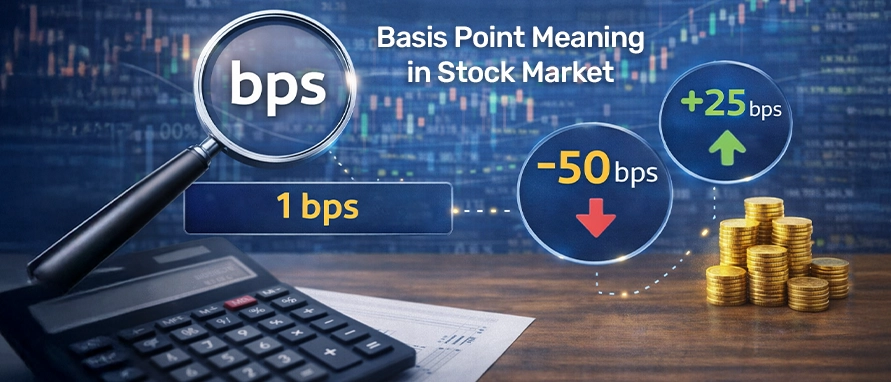
Understand the meaning of a basis point in the stock market and how it is used to measure small changes in prices, yields, and interest rates.
A basis point is a commonly used unit in the stock market and financial markets to express very small changes in rates and returns with precision. It helps avoid confusion that can arise when using percentages, especially when tracking movements in interest rates, bond yields, fund returns, or index changes where even minor variations can be significant.
A basis point is a standard unit of measurement used to show small changes in financial values in a clear and exact way. It represents one hundredth of a percentage point.
In simple terms:
1 basis point = 0.01 percent
100 basis points = 1 percent
Financial products often change by small fractions of a percent. Using basis points helps communicate these changes clearly and precisely. This is why basis points, written as bps, are widely used in stock market reporting, bond markets, and banking-related rate announcements.
In finance, basis points are used across multiple markets such as stocks, bonds, mutual funds, loans, and interest rates. They help investors, analysts, and institutions communicate changes accurately.
For example, saying an interest rate increased by 25 basis points is clearer than saying it increased by 0.25 percent. In financial contracts and policy announcements, precision is important, which is why basis points are widely preferred.
Basis points are used to remove confusion and improve clarity when discussing small numerical changes.
They are preferred because:
Percentage changes can be misunderstood when increases and decreases are discussed
Basis points clearly indicate the absolute change
Financial markets often deal with very small movements
Policy decisions and pricing require precise communication
Using basis points ensures that everyone interprets the change in the same way.
In the stock market, basis points are used to describe movements in stock prices, index changes, returns, and yield variations. They are especially useful when changes are small but still significant for traders and investors.
Small fluctuations in stock prices or returns are frequently expressed in basis points to maintain precision. For example, a stock return moving from 5.20 percent to 5.35 percent reflects a change of 15 basis points, which is easier to communicate precisely.
Market indices also use basis points to show subtle shifts. When an index moves by a fraction of a percent, describing the change in basis points helps market participants understand the exact movement without misinterpretation.
Basis points are most commonly used when discussing interest rates, especially by central banks and financial institutions. Rate hikes and cuts are almost always communicated in basis points.
For instance, an interest rate cut of 50 basis points means the rate has been reduced by 0.50 percent. This method ensures clarity for lenders, borrowers, and investors.
When the Reserve Bank of India adjusts policy rates, the changes are announced in basis points. This helps markets immediately understand the magnitude of the change and its potential impact on loans, deposits, and investments.
The basis points calculation follows a simple and standard approach. The relationship between basis points and percentages can be understood as follows.
1 basis point = 0.01 percent
Basis points = Percentage change multiplied by 100
This conversion makes it easy to switch between percentage values and basis points when analysing data.
Basis points are calculated by converting a percentage difference into a numerical basis point value.
The general steps are:
Identify the percentage change
Multiply the percentage change by 100
The result is the value in basis points
For example, a change of 0.75 percent equals 75 basis points.
Tools can be used to convert percentages into basis points, simplifying analysis and reducing calculation errors. Users enter the percentage change, and the calculator automatically converts it into basis points.
Such calculators are commonly used by analysts, traders, and finance students to save time and avoid manual calculation errors.
Examples help clarify how basis points are used in real situations.
An interest rate increases from 6 percent to 6.25 percent, representing a rise of 25 basis points
A fund expense ratio reduces from 1.50 percent to 1.35 percent, showing a decrease of 15 basis points
A stock index return improves from 8.10 percent to 8.30 percent, indicating a gain of 20 basis points
These examples show how basis points simplify precise communication.
The difference between basis points and percentages becomes clearer when viewed side by side. The table below explains the distinction.
| Basis of Comparison | Basis Points | Percentage |
|---|---|---|
Unit size |
Very small |
Larger |
Clarity |
High precision |
Can be ambiguous |
Common usage |
Finance and markets |
General measurement |
Example |
25 bps |
0.25 percent |
Although basis points are simple, they are often misunderstood.
Common errors include:
Assuming 1 basis point equals 1 percent
Confusing percentage change with percentage points
Misinterpreting increases and decreases
Ignoring the context of the change
Understanding the basic definition helps avoid these mistakes.
Basis points offer several practical advantages in financial communication.
Key benefits include:
Clear and unambiguous communication
Accurate expression of small changes
Widely accepted across financial markets
Useful for policy, pricing, and analysis
These features make basis points a widely used unit in financial markets.
While useful, basis points have some limitations, especially for those new to finance or unfamiliar with percentages.
Some limitations are:
May confuse beginners without proper explanation
Less intuitive outside financial contexts
Require basic percentage knowledge
These limitations are generally minor compared to their benefits.
Basis points play an important role in the stock market and financial systems by allowing precise communication of small numerical changes. Whether used for stock price movements, market indices, or interest rate decisions, basis points reduce confusion and improve clarity. Knowledge of basis points provides a framework for interpreting small numerical changes in financial metrics.
This content is for informational purposes only and the same should not be construed as investment advice. Bajaj Finserv Direct Limited shall not be liable or responsible for any investment decision that you may take based on this content.
Fifty basis points refer to a change of 0.50 percent. It can indicate either an increase or decrease in a rate or value, depending on the context of the market or financial instrument.
No, one basis point is equal to 0.01 percent. It is a smaller unit of measurement used to express changes in interest rates, yields, and other financial metrics more precisely than percentages.
There are 100 basis points in 1 percent. A basis point represents one one-hundredth of a percentage point, making it a convenient way to discuss small changes in rates or returns.
Basis points are commonly used in the stock market, bond market, mutual funds, interest rates, and central bank policies. They provide clarity and precision when discussing changes in financial metrics or rates.
Basis points are used across all areas of finance, not just the stock market. They are applied in various contexts, such as fixed income securities, loans, mortgages, and currency markets, for measuring small changes in rates.
Yes, basis points can be negative. A negative basis point value typically indicates a decrease in rates, returns, or prices, such as when central banks lower interest rates or yields decline in bond markets.
Basis points are calculated by multiplying the percentage change by 100. For example, a 0.5% change in a rate is equivalent to 50 basis points, providing a clearer representation of small changes.
.jpeg)












 Academy



.jpeg "image not found")