Personal Loan Based on Your Needs
Personal Loan for Wedding Personal Loan for Travel Personal Loan for Medical Emergency ₹1 Lakh Personal Loan ₹50,000 Personal Loan Personal Loan for EmergencyBusiness Loan Details
Compare Business Loan Interest Rates Business Loan EMI Calculator Business Loan Eligibility Business Loan Documents RequiredBusiness Loans Based on Your Needs
Business Loan for Startups Business Loan for Women Machinery Loan ₹5 Lakh Business Loan ₹50 Lakh Business LoanHome Loan Based on Your Needs
Home Construction Loan Home Renovation Loan ₹50 Lakh Home Loan EMI Home Loan on ₹40,000 Salary Home Loan for Women Home Loan for Bank EmployeesPopular Home Loan Balance Transfer Options
Bajaj Housing Finance Home Loan Balance Transfer PNB Housing Finance Home Loan Balance Transfer LIC Housing Finance Home Loan Balance Transfer ICICI Bank Home Loan Balance Transfer L&T Finance Home Loan Balance Transfer Sammaan Capital Home Loan Balance TransferHome Loan Balance Transfer Overview
Home Loan Balance Transfer EMI Calculator Documents Required for Home Loan Balance TransferLoans for Studying Abroad
Education Loan for UK Education Loan for Australia Education Loan for SingaporePopular Two Wheeler Loans
Bajaj Auto Credit Two Wheeler Loan Muthoot Capital Two Wheeler Loan L&T Finance Two Wheeler LoanUsed Car Loan Overview
Used Car Loan Eligibility Criteria Used Car Loan Interest Rates Used Car Loan EMI Calculator Used Car Loan StatusPopular Used Car Loan
Bajaj Finance Used Car LoanLoan Against Property Based on Your Needs
Commercial Property Loan Mortgage Loan Loan Against Property To Start Business ₹40 Lakh Loan Against PropertyPopular Loan Against Property Balance Transfer Options
Bajaj Housing Finance Loan Against Property Balance Transfer ICICI Bank Loan Against Property Balance Transfer L&T Finance Loan Against Property Balance Transfer LIC Housing Finance Loan Against Property Balance Transfer PNB Housing Finance Loan Against Property Balance Transfer Sammaan Finserve Loan Against Property Balance TransferCard Usage & Benefits
How to Use EMI Card Where EMI Card is Accepted Pay EMI Online Insta EMI Card OffersUnderstanding an EMI Card
What is EMI Card? Features & Benefits EMI Card Charges & Fees EMI Card FAQs EMI Card Vs Credit CardThings You Need to Know
Credit Card Login Credit Card Statement Credit Card Interest Rates Credit Card Payment Credit Card Charges Credit Card Limit Credit Card Reward Points Credit Card OffersEligibility & Application Process
Credit Card Eligibility Documents Required for Credit Card Credit Card Application StatusExplore Health Insurance
Individual Health Insurance Top Up Health Insurance Health Insurance Renewal Critical Illness Insurance Preventive Health Check Up Family Health InsurancePopular Health Insurance Plans
Niva Bupa Health Insurance Tata AIG Health Insurance Care Health InsuranceHealth Plans by Coverage Amount
₹1 Lakh Health Insurance Plan ₹3 Lakh Health Insurance Plan ₹5 Lakh Health Insurance Plan ₹50 Lakh Health Insurance PlanMonthly Interest Rate on Fixed Deposit
₹1 Lakh Fixed Deposit ₹3 Lakh Fixed Deposit ₹6 Lakh Fixed Deposit ₹8 Lakh Fixed Deposit ₹10 Lakh Fixed DepositDemat Account Overview
How to open a demat account Documents Required for Demat Account Eligibility criteria for Demat AccountTypes of Demat Account
Basic Service Demat Account Repatriable Demat Account Non Repatriable Demat AccountAccount Holder Types
Corporate Demat Account Joint Demat Account Minor Demat Account NRI Demat AccountStock Market Sectors
All Sectors Banking Sector Finance Sector Infrastructure Sector Health Care SectorLearn how the brand equity ratio measures the value of a company’s brand relative to its overall worth and why it matters for long-term market positioning.
The Brand Equity Ratio evaluates how much of a company’s total value can be attributed to its brand. It highlights the strength of brand perception and its financial impact on a firm’s market performance. A strong ratio signifies that the brand name itself adds substantial worth, while a lower ratio implies limited influence of branding on company value.
There is no single formula for measuring brand equity, but several recognised approaches are used in valuation and corporate finance.
Some of the most common methods include:
Price Premium Method: Compares branded product prices against generic alternatives.
Income Approach: Estimates the future earnings attributable to the brand.
Cost-Based Approach: Calculates brand value based on marketing and development costs incurred over time.
Market Approach: Compares brand valuations with similar companies or market transactions.
Each method offers a unique perspective, depending on whether the focus is marketing performance or financial contribution.
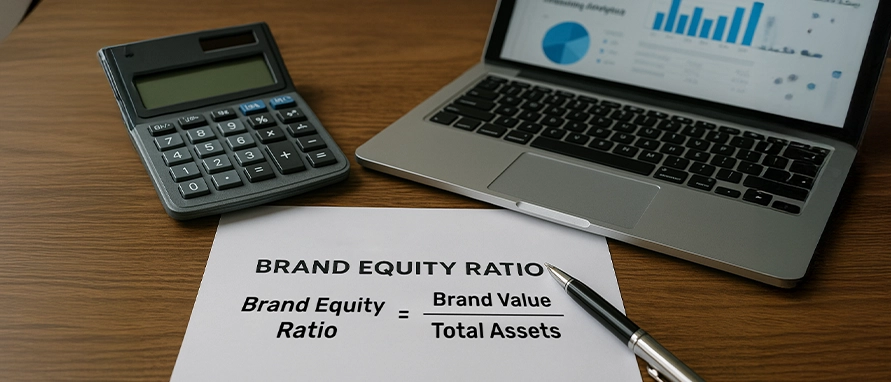
The general formula for the Brand Equity Ratio is:
Brand Equity Ratio = Brand Value ÷ Total Business Value × 100
Where:
Brand Value represents the financial worth of the brand (often derived from valuation studies or intangible asset assessments).
Total Business Value includes both tangible and intangible assets such as equity, debt, goodwill, and market capitalisation.
This ratio reveals what percentage of a company’s value stems directly from its brand strength.
Let’s consider a company with a total business value of ₹1,000 crore and a brand valuation of ₹250 crore.
Brand Equity Ratio = (₹250 crore ÷ ₹1,000 crore) × 100 = 25%
This means that 25% of the firm’s overall worth is attributed to its brand — a sign of strong consumer trust and competitive differentiation.
Companies with well-known brands like FMCG leaders or luxury manufacturers typically show higher ratios, reflecting brand-driven profitability and pricing power.
A higher Brand Equity Ratio indicates strong brand influence, customer loyalty, and perceived value. Businesses can use this ratio for:
Valuation and M&A: Assessing intangible asset worth during mergers or acquisitions.
Investment Analysis: Estimating how much of shareholder value is brand-dependent.
Marketing ROI: Measuring the return on long-term brand-building efforts.
Benchmarking: Comparing brand contribution across products or competitors.
However, brand valuation often includes assumptions about consumer behaviour, so ratios should be reviewed alongside qualitative market insights.
The Brand Equity Ratio quantifies how much of a company’s success is driven by its brand. It serves as an essential link between marketing performance and financial valuation. While high ratios highlight brand-driven growth, analysts should combine these insights with profitability and cash flow data for balanced evaluation.
This content is for informational purposes only and the same should not be construed as investment advice. Bajaj Finserv Direct Limited shall not be liable or responsible for any investment decision that you may take based on this content.
The brand equity ratio shows the proportion of a company’s total value that comes from its brand. A higher ratio suggests strong brand recognition, pricing power, and customer loyalty contributing significantly to overall enterprise value.
Yes, a negative ratio can occur when brand value is impaired or liabilities outweigh intangible assets. This may happen in cases of reputational damage, declining consumer trust, or poor market performance.
The ratio is usually evaluated during mergers, acquisitions, brand audits, or investor presentations. It helps stakeholders understand the brand’s financial contribution and assess how effectively it drives long-term enterprise value.
With a Postgraduate degree in Global Financial Markets from the Bombay Stock Exchange Institute, Nupur has over 8 years of experience in the financial markets, specializing in investments, stock market operations, and project management. She has contributed to process improvements, cross-functional initiatives & content development across investment products. She bridges investment strategy with execution, blending content insight, operational efficiency, and collaborative execution to deliver impactful outcomes.
Unlock the world of credit! From picking the perfect card to savvy loan management, navigate wisely.
Money Management and Financial Planning covers personal finance basics, setting goals, budgeting...
Explore the investment cosmos! From beginner's guides to sharp-witted strategies, explore India's treasure trove of options.
Navigate the tax maze with ease! Uncover Income Tax 101, demystify jargon with Terms for Beginners, and choose between Old or New Regimes.
Discover essential insights on various types of insurance in India.
Welcome to Tech in Finance, where we explore the exciting intersection of technology and finance...