Our Products
 Loans
Loans
 Cards
Cards
 Insurance
 Investment
 Stock Market
 Electronics Mall
 CIBIL Score
 Knowledge Centre
 Calculators
Our Services

 Do not call
 En
En
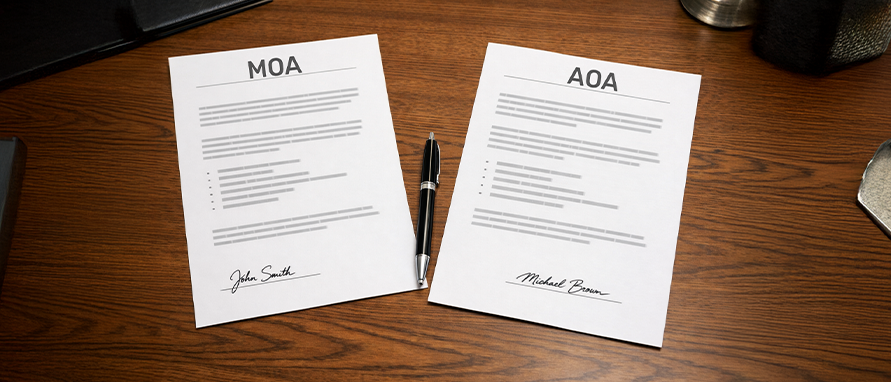
Understand the key differences between Memorandum of Association (MOA) and Articles of Association (AOA) in a company’s constitutional framework.
Companies incorporated under the Companies Act must prepare two key documents—MOA (Memorandum of Association) and AOA (Articles of Association). These documents define a company’s identity, scope of operations, internal rules, and governance structure. Although they work together, their purpose, content, and legal implications are different. This article explains the meaning, purpose, components, and key differences between MOA and AOA in simple terms.
The Memorandum of Association (MOA) is a company’s charter—the foundational document that defines its scope of operations and relationship with the outside world.
Specifies the company’s name, objectives, registered office, and capital structure.
Determines the extent of the company’s powers.
A company cannot perform activities beyond the MOA (ultra vires doctrine).
Mandatory for all companies at the time of incorporation.
The Memorandum of Association states what a company can do and why it is formed.
The Articles of Association (AOA) contain internal rules for the company’s governance. It acts as a user manual guiding how the company will operate day-to-day.
Defines rules relating to management, share issuance, voting rights, meetings, dividend policy, etc.
Regulates relationships between the company and its members.
The company can change its AOA through special resolution, subject to law.
The Articles of Association explain how the company will run internally.
The table below summarises the major differences between MOA and AOA:
| Basis | MOA | AOA |
|---|---|---|
Meaning |
Charter of the company defining scope and objectives. |
Internal rulebook governing company’s operations. |
Purpose |
Restricts and defines a company's activities. |
Provides operational guidelines and internal management rules. |
Status |
Supreme document; subordinate only to Companies Act. |
Subordinate to MOA and Companies Act. |
Alteration |
Subject to stricter legal requirements; needs government/regulator approval in some cases. |
Subject to fewer procedural requirements to amend via special resolution. |
Contents |
Name Clause, Registered Office Clause, Object Clause, Liability Clause, Capital Clause, Subscription Clause. |
Rules regarding meetings, directors, voting, share issue, dividends, and governance. |
Binding Nature |
Binds the company with external parties. |
Binds company with its members internally. |
Legal Effect |
Acts done beyond MOA are void (ultra vires). |
Acts inconsistent with AOA may be valid if allowed under MOA. |
Requirement |
Mandatory for all companies. |
Mandatory for private and public companies. |
The Memorandum of Association (MOA) plays a foundational role in setting up a company and defining its legal identity.
Defines the purpose and powers of the company: It clearly states what activities the company is allowed to undertake.
Provides clarity to investors and stakeholders: By outlining the business scope, it helps investors assess whether the company aligns with their interests.
Acts as a core legal document: MOA is compulsory during incorporation and forms the basis of the company’s registration.
Prevents unauthorised activities: It restricts the company from engaging in activities beyond its stated objectives, protecting shareholders and creditors.
The Articles of Association (AOA) ensures that the company’s internal operations run in an organised and transparent manner.
Supports systematic internal functioning: It lays down standard procedures for managing daily affairs.
Defines roles and responsibilities: AOA clarifies the powers and duties of directors, officers, and shareholders.
Regulates operational processes: It includes rules for share transfers, meetings, voting, and dividend distribution.
Reduces internal disputes: Clear procedural guidelines help avoid misunderstandings and conflicts among stakeholders.
MOA and AOA work together to form the complete governance framework of a company.
MOA establishes the scope: It sets the company’s objectives and legal limits.
AOA governs execution: It explains how activities within that scope will be carried out.
Consistency is mandatory: AOA must always comply with the provisions of the MOA and cannot override it.
In simple terms:
MOA = What the company can do
AOA = How the company will do it
The Memorandum of Association (MOA) is required at key stages where the company’s identity and scope of operations must be clearly established.
During company incorporation: MOA is a mandatory document filed with the Registrar of Companies to legally form the company.
For licences, approvals, or loans: Authorities and lenders rely on the MOA to verify the company’s permitted activities.
When defining or altering business objectives: Any change in core business activities must align with, or be amended in, the MOA.
The Articles of Association (AOA) governs the internal functioning of a company and is relevant in day-to-day management matters.
Shareholder and board governance: AOA sets rules for meetings, resolutions, and decision-making processes.
Issuing or transferring shares: Procedures for allotment, transfer, and transmission of shares are defined here.
Operational procedures: It covers voting shares, dividend distribution, accounts, and administrative rules.
The MOA outlines the company’s external framework and legal boundaries.
Name Clause: Specifies the registered legal name of the company.
Registered Office Clause: States the jurisdiction (state) where the company is registered.
Object Clause: Defines the main business activities and permitted ancillary operations.
Liability Clause: Clarifies the extent of liability of members, whether limited or unlimited.
Capital Clause: Mentions the authorised share capital and its division into shares.
Subscription Clause: Lists the initial subscribers and their commitment to take shares.
The AOA details the internal rules and management structure of the company.
Share capital and rights: Explains classes of shares and variation of shareholder rights.
Share transfer rules: Sets conditions and procedures for transfer of ownership.
Directors’ appointment and powers: Defines roles, authority, and responsibilities of directors.
General meeting rules: Lays down procedures for conducting shareholder meetings.
Voting procedures: Specifies voting rights and methods.
Dividend and accounts: Covers profit distribution and financial record-keeping.
Borrowing powers: Outlines limits and conditions for raising loans.
Winding-up rules: Describes procedures in case of company dissolution.
Here is a simple way to understand the difference between a company’s MOA and AOA:
MOA (Memorandum of Association) defines the company’s scope, powers, and objectives.
AOA (Articles of Association) lays down the rules for internal management and operations.
MOA has an external focus; AOA focuses on internal governance.
MOA is restrictive, limiting what the company can legally do; AOA is flexible, guiding day-to-day functioning.
Together, they govern both the purpose and administration of the company.
This content is for informational purposes only and the same should not be construed as investment advice. Bajaj Finserv Direct Limited shall not be liable or responsible for any investment decision that you may take based on this content.
The Memorandum of Association (MOA) defines a company’s objectives, powers, and operational scope, while the Articles of Association (AOA) lay down internal rules, management procedures, and governance mechanisms to help day-to-day operations.
Companies require both documents because the MOA limits the scope of activities a company can undertake, while the AOA provides detailed procedures for internal governance, decision-making, and compliance with corporate regulations.
The AOA contains rules related to shares and shareholder rights, meetings, voting procedures, director responsibilities, dividend distribution, and internal governance. It ensures clarity on operational and managerial practices within the company.
The MOA and AOA are usually prepared by the company’s founders or promoters, often with assistance from legal professionals. They ensure that both documents comply with regulatory requirements and reflect the company’s intended structure and governance.
The AOA can be amended relatively easily through a special resolution by shareholders. Changes to the MOA are subject to stricter legal compliance, approvals from authorities, and sometimes court permission depending on the nature of the amendment.
Yes, the Memorandum of Association is mandatory for the incorporation of every company under the Companies Act. It is a fundamental document that defines the company’s objectives and legal scope of operations.
Yes, both private and public companies are required to maintain an Articles of Association as per the Companies Act. It governs internal management, rights, duties, and operational procedures for shareholders and directors.
.jpeg)












 Academy


.jpeg "image not found")