Our Products
 Loans
Loans
 Cards
Cards
 Insurance
 Investment
 Stock Market
 Electronics Mall
 CIBIL Score
 Knowledge Centre
 Calculators
Our Services

 Do not call
 En
En
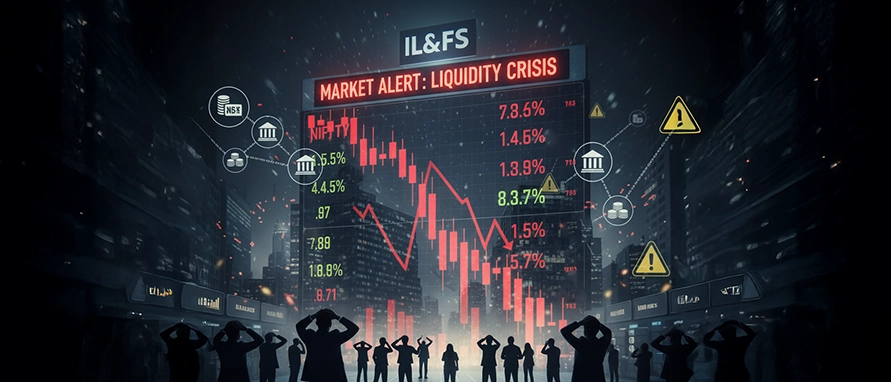
The default by Infrastructure Leasing & Financial Services (IL&FS) in 2018 marked a significant disruption in India’s financial system. What began as missed repayments at a large infrastructure financing group quickly spread across debt markets, non-banking financial companies (NBFCs), and mutual funds. The episode exposed structural vulnerabilities in funding models, governance frameworks, and credit assessment practices, prompting regulatory intervention and long-term changes in oversight.
Infrastructure Leasing & Financial Services (IL&FS) was incorporated in 1987 as an infrastructure development and finance company, focused on funding large-scale projects in transportation, energy, and urban infrastructure.
Over time, the group expanded into a complex structure comprising more than 300 subsidiaries, associates, and joint ventures, operating across multiple sectors and geographies.
IL&FS had institutional shareholders including Life Insurance Corporation of India (LIC), State Bank of India (SBI), HDFC, and Central Bank of India, which contributed to its standing in credit markets.
Its operating model relied largely on borrowed funds, with short-term liabilities used to finance long-gestation infrastructure projects, creating exposure to maturity mismatches.
The crisis surfaced in mid-2018 when IL&FS began missing repayments on short-term borrowings, leading to successive credit rating downgrades and market-wide concern.
Key contributing factors included:
Significant asset–liability mismatch arising from short-term borrowing and long-term project financing
Consolidated debt exceeding ₹1 lakh crore with limited operating cash flows
Delays in project execution resulting in cost overruns
Stalled assets that did not generate expected revenue
Limited transparency across group entities
Weak oversight mechanisms within the corporate structure
Following repayment defaults, rating agencies downgraded IL&FS instruments, restricting its access to funding and accelerating stress across connected financial institutions.
The IL&FS defaults transmitted stress through multiple segments of the financial system within a short period.
Several NBFCs faced funding constraints as lenders reassessed credit risk. Institutions dependent on short-term market borrowing experienced reduced access to liquidity.
Debt mutual funds with exposure to IL&FS securities encountered elevated redemption requests. To meet these outflows, funds sold liquid assets, which increased pressure on broader bond markets.
Corporate bond yields rose sharply as risk premiums widened. NBFCs and housing finance companies found it difficult to roll over existing borrowings.
Financial services, infrastructure, and real estate stocks recorded heightened volatility as concerns about systemic exposure spread across equity markets.
As the defaults highlighted broader financial stability risks, regulatory and administrative intervention followed.
The National Company Law Tribunal approved the replacement of IL&FS’s board with government-appointed directors to stabilise operations and initiate resolution.
The Reserve Bank of India introduced system-wide liquidity support through open market operations and targeted funding facilities.
Market regulators facilitated temporary measures to support mutual fund liquidity.
Enhanced asset–liability management requirements for NBFCs
Increased supervisory scrutiny of large financial intermediaries
Strengthened disclosure norms across regulated entities
These steps were aimed at containing contagion and restoring orderly functioning in credit markets.
Credit evaluation frameworks placed greater emphasis on cash-flow visibility, group-level exposures, and project execution timelines.
Funding conditions favoured larger institutions with diversified balance sheets, while several smaller NBFCs reduced operations or exited specific lending segments.
Corporate governance standards received increased regulatory focus, including tighter audit requirements and clearer accountability at board level.
A court-supervised resolution process was initiated to monetise group assets and repay creditors. Multiple subsidiaries were transferred or sold as part of phased recovery efforts, which continue under judicial oversight.
The crisis highlighted structural aspects of India’s financial ecosystem, including:
Interconnected exposure between NBFCs, mutual funds, and capital markets
The role of liquidity risk in leveraged infrastructure financing models
The importance of consolidated group disclosures
The need for early supervisory intervention in rapidly expanding financial entities
These observations informed subsequent regulatory adjustments across lending and capital market segments.
The IL&FS defaults represented a turning point in India’s financial landscape, revealing vulnerabilities in funding structures, governance practices, and credit transmission channels. While the episode caused short-term disruption across debt and equity markets, it also led to regulatory recalibration and closer oversight of non-bank financial intermediaries. The ongoing resolution process continues to shape approaches to risk management and financial stability.
This content is for informational purposes only and the same should not be construed as investment advice. Bajaj Finserv Direct Limited shall not be liable or responsible for any investment decision that you may take based on this content.
The crisis resulted from a combination of asset–liability mismatches, high consolidated debt, project delays, and governance shortcomings, which together led to repayment defaults in 2018.
NBFCs, mutual funds, housing finance companies, and infrastructure-linked industries experienced the most direct impact due to interconnected funding exposures.
Authorities replaced the IL&FS board through NCLT approval, initiated a court-monitored resolution process, and coordinated with regulators to introduce liquidity and supervisory measures.
Debt fund investors faced valuation adjustments and delayed redemptions in some schemes, while equity markets recorded increased volatility in financially linked sectors.
No. Asset monetisation and creditor repayments are still underway under judicial supervision, with progress occurring in phases.
.jpeg)












 Academy


.jpeg "image not found")