Our Products
 Loans
Loans
 Cards
Cards
 Insurance
 Investment
 Stock Market
 Electronics Mall
 CIBIL Score
 Knowledge Centre
 Calculators
Our Services

 Do not call
 En
En
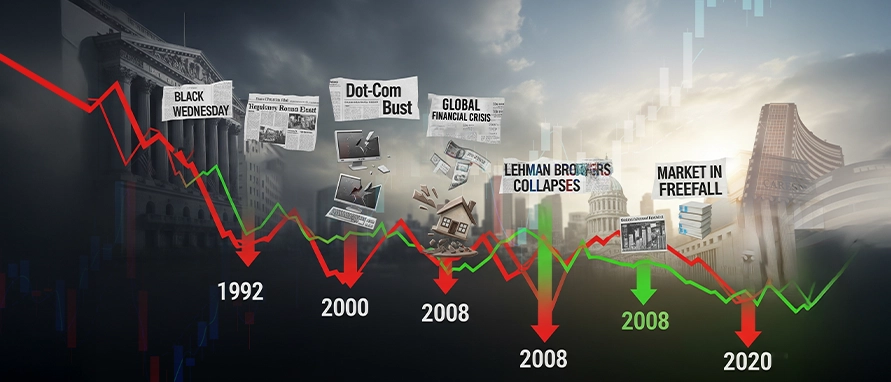
India’s equity markets have experienced several periods of sharp decline driven by domestic developments and global financial disruptions. These episodes have influenced regulatory frameworks, market infrastructure, and trading behaviour, while also reshaping participation across institutional and retail segments.
What happened:
Stockbroker Harshad Mehta exploited gaps in the banking system by using fraudulent bank receipts to channel funds into equities, artificially inflating prices during early 1992.
Impact:
The BSE Sensex rose sharply before falling by roughly 40–50% once the irregularities surfaced. The episode led to tighter market oversight and accelerated reforms in disclosure, settlement, and surveillance mechanisms.
What happened:
The collapse of major financial institutions in the United States, including Lehman Brothers, triggered widespread global risk aversion and capital withdrawal from emerging markets.
Impact:
Indian equities declined by close to 60% from their peak. The period saw heightened volatility and foreign outflows. Market regulators and the Reserve Bank of India implemented liquidity measures, while supervisory frameworks for intermediaries and market infrastructure were strengthened.
What happened:
China’s unexpected currency devaluation in August 2015 led to global uncertainty, affecting capital flows across emerging economies.
Impact:
Indian indices corrected by approximately 20% during this phase, reflecting broader risk-off sentiment. Portfolio flows remained volatile as global investors reassessed exposure to emerging markets.
What happened:
On 8 November 2016, the Indian government withdrew ₹500 and ₹1,000 currency notes from circulation, creating a temporary liquidity shock in cash-dependent segments of the economy.
Impact:
Equity markets experienced short-term volatility, particularly in consumer-facing sectors. Unlike global crisis-driven crashes, this event primarily affected domestic demand conditions rather than triggering systemic market declines.
What happened:
The onset of the COVID-19 pandemic and nationwide lockdowns led to one of the fastest market declines on record.
Impact:
Between February and March 2020, the Sensex fell by about 38%. Subsequent recovery was supported by fiscal measures, central bank liquidity operations, and increased domestic market participation.
Market disruptions over time have highlighted recurring structural themes across India’s equity ecosystem:
Broad market participation across sectors and capitalisation segments has historically influenced how shocks are distributed within indices during periods of stress.
Major downturns have been followed by enhancements in surveillance, risk management systems, settlement frameworks, and investor protection regulations implemented by Securities and Exchange Board of India (SEBI) and other authorities.
Global financial events, public health emergencies, and currency movements have demonstrated how external shocks can transmit rapidly into domestic markets.
While recovery timelines have varied across episodes, Indian markets have shown differing rebound trajectories depending on the underlying cause and policy response.
Together, these patterns illustrate how market structure, regulation, and external conditions interact during periods of heightened volatility.
Also Read: Things to do when the share market is down
Stock market crashes in India have emerged from a mix of domestic irregularities and global disruptions. Each episode has contributed to changes in regulation, market infrastructure, and participation dynamics. Viewed collectively, these events provide historical context on how India’s equity markets respond to systemic stress over time.
This content is for informational purposes only and the same should not be construed as investment advice. Bajaj Finserv Direct Limited shall not be liable or responsible for any investment decision that you may take based on this content.
A stock market crash refers to a rapid and significant decline in equity prices across a broad range of securities, typically triggered by economic, financial, or systemic events.
Major crashes tend to coincide with exceptional domestic or global disruptions. While volatility is a regular feature of markets, large-scale downturns are generally associated with specific external shocks or structural issues.
Foreign portfolio outflows have amplified declines during certain periods, particularly in globally driven events such as 2008 and 2015–16, reflecting the influence of international risk sentiment on Indian equities.
Recovery timelines have differed across episodes. For example, post-2008 recovery took several years, whereas the rebound following the 2020 pandemic-related decline occurred more rapidly due to coordinated fiscal and monetary responses.
The 2008 decline was primarily driven by the global financial crisis, which originated in the US banking system and led to widespread capital withdrawal from emerging markets, including India.
Market crashes are generally triggered by unforeseen events or systemic stresses. While historical patterns offer context, precise timing and causes cannot be reliably anticipated.
Past events provide reference points for understanding market behaviour, but each downturn arises from distinct circumstances shaped by prevailing economic and financial conditions.
.jpeg)












 Academy



.jpeg "image not found")