Our Products
 Loans
Loans
 Cards
Cards
 Insurance
 Investment
 Stock Market
 Electronics Mall
 CIBIL Score
 Knowledge Centre
 Calculators
Our Services

 Do not call
 En
En
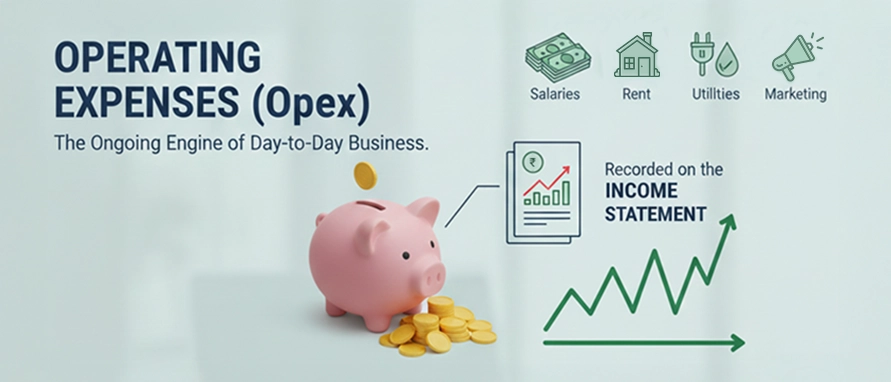
Explore operating expenses to understand the day-to-day costs businesses incur to keep their core functions running.
Operating expenses represent the routine costs a business incurs to run its day-to-day activities. These expenses cover functions such as administration, sales, marketing, and general operations, and they directly influence a company’s ability to manage resources efficiently. Understanding operating expenses helps assess operational discipline, cost structure, and overall financial health.
Operating expenses (OpEx) are the day-to-day costs a business incurs to run its core operations. These expenses are necessary for maintaining regular business functions but do not include costs related to producing goods, financing activities, or one-time capital purchases.
Operating expenses appear on the income statement and are deducted from gross profit to arrive at operating income. Because they directly influence profitability, companies closely monitor and manage OpEx to maintain efficiency and competitiveness.
Common examples include employee salaries, rent, utilities, marketing costs, office supplies, and insurance.
Operating expenses are important because they represent the ongoing costs required to keep a business functioning. Their purpose goes beyond mere spending—they help:
Support the company’s revenue-generating activities
Maintain product or service quality
Enable administrative and management operations
Facilitate marketing, sales, and customer engagement
Drive long-term business sustainability
High operating expenses relative to revenue can indicate pressure on margins, while lower operating cost intensity may reflect a more streamlined cost structure.
Operating expenses generally fall into several major categories:
Includes salaries, office rent, travel, utilities, advertising, and administrative costs.
Expenses incurred to develop new products or improve existing ones.
Brand promotions, digital marketing campaigns, sponsorships, events, and customer outreach.
Upkeep of equipment, facilities, and technology infrastructure.
Fees paid to consultants, auditors, lawyers, and contractors.
Software subscriptions, insurance premiums, communication expenses, etc.
Operating expenses can be calculated in different ways depending on the level of detail needed.
Basic operating expenses can be calculated using:
Operating Expenses = SG&A Expenses + R&D Expenses + Other Operating Costs
Operating expenses from income statement can be calculated using:
Operating Expenses = Total Revenue – Operating Income – Cost of Goods Sold (COGS)
This ratio measures how efficiently a company is managing its operating costs.
Operating Expense Ratio (OER) = (Operating Expenses ÷ Net Sales) × 100
A lower OER represents a lower operating cost intensity.
The Operating Expense Ratio helps assess how much of a company’s revenue is consumed by its operational costs.
Indicates operational efficiency
Helps compare companies within the same industry
Reveals cost control effectiveness
Assists financial analysts and investors in evaluating profitability
While managing operating expenses is essential, companies often face several challenges:
Balancing cost reduction with quality output
Inflation increasing rent, utilities, and wages
Rising marketing and technology costs
Over-dependence on manual processes increasing labor spend
Ineffective budgeting or lack of forecasting
Overspending on non-productive activities
Poor OpEx control may lead to declining profits, cash flow issues, or an inability to compete effectively.
Operating expenses are vital for sustaining a company’s daily operations. Understanding OpEx, how they are calculated, and how they impact profitability helps businesses make informed decisions.
Points to remember:
Operating expenses reflect the ongoing costs required to run a business
They significantly profitability and operating income
Monitoring OpEx helps maintain financial health
The Operating Expense Ratio offers a method for examining operating cost intensity
Cost control and operational quality are often considered together
Efficient management of operating expenses can contribute to stable operations and support long-term business continuity.
This content is for informational purposes only and the same should not be construed as investment advice. Bajaj Finserv Direct Limited shall not be liable or responsible for any investment decision that you may take based on this content.
Operating expenses are the recurring costs involved in running a company’s core day-to-day activities, excluding production-related costs and non-operating items such as interest or one-off losses.
Operating expenses can be calculated by adding major operating cost categories such as SG&A, R&D, and administrative expenses. They may also be derived using the relationship:
Operating Expenses = Revenue – Operating Income – COGS.
The Operating Expense Ratio indicates the share of revenue consumed by operating costs, helping assess efficiency. A lower ratio reflects efficient cost control and improved operational performance.
Operating expenses refer to routine costs directly linked to ongoing business activities, while non-operating expenses arise from activities outside core operations, including interest expenses, currency losses, or other incidental charges.
.jpeg)












 Academy


.jpeg "image not found")