
Our Products
 Loans
Loans
 Cards
Cards
 Insurance
 Investment
 Stock Market
 Electronics Mall
 CIBIL Score
 Knowledge Centre
 Calculators
Our Services

 Do not call
 En
En
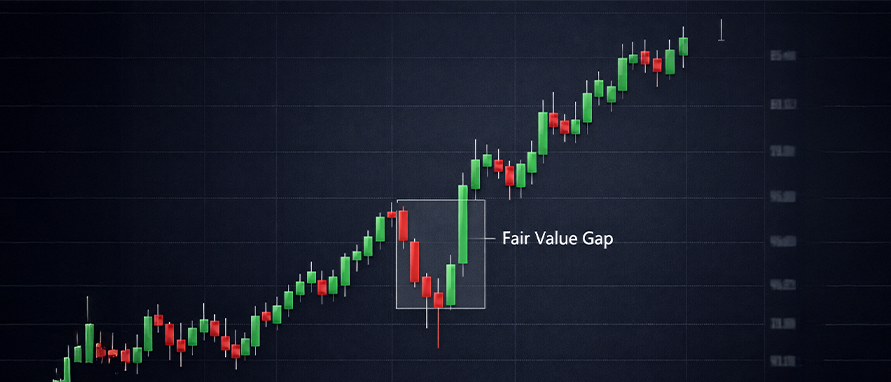
Learn what a Fair Value Gap is in technical analysis and how traders use it to identify potential areas of price imbalance and reversal.
A Fair Value Gap (FVG) is a popular price-action concept used by traders to identify market imbalances where price has moved too quickly, leaving behind inefficient trading zones. These gaps are areas where price has historically revisited, indicating potential zones of interest in price analysis. Fair Value Gaps are widely used in institutional trading concepts and are especially common in forex, indices, and equity markets. Understanding FVGs helps traders improve entries, exits, and overall market timing.
A Fair Value Gap occurs when there is a sharp price movement that skips normal trading activity between buyers and sellers. This usually appears as a gap between three consecutive candles, where the middle candle moves strongly and leaves an untraded price range between the previous and next candle. This gap represents an imbalance in supply and demand, meaning price did not have enough time to trade fairly. Markets often revisit these zones later to rebalance, making FVGs useful for identifying potential support or resistance areas.
In trading, FVG refers to an area on the chart where institutional buying or selling has caused price to move aggressively. Traders use these gaps to anticipate future price retracements. When price returns to a Fair Value Gap, it may either bounce or consolidate before continuing its trend. FVGs are commonly used alongside trend analysis, market structure, and stock liquidity concepts to improve trade accuracy. They are not standalone signals and are most effective when combined with confirmation tools.
There are different types of Fair Value Gaps based on market direction:
Bullish Fair Value Gap: Formed during strong upward moves, where price may revisit the gap before continuing higher.
Bearish Fair Value Gap: Created during sharp downward moves, often acting as resistance when price retraces.
Imbalance-Based FVG: Occurs due to extreme momentum caused by news, earnings, or institutional activity.
Each type helps traders understand whether buyers or sellers are in control.
While both,Fair Value Gaps (FVGs) and Liquidity Gaps, highlight potential market inefficiencies, they focus on different aspects of price and volume dynamics.
| Aspect | Fair Value Gap (FVG) | Liquidity Gap |
|---|---|---|
Definition |
A Fair Value Gap arises when there is an imbalance between buyers and sellers, often due to aggressive price movements that leave untested price zones. |
A Liquidity Gap occurs in areas of the chart where trading volume is low and stop-loss or pending orders are clustered, leading to potential price reactions. |
Focus |
Highlights price inefficiencies and unfilled orders in the market. |
Highlights concentrations of liquidity where the price is likely to react or reverse. |
Cause |
Caused by sudden momentum, market shocks, or aggressive institutional activity. |
Caused by low participation, thin order books, or clustered stop orders. |
Purpose in Analysis |
Used by traders to identify potential zones for price correction or entry/exit points. |
Used to anticipate price reactions, breakouts, or reversals in areas of low liquidity. |
Relationship |
FVGs and liquidity gaps may overlap, but they represent different market mechanics. |
While complementary to FVGs, liquidity gaps focus on order flow rather than price imbalance. |
Both Fair Value Gaps and Liquidity Gaps provide traders with valuable insights into market behaviour. FVGs indicate untested price zones caused by aggressive movements, whereas liquidity gaps highlight areas where stop orders or low trading volumes may influence price. Recognising and combining these concepts can help traders plan entries, exits, and anticipate market reactions more effectively.
Using Fair Value Gaps offers several advantages:
Helps identify areas where retracement often occurs
Improves trade entries with enhanced risk-to-reward setups
Works across multiple timeframes
Aligns well with institutional trading concepts
Useful in trending and volatile markets
When analysed alongside other indicators, FVGs may provide additional insight into price movements.
Despite their usefulness, FVGs have limitations:
Not all gaps get filled by price
False signals can occur in choppy markets
Requires strong trend and structure confirmation
Overuse can lead to overtrading
Market conditions can invalidate older FVGs
Traders must manage risk and avoid relying solely on Fair Value Gaps.
Some common mistakes include:
Treating every gap as a guaranteed reversal zone
Ignoring market trend and structure
Entering trades without confirmation
Using FVGs on very low timeframes without context
Not applying proper stop-loss rules
Avoiding these mistakes improves long-term trading performance.
Fair Value Gaps are technical tools for identifying market imbalances and potential price reaction zones. They help traders understand where price moved inefficiently and where it may return. While FVGs offer advantages, they should always be combined with trend analysis, confirmation signals, and sound risk management. When used correctly, Fair Value Gaps can significantly improve trading decisions and consistency.
This content is for informational purposes only and the same should not be construed as investment advice. Bajaj Finserv Direct Limited shall not be liable or responsible for any investment decision that you may take based on this content.
A fair value gap (FVG) is a price area where the market moves rapidly, leaving behind an imbalance of untraded zones. These gaps indicate that supply and demand were temporarily out of alignment during the move.
Traders often observe how price interacts with these gaps, noting potential areas of market imbalance for analysis with confirmation from the prevailing trend and other technical indicators to manage risk.
A fair value gap represents price imbalance from rapid movement, whereas a liquidity gap highlights areas with clustered buy or sell orders. FVG focuses on untraded price zones, while liquidity gaps emphasise market order flow and concentration.
Yes, fair value gaps can be applied to intraday charts. Traders must confirm the trend, price action, and relevant market conditions before using FVGs to identify potential trade opportunities.
Beginners can study fair value gaps but should first understand market structure, trends, and risk management principles. Using FVGs without proper knowledge may lead to misinterpretation and trading losses.
.jpeg)












 Academy



.jpeg "image not found")