Our Products
 Loans
Loans
 Cards
Cards
 Insurance
 Investment
 Stock Market
 Electronics Mall
 CIBIL Score
 Knowledge Centre
 Calculators
Our Services

 Do not call
 En
En
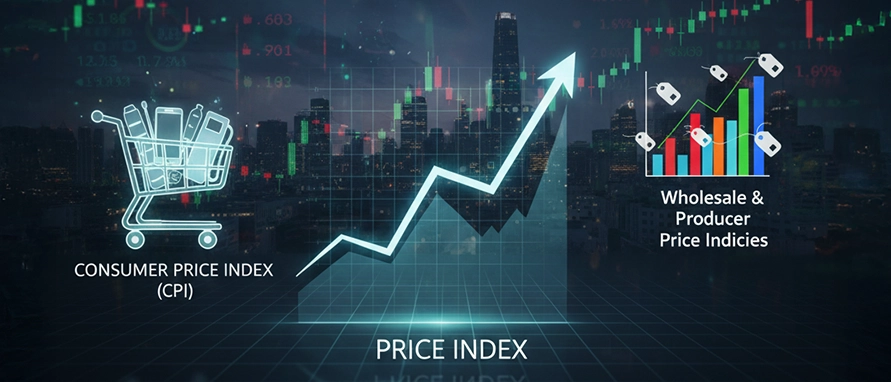
Explore what a price index represents to learn how it tracks changes in the cost of goods, services, or market performance over time.
A price index is one of the most widely used economic indicators for tracking how prices change over time. Governments, investors, policymakers, and businesses rely on price indices to understand inflation, cost of living, and overall market trends. Because prices fluctuate constantly, a price index helps measure the average change in the prices of a selected basket of goods or assets compared to a base year or period. It provides essential insights into purchasing power, economic policy decisions, and financial planning.
A price index is a statistical measure that tracks the average price movement of a specific set of goods, services, or financial assets over time. It compares the price level in a current period with that of a base period, which is assigned a reference value—usually 100.
Price indices help monitor inflation, analyse market fluctuations, and evaluate economic health. For example, when the price index rises, it indicates an increase in the general price level or inflation; when it falls, it signals deflation or declining prices.
A price index can be defined simply as:
A numerical measure that shows how the prices of a selected basket of goods or assets have changed relative to a base period.
The meaning of a price index is rooted in understanding how fast prices are increasing or decreasing. It simplifies complex price changes into a single figure, making comparison across time periods easier. Whether used in everyday consumer analysis (like CPI) or financial markets (like stock indices), price indices allow for consistent tracking of value movement.
There are several major types of price indices, each serving a different purpose:
Consumer Price Index (CPI) – Tracks retail prices of a basket of consumer goods and services; the most common measure of inflation.
Producer Price Index (PPI) – Measures price changes at the wholesale or producer level.
Wholesale Price Index (WPI) – Tracks price changes in bulk trade, often used in India.
Share Price Index – Measures price movement of listed stocks (e.g., Nifty 50, Sensex).
GDP Deflator – Measures price change of all domestically produced goods and services.
These indices provide different perspectives on inflation, production costs, market behaviour, and economic activity.
The general formula for a price index is:
Price Index = (Price in Current Period / Price in Base Period) × 100
For more complex indices (like CPI or WPI), the formula accounts for weighted categories:
Price Index = (Σ (Current Price × Weight) / Σ (Base Price × Weight)) × 100
Base Period – Reference time with index value 100.
Current Period Price – The updated cost of each item.
Weights – Show the relative importance of each item in the basket.
The following table outlines the main distinctions between the indices:
| Basis | Price Index | Share Price Index |
|---|---|---|
Meaning |
Measures price change of goods/services |
Tracks price movement of stocks |
Purpose |
Analyse inflation & purchasing power |
Measure market performance |
Components |
Consumer items, wholesale goods |
Listed company shares |
Users |
Government, economists, households |
Investors, fund managers |
Examples |
CPI, WPI, GDP deflator |
Nifty 50, Sensex, S&P 500 |
While general price indices measure inflation, share price indices reflect the performance and valuation of financial markets.
Several factors cause price index values to change:
Changes in the basket components – New goods, discontinued items, or consumption pattern shifts.
Weight adjustments – Rebalancing the importance of items.
Base year revision – Updating the reference point for accuracy.
Supply chain disruptions – Affect prices of major goods.
Government policies – Taxes, subsidies, import/export rules.
Global economic conditions – Commodity prices, geopolitical risks.
These factors ensure price indices evolve with consumption behaviour and market conditions.
Price indices have notable shortcomings:
Substitution bias: Consumers often switch to cheaper alternatives, but indices may not fully capture this.
Quality changes: Improvements in product quality may distort real inflation.
Outdated baskets: Slow revisions can make indices less representative.
Regional variations: Price differences across cities or regions may not be reflected.
Time lag: Data collection and processing delay real-time insights.
Despite these limitations, price indices remain essential for economic decision-making.
A price index helps track how prices shift over time and offers a clear view of inflation, purchasing power, and overall economic trends. It helps various user groups interpret market movements and understand economic conditions. Despite limitations such as substitution bias and quality adjustments, it remains a core tool in economic and financial assessment.
Important takeaways:
Tracks how prices change across goods and services
Helps measure inflation and purchasing power
Used for understanding budgeting trends, market conditions, and policy analysis
Has limitations but remains essential for economic evaluation
This content is for informational purposes only and the same should not be construed as investment advice. Bajaj Finserv Direct Limited shall not be liable or responsible for any investment decision that you may take based on this content.
A price index is calculated by dividing the current period price by the base period price and multiplying the result by 100, allowing comparison of price levels over time.
The Consumer Price Index is computed using weighted averages of a standardised basket of goods and services, reflecting typical household consumption patterns.
A share price index tracks the movement of selected listed companies' share prices to measure overall stock market performance or the performance of a specific sector.
Price indices are limited by factors such as substitution bias, variations in product quality, outdated consumption baskets, and regional differences in pricing.
.jpeg)












 Academy


.jpeg "image not found")