Our Products
 Loans
Loans
 Cards
Cards
 Insurance
 Investment
 Stock Market
 Electronics Mall
 CIBIL Score
 Knowledge Centre
 Calculators
Our Services

 Do not call
 En
En
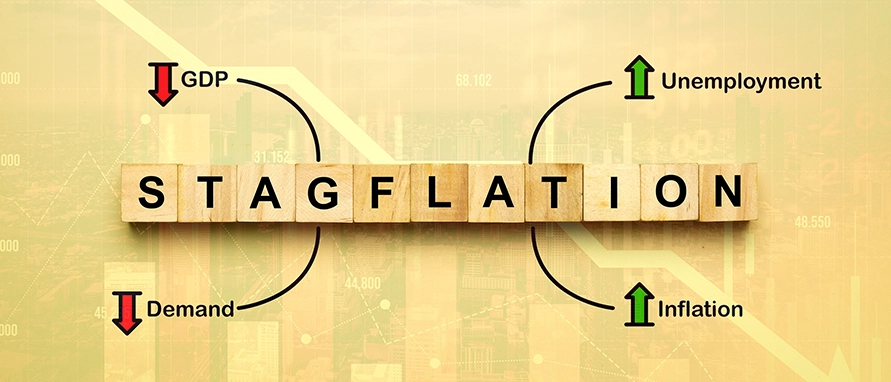
Explore stagflation to understand how slow growth and high inflation create challenging economic conditions.
Stagflation is widely regarded as one of the most difficult economic conditions to manage because it brings together two opposing forces: high inflation and stagnant economic growth. Unlike a typical recession, where falling demand usually keeps prices stable or even pushes them down, stagflation creates the unusual scenario where the economy slows while prices continue to rise. This combination places both policymakers and households under significant strain, as living costs increase while job opportunities and income growth decline.
Understanding stagflation is important for students, investors, businesses, and policymakers because it affects interest rates, fiscal policy, employment, and long-term economic planning.
Stagflation refers to an economic period characterised by slow or negative economic growth, high unemployment, and persistent inflation. Normally, inflation rises when the economy is strong, as higher demand pushes prices up. However, in stagflation, inflation continues even though demand is weak and the economy is stagnating. This makes stagflation unique and extremely challenging to control.
Stagflation reduces purchasing power, discourages investment, weakens business confidence, and can prolong economic distress if not tackled properly. Because inflation is high, households spend more on essentials, while firms experience increased production costs with limited ability to raise output.
The term stagflation was first used in the United Kingdom in the 1960s by Conservative politician Iain Macleod, who combined the words “stagnation” and “inflation” to describe a situation where high inflation coexisted with slowing economic growth.
Although the term emerged earlier, stagflation became globally recognised during the 1970s oil crisis, when developed economies like the United States, United Kingdom, and Japan simultaneously experienced rising inflation, energy shortages, and declining economic performance.
This period remains the most well-known example in modern economic history and continues to shape policy responses to inflation and supply shocks.
Stagflation involves several distinct economic symptoms occurring at the same time:
High inflation rates despite weak economic activity
Rising unemployment because businesses reduce output
Little or no GDP growth
Decline in consumer spending due to reduced purchasing power
Rising input and production costs
Lower business investment as profitability weakens
Persistent economic uncertainty affecting households and investors
These conditions create a self-reinforcing cycle, where falling demand and rising prices feed each other, prolonging economic distress.
Stagflation usually results from a combination of supply-side disruptions, policy mistakes, and structural inefficiencies. Some of the major causes include:
Sudden increases in the cost of key inputs—such as oil, food, or raw materials—can trigger cost-push inflation even when demand is low. The 1970s oil embargo is a classic example.
Excessive money printing, rigid labour policies, or heavy regulation can suppress productivity while fuelling inflation.
When wages, energy, or import costs rise significantly, companies pass these costs onto consumers, pushing prices higher even during economic stagnation.
Low productivity, inefficient industries, or limited innovation can slow growth and make the economy more vulnerable to external shocks.
A sharp depreciation raises import costs, contributing to inflation while reducing domestic purchasing power.
A few well-known historical events highlight how stagflation has affected different economies:
Stagflation became globally recognised when crude oil prices quadrupled due to OPEC restrictions. Energy-dependent economies experienced high inflation, industrial contraction, and mass unemployment.
Increasing wages, weak productivity, and supply disruptions led to persistent inflation alongside stagnant growth.
Some developing countries have faced stagflation after currency devaluations or supply shortages, particularly when combined with poor fiscal discipline.
Stagflation affects households, businesses, and government finances. Its main impacts include:
Reduced consumer purchasing power
Higher borrowing and financing costs
Slower business expansion and investment
Falling corporate profits
Increased unemployment
Greater fiscal pressure on governments
Lower investor confidence and market volatility
Stagflation can also lead to social pressures, wage disputes, and a general decline in living standards.
Stagflation presents a unique policy dilemma because tools to control inflation often worsen unemployment. For example:
Raising interest rates helps reduce inflation but slows growth, increases job losses, and can impact shareholder returns.
Lowering interest rates encourages growth but risks pushing inflation even higher.
Policymakers must balance these conflicting goals while implementing long-term structural reforms, improving productivity, and stabilising supply chains.
Stagflation represents one of the most challenging economic scenarios, combining rising prices with weak growth and unemployment. Because conventional policy responses often conflict, understanding stagflation helps governments, businesses, and households anticipate economic impacts and plan accordingly. A clear understanding of its drivers and past episodes helps governments, firms, and households respond more effectively when pressures emerge.
Main Highlights:
Stagflation combines high inflation, low growth, and rising unemployment.
It is difficult to manage because policy tools can worsen one issue while solving another.
Understanding causes and effects helps in planning during economic uncertainty.
Historical patterns offer useful insights for policy and decision-making.
This content is for informational purposes only and the same should not be construed as investment advice. Bajaj Finserv Direct Limited shall not be liable or responsible for any investment decision that you may take based on this content.
Stagflation describes an economic situation where inflation remains high while economic growth slows and unemployment rises, creating a combination of weak activity and persistent price pressures.
Stagflation can arise from major supply disruptions, sharp increases in production costs, ineffective economic policies, or underlying structural issues that restrict growth while prices continue to rise.
Stagflation is challenging to manage because measures that control inflation may weaken economic activity, while growth-supporting policies can intensify inflation. This trade-off complicates policy responses.
Policymakers can address stagflation through structural reforms, productivity improvements, supply-chain strengthening, and carefully calibrated monetary tightening designed to reduce inflation without severely harming growth.
.jpeg)












 Academy


.jpeg "image not found")