Our Products
 Loans
Loans
 Cards
Cards
 Insurance
 Investment
 Stock Market
 Electronics Mall
 CIBIL Score
 Knowledge Centre
 Calculators
Our Services

 Do not call
 En
En
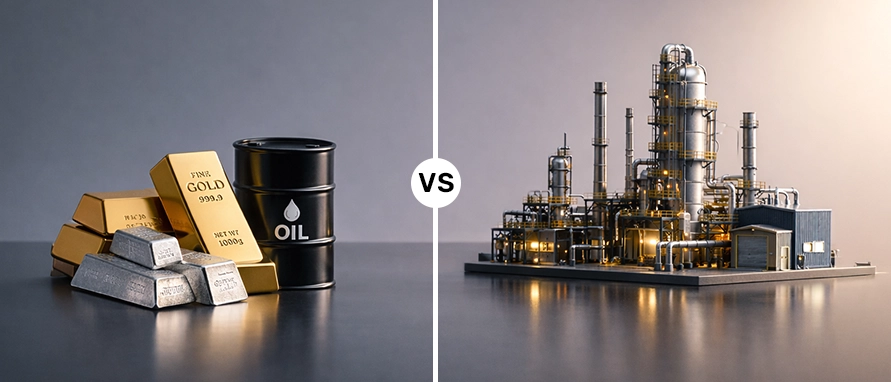
Learn the difference between commodity ETFs and commodity stocks to understand how each offers exposure to commodities through different investment structures.
A Commodity ETF (Exchange Traded Fund) is an investment fund that tracks the price of a commodity such as gold, silver, or crude oil. Instead of buying the physical commodity, investors buy units of the ETF, which represents the underlying asset.
Commodity ETFs are traded on stock exchanges, just like shares, and their price fluctuates based on the commodity they track. These funds are widely used for gaining exposure to commodities without dealing with storage or physical ownership.
Commodity ETFs work by tracking the price of a specific commodity or a basket of commodities. They may either:
Hold the physical commodity (like gold ETFs)
Invest in commodity futures contracts
Track commodity indices
Key features include:
Exchange trading: Bought and sold on stock exchanges
Price tracking: ETF price follows commodity price movements
Passive structure: No active stock selection
Asset-backed: Supported by physical or derivative holdings
Commodity ETFs are commonly used for diversification and inflation hedging.
Below is a table of a few commodity ETFs available in India:
| ETF Name | Commodity Tracked | Expense Ratio (Approx.) |
|---|---|---|
Nippon India Gold ETF |
Gold |
Low |
SBI Gold ETF |
Gold |
Low |
HDFC Gold ETF |
Gold |
Low |
ICICI Prudential Silver ETF |
Silver |
Low |
Axis Gold ETF |
Gold |
Low |
These ETFs allow investors to invest in commodities like gold and silver through a demat account.
Commodity stocks are shares of companies whose business is linked to commodities such as metals, oil, gas, or agriculture. Instead of investing directly in the commodity, investors invest in the companies that produce or process these commodities.
Examples include mining companies, oil producers, and steel manufacturers.
Commodity stocks’ performance depends not only on commodity prices but also on business efficiency, management, and market conditions.
Commodity stocks derive revenue from the production, processing, or trading of commodities.
Key aspects:
Revenue linkage: Earnings depend on commodity prices
Business operations: Includes extraction, refining, or distribution
Market exposure: Stock price is influenced by both commodity and company performance
Dividends: Some companies distribute profits as dividends
When commodity prices rise, these companies may benefit from higher revenue and profitability.
Below is a table of a few commodity-related companies in India:
| Company Name | Sector |
|---|---|
Energy & Petrochemicals |
|
Metals & Mining |
|
Mining |
|
Oil & Gas |
|
Metals |
|
Natural Gas |
|
Metals |
These companies are listed on Indian stock exchanges and are influenced by global commodity trends.
Here is a comparison between commodity ETFs and commodity stocks:
| Parameter | Commodity ETFs | Commodity Stocks |
|---|---|---|
Exposure |
Direct commodity price |
Company-based exposure |
Risk |
Lower (commodity-focused) |
Higher (business + commodity risk) |
Diversification |
High (depends on ETF) |
Low (single company) |
Volatility |
Based on commodity prices |
Influenced by market + business factors |
Returns |
Tracks commodity prices |
Can exceed or underperform commodity |
Dividends |
Rare (depends on ETF type) |
Possible |
Complexity |
Simple |
Moderate (requires analysis) |
Commodity ETFs offer several advantages:
Easy exposure to commodities without physical storage
High liquidity due to exchange trading
Lower expense compared to active funds
Diversification within a portfolio
Useful for hedging against inflation
Commodity stocks also offer some advantages:
Potential for higher returns through company growth
Dividend income from profitable companies
Exposure to business expansion opportunities
Participation in global commodity demand trends
Commodity ETFs carry certain risks:
Tracking error may affect returns
Commodity price volatility
Limited upside compared to equities
Dependence on underlying commodity performance
Commodity stocks have their own risks:
Business risk related to operations
Exposure to global commodity cycles
Market volatility
Regulatory and geopolitical risks
Commodity ETFs and commodity stocks can be accessed through a demat and trading account.
Steps include:
Open a demat account with a registered platform
Fund the trading account
Search for ETFs or commodity stocks on the exchange
Place a buy order
Monitor performance over time
Investors use these instruments to gain exposure to commodities without directly buying physical assets.
Before investing, consider the following factors:
Risk appetite and investment goals
Investment horizon (short-term or long-term)
Level of diversification required
Understanding of commodity markets
Volatility tolerance
Research and market awareness
Commodity ETFs and commodity stocks offer two different ways to invest in commodities. ETFs provide direct exposure to commodity prices with lower risk, while commodity stocks offer exposure to companies linked to commodities with potential for higher returns. The choice depends on an investor’s risk profile, goals, and understanding of market dynamics.
This content is for informational purposes only and the same should not be construed as investment advice. Bajaj Finserv Direct Limited shall not be liable or responsible for any investment decision that you may take based on this content.
A commodity ETF in India is a fund that tracks the price of commodities like gold or silver and is traded on stock exchanges like shares.
Commodity stocks are shares of companies involved in producing or processing commodities such as oil, metals, and natural gas.
Yes, many commodity companies distribute dividends depending on their profitability and financial performance.
Yes, commodity ETFs commonly track gold, silver, crude oil, or commodity indices depending on their structure.
A commodity ETF tracks the price of a commodity through a fund, while direct commodities involve physical ownership or futures contracts.
One disadvantage is tracking error, where the ETF may not perfectly match the performance of the underlying commodity.
.jpeg)












 Academy


.jpeg "image not found")