Our Products
 Loans
Loans
 Cards
Cards
 Insurance
 Investment
 Stock Market
 Electronics Mall
 CIBIL Score
 Knowledge Centre
 Calculators
Our Services

 Do not call
 En
En
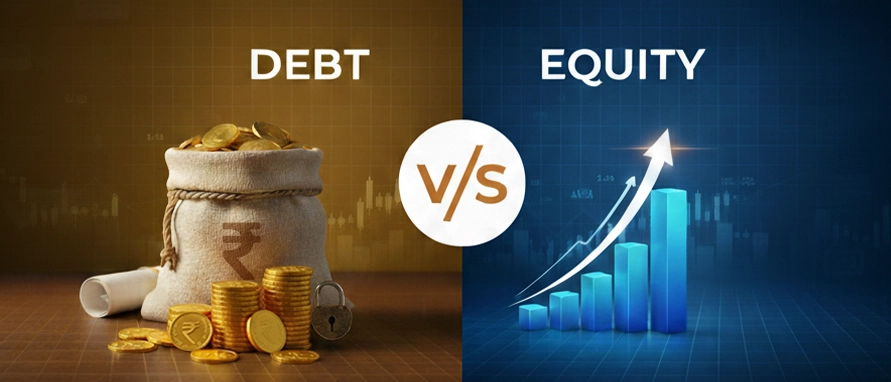
The debt and equity markets are two fundamental segments of the financial system. While the debt market deals with fixed-income securities, the equity market involves ownership stakes in companies. Comparing the two helps understand their distinct roles in financing and investment.
The debt market (or bond market) is where entities like governments and corporations raise funds by issuing debt instruments such as bonds, debentures, and notes. Investors who buy these instruments lend money in exchange for fixed interest payments and repayment of principal at maturity.
Key Features:
Provides predictable income through interest.
Suitable for investors seeking lower risk.
Common instruments: Government Bonds, Corporate Bonds, Treasury Bills, and Certificates of Deposit.
Returns are stable, but limited compared to equities.
The equity market (or stock market) allows companies to raise capital by selling ownership shares to investors. These shareholders become partial owners and can earn through dividends and capital appreciation when stock prices rise.
Key Features:
Offers ownership and voting rights.
Potential for higher long-term returns.
Involves greater market risk and volatility.
Returns depend on company performance and market conditions.
Both markets help companies raise capital but differ in structure as shown below:
| Aspect | Debt Capital Markets | Equity Capital Markets |
|---|---|---|
Purpose |
To borrow funds through debt issuance. |
To raise funds by selling ownership. |
Instruments |
Bonds, Debentures, Notes, CPs. |
Stocks, IPOs, Rights Issues. |
Return Type |
Fixed interest income. |
Dividends + Capital gains. |
Investor Role |
Creditor (lender). |
Owner (shareholder). |
Tenure |
Fixed maturity period. |
Indefinite (until shares are sold). |
Control Rights |
No ownership or voting rights. |
Voting rights in company matters. |
Debt capital markets emphasise stability and repayment assurance, while equity markets focus on long-term wealth creation and business participation.
Globally, the debt market is larger than the equity market, driven by extensive government and corporate borrowing.
| Country/Region | Debt Market Size (Approx.) | Equity Market Size (Approx.) |
|---|---|---|
United States (2024) |
USD ~ 58.2 trillion (≈ 40.1% of global fixed‑income) |
USD ~ 62.2 trillion (≈ 49.1% of global equity) |
India (2024) |
~ ₹ 217 trillion |
~₹ 438 trillion |
Global (2024) |
USD ~ 145.1 trillion (fixed income outstanding) |
USD ~ 126.7 trillion (equity market cap) |
In India, debt markets—dominated by government securities—are catching up rapidly with the booming equity space. However, equity markets attract more retail participation due to higher visibility and growth potential.
Also Read: Debt to Equity Ratio
Here’s how they differ across key investment parameters:
| Basis | Debt Market | Equity Market |
|---|---|---|
Nature of Investment |
Loan or lending-based. |
Ownership-based. |
Return Type |
Fixed interest. |
Variable (dividends + price gain). |
Risk Level |
Low to moderate. |
High (market-driven). |
Investor Role |
Creditor with repayment rights. |
Owner with profit participation. |
Maturity |
Predefined maturity date. |
No fixed tenure. |
Volatility |
Relatively stable. |
Highly volatile. |
Taxation |
Interest is taxed as income. |
Dividends is taxed as income; capital gains taxed according to holding period |
Regulatory Body |
SEBI & RBI (India). |
SEBI & Stock Exchanges. |
Example |
Government Bond, NCD. |
Equity Share, IPO stock. |
Here’s how debt and equity stack up for both investors and issuers:
| Perspective | Debt Market | Equity Market |
|---|---|---|
For Investors (Pros) |
Stable returns, lower risk, predictable income. |
Potential for high returns and ownership benefits. |
For Investors (Cons) |
Limited upside; inflation risk. |
High volatility, risk of capital loss. |
For Issuers (Pros) |
Retain full ownership; fixed repayment terms. |
No repayment obligation; permanent capital. |
For Issuers (Cons) |
Interest cost burden; affects leverage. |
Dilution of control; dividend expectation. |
Here’s a quick look at how debt and equity differ in terms of risk, return, and market volatility:
| Factor | Debt Market | Equity Market |
|---|---|---|
Risk |
Lower—mostly credit and interest rate risk. |
Higher—market and performance risk. |
Return Potential |
Moderate, steady income. |
High, but unpredictable. |
Volatility |
Less sensitive to market trends. |
Directly linked to market sentiment and economic cycles. |
In essence, debt instruments generally appeal to stability-focused investors, whereas equity markets cater to those comfortable with higher volatility.
Both debt and equity markets function within a strong regulatory framework to ensure transparency, investor protection, and fair trading practices.
The debt market in India operates under multiple regulators, each with a defined scope to maintain stability and credibility.
RBI – Regulates government securities and monetary policy-linked instruments.
SEBI – Oversees corporate bond issuance and trading.
FIMMDA – Sets benchmarks and operational standards for fixed-income markets.
The equity market, being more volatile and publicly traded, is closely monitored to ensure compliance and safeguard investor interests.
SEBI – Governs stock exchanges, IPOs, and investor protection.
Stock Exchanges (NSE/BSE) – Facilitate equity trading and price discovery.
Depositories (NSDL/CDSL) – Maintain dematerialised records of ownership.
Participants in Both:
Banks, mutual funds, insurance companies, retail investors, foreign portfolio investors (FPIs), and pension funds actively trade in both markets, depending on risk-return goals.
A mix of debt and equity can help balance stability and growth potential.
Considerations for Allocation:
Risk Tolerance: Conservative → More debt; Aggressive → More equity.
Investment Horizon: Short-term → Debt; Long-term → Equity.
Income Needs: Regular income → Debt; Wealth creation → Equity.
Market Conditions: Rising interest rates favor debt; bullish markets favor equity.
A combination of equity and debt instruments may reduce volatility and support balanced returns.
The debt and equity markets serve complementary roles in the financial ecosystem.
Debt markets prioritise stability and predictable returns, while equity markets drive innovation, ownership, and long-term wealth creation.
For investors, diversification across both ensures a resilient financial strategy.
Key Takeaways:
Debt = borrowing and fixed income; Equity = ownership and growth potential.
Debt markets are less volatile, equity markets more rewarding but risky.
Issuers use both markets strategically for capital and expansion.
A diversified mix aligns returns with risk appetite and goals.
This content is for informational purposes only and the same should not be construed as investment advice. Bajaj Finserv Direct Limited shall not be liable or responsible for any investment decision that you may take based on this content.
The key difference between debt and equity markets lies in the nature of investment. Debt markets involve lending capital to issuers in exchange for fixed interest and repayment at maturity, whereas equity markets allow investors to buy ownership stakes in companies and share in their profits or losses.
Debt capital markets focus on raising funds through debt instruments such as bonds, debentures, or notes, which provide regular interest payments. Equity capital markets, on the other hand, manage the issuance and trading of company shares that represent ownership in a business.
The debt market is a segment of the financial system where governments, corporations, and other institutions borrow money by issuing debt securities. Investors in this market earn fixed returns and receive the principal amount back at maturity.
Equity markets are platforms where company shares are issued, bought, and sold, allowing investors to participate in business ownership. Returns in these markets depend on share price appreciation and dividend payouts.
.jpeg)












 Academy


.jpeg "image not found")