Our Products
 Loans
Loans
 Cards
Cards
 Insurance
 Investment
 Stock Market
 Electronics Mall
 CIBIL Score
 Knowledge Centre
 Calculators
Our Services

 Do not call
 En
En
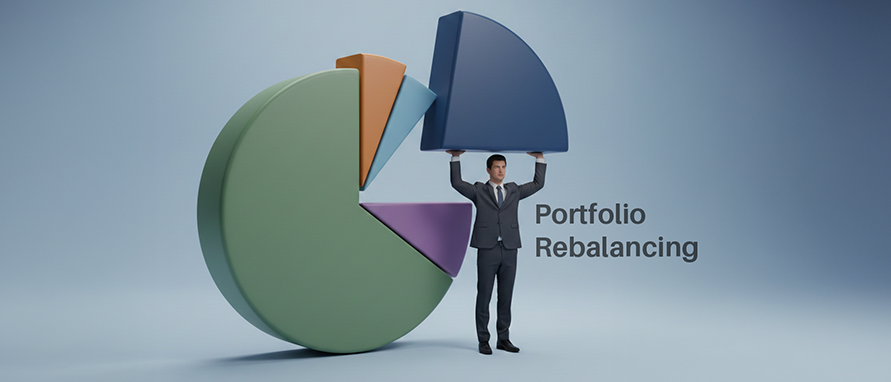
Learn how portfolio rebalancing works to discover why adjusting asset weights helps maintain risk and return alignment.
Portfolio rebalancing is one of the most important yet often overlooked aspects of successful long-term investing. While investors may select a particular combination of stocks, mutual funds, or other assets, the proportions within that mix can change over time due to market movements. Market movements can shift the weights of your investments, exposing you to more risk than intended—or reducing your return potential. Rebalancing adjusts the portfolio when market movements cause asset proportions to deviate from the previously determined allocation.
Portfolio rebalancing is the process of adjusting your investment allocation back to your preferred or target mix. Every investor sets an asset allocation based on risk profile—for example, 60% equity and 40% debt. Over time, market fluctuations cause these proportions to change. Rebalancing helps bring the portfolio back to the original percentage targets.
For instance, if the equity market rises sharply, your 60% equity allocation may turn into 70%. Rebalancing would involve selling some equity and reallocating that amount to debt, restoring the portfolio to 60:40.
Rebalancing adjusts the portfolio to maintain the originally defined asset allocation as market conditions change.
In simple terms, portfolio rebalancing means “resetting” your investment mix back to your desired allocation.
It follows a straightforward idea:
Different assets grow at different speeds
These shifts may increase or decrease your overall risk
Rebalancing helps you manage risk and maintain discipline
It is not about timing the market or predicting returns. Instead, it works like a thermostat—automatically correcting fluctuations and keeping your financial strategy on track.
Rebalancing also helps prevent emotional decision-making. Without rebalancing, investors may let winning assets overweight their portfolio or panic-sell during downturns.
Rebalancing offers several advantages:
Maintains Your Risk Profile: Prevents unintentional risk-taking as fast-growing assets increase in weight.
Ensures Strategic Discipline: Encourages systematic investing rather than reacting to market noise.
Locks In Profits: Selling overweight assets helps capture gains before markets reverse.
Manages Volatility: A balanced asset mix can help maintain the proportions of different assets over time.
Supports Long-Term Goals: Keeps your investments aligned with financial targets like retirement, house purchase, or wealth creation.
Reduces Behavioral Biases: Avoids overconfidence, fear, and greed-driven decisions.
Regular rebalancing is especially beneficial for conservative investors or those nearing financial milestones.
Rebalancing can be done manually or automatically, depending on your investment structure.
The general process includes:
A portfolio’s allocation may include different proportions of equities, debt, gold, real estate, and other assets
Measure the updated allocation after market movements.
Example:
Target: 60% equity
Current: 75% equity
To rebalance, you may:
Sell part of the overweight asset (equity)
Buy more of the underweight asset (debt)
Common methods include:
Periodic Rebalancing: Every 6 or 12 months
Threshold Rebalancing: When asset weight moves beyond a set limit (e.g., ±5%)
Hybrid Method: Combination of time and threshold
Evaluate whether the benefits outweigh transaction costs or capital gains tax.
If equity grows from 60% to 70% in a ₹10 lakh portfolio, the investor needs to sell ₹1 lakh of equity and move it to debt to restore 60:40.
While beneficial, portfolio rebalancing has some limitations:
Tax Impact: Selling assets may trigger capital gains tax.
Transaction Costs: Brokerage fees or exit loads may reduce returns.
Opportunity Cost: Selling high-performing assets may reduce short-term gains.
Strict Discipline Required: Investors may hesitate to sell “winners.”
Not Always Needed: Too frequent rebalancing may lead to unnecessary trading.
Market Timing Misconception: Rebalancing is not designed to beat the market; it's for risk control.
Balancing these drawbacks with the long-term advantages is essential.
Portfolio rebalancing plays a key role in long-term wealth building. It helps maintain the intended risk level, supports strategic discipline, and promotes steady growth. Although it may involve taxes and costs, the stability and alignment it brings to investment goals make it an essential practice. The selection of a rebalancing method, whether periodic, threshold-based, or hybrid, affects the timing and frequency of portfolio adjustments.
Main Highlights:
Maintains the desired risk level over time
Supports long-term discipline and consistency
Helps reduce volatility and improve stability
May involve costs, but benefits often outweigh them
Effectiveness depends on how it aligns with the overall approach being used.
This content is for informational purposes only and the same should not be construed as investment advice. Bajaj Finserv Direct Limited shall not be liable or responsible for any investment decision that you may take based on this content.
A typical example is when a portfolio targeted at 60% equity and 40% debt shifts to 75% equity due to market gains. Rebalancing involves selling part of the equity portion and allocating the proceeds to debt to restore the intended 60:40 allocation.
Rebalancing helps manage risk, maintains long-term allocation discipline, captures gains from outperforming assets, and supports more stable and predictable investment behaviour over time.
Rebalancing may create taxable events when assets are sold, leading to short-term or long-term capital gains tax depending on the holding period and the nature of the investment.
Rebalancing may be conducted periodically, such as once or twice a year, or when asset weights deviate from the originally determined allocation, for example by 5–10%.
.jpeg)












 Academy



.jpeg "image not found")