Our Products
 Loans
Loans
 Cards
Cards
 Insurance
 Investment
 Stock Market
 Electronics Mall
 CIBIL Score
 Knowledge Centre
 Calculators
Our Services

 Do not call
 En
En
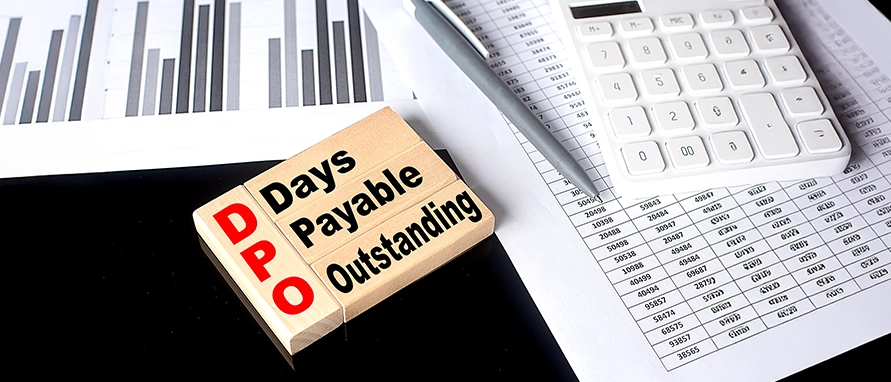
Learn how Days Payable Outstanding measures the average time a company takes to pay suppliers and what it reveals about cash flow efficiency.
Days Payable Outstanding (DPO) indicates how long a company takes to pay its suppliers after receiving goods or services. It reflects the firm’s payment practices and cash flow management. A suitable DPO level can support liquidity without straining supplier relationships.
Days Payable Outstanding (DPO) indicates the average number of days a company takes to pay its bills and invoices after receiving goods or services. It shows how effectively a business manages its accounts payable and cash outflows.
A higher DPO suggests the company is taking longer to pay suppliers — potentially conserving cash — while a lower DPO indicates faster payments, which may strengthen supplier relationships but reduce liquidity.
The basic formula to calculate Days Payable Outstanding is:
DPO = (Average Accounts Payable ÷ Cost of Goods Sold) × Number of Days
Average Accounts Payable = (Opening A/P + Closing A/P) ÷ 2
COGS = Total cost of goods sold during the period
Number of Days = Days in the accounting period (usually 365 or 90 for quarterly analysis)
If a company has:
Opening Accounts Payable = ₹4,00,000
Closing Accounts Payable = ₹6,00,000
Cost of Goods Sold = ₹36,00,000
Period = 365 days
Then,
Average A/P = (₹4,00,000 + ₹6,00,000) ÷ 2 = ₹5,00,000
DPO = (₹5,00,000 ÷ ₹36,00,000) × 365 = 50.7 days
This means the company takes about 51 days on average to pay its suppliers.
Using average accounts payable ensures accuracy by factoring in changes in payables over time. It smooths out short-term fluctuations and reflects consistent payment trends across the financial period.
Some analysts use a daily version of the formula for quick analysis:
DPO = Average Accounts Payable ÷ (COGS ÷ Number of Days)
This approach divides daily cost of goods sold into average payables to estimate the number of days payable remain outstanding.
Identify accounts payable balances: Gather opening and closing payables from the balance sheet.
Compute average payables: Add the two and divide by 2.
Find COGS: Extract the total cost of goods sold from the income statement.
Apply the formula: Use DPO = (Average A/P ÷ COGS) × Number of Days.
Interpret results: Compare with industry benchmarks to gauge efficiency.
Regularly tracking DPO could help identify liquidity trends and optimise supplier payment terms.
Average DPO represents the mean time taken to settle obligations over multiple accounting periods.
It’s particularly useful for evaluating long-term cash management practices and monitoring improvements in working capital efficiency.
For example, a reduction in DPO over several quarters may indicate tighter cash flow or stricter supplier terms, whereas an increase might suggest deliberate payment deferral to preserve liquidity.
Interpreting DPO effectively requires context — a high or low value isn’t inherently good or bad.
Indicates delayed payments and improved short-term liquidity.
May strain supplier relationships if excessive.
Reflects prompt payments and strong supplier goodwill.
May reduce available cash for operations.
Here’s how payment timelines differ across sectors, influenced by industry practices, supplier relationships, and cash flow dynamics.
| Industry | Average DPO (Days) | Notes |
|---|---|---|
Retail |
35–50 |
Short cycles; frequent purchases |
Manufacturing |
50–70 |
Dependent on credit terms and volume |
Technology / SaaS |
30–45 |
Low inventory levels, quick cash turnover |
Automotive |
60–90 |
Long supply chain and bulk contracts |
FMCG / Consumer Goods |
40–60 |
Driven by supplier credit policies |
While DPO is insightful, it should not be analysed in isolation.
Limitations include:
It may not reflect differences in supplier payment terms.
Seasonal fluctuations can distort averages.
A high DPO might signal liquidity stress rather than efficiency.
It doesn’t account for discounts lost due to delayed payments.
For a clearer picture, combine DPO analysis with Days Sales Outstanding (DSO) and Days Inventory Outstanding (DIO) to compute the Cash Conversion Cycle (CCC).
The Days Payable Outstanding (DPO) metric helps businesses understand how efficiently they manage payables and cash flow.
Maintaining an appropriate balance helps support supplier relations while preserving liquidity.
Key Takeaways:
DPO measures the average time taken to pay suppliers.
The formula: (Average A/P ÷ COGS) × Number of Days.
A high DPO improves liquidity but may affect credit terms.
Benchmarking against industry peers provides clearer context.
Appropriate DPO levels align with both operational needs and supplier expectations.
This content is for informational purposes only and the same should not be construed as investment advice. Bajaj Finserv Direct Limited shall not be liable or responsible for any investment decision that you may take based on this content.
Days Payable Outstanding (DPO) is calculated using the formula (Average Accounts Payable ÷ Cost of Goods Sold) × Number of Days. It measures the average time a company takes to pay its suppliers after receiving goods or services.
The DPO formula reflects the relationship between accounts payable, cost of goods sold, and the time period being assessed. It indicates how efficiently a business manages its short-term obligations and cash outflows to suppliers.
DPO varies widely across sectors depending on operating models and supply chain structures. Manufacturing and capital-intensive industries often record higher DPOs due to longer production cycles and larger purchase volumes, whereas service-based companies generally maintain shorter payment periods.
DPO has limitations as it does not account for variations in supplier terms, early payment discounts, or negotiated credit conditions. Relying solely on DPO can overlook liquidity nuances and operational risks linked to payment practices.
.jpeg)












 Academy


.jpeg "image not found")