Our Products
 Loans
Loans
 Cards
Cards
 Insurance
 Investment
 Stock Market
 Electronics Mall
 CIBIL Score
 Knowledge Centre
 Calculators
Our Services

 Do not call
 En
En
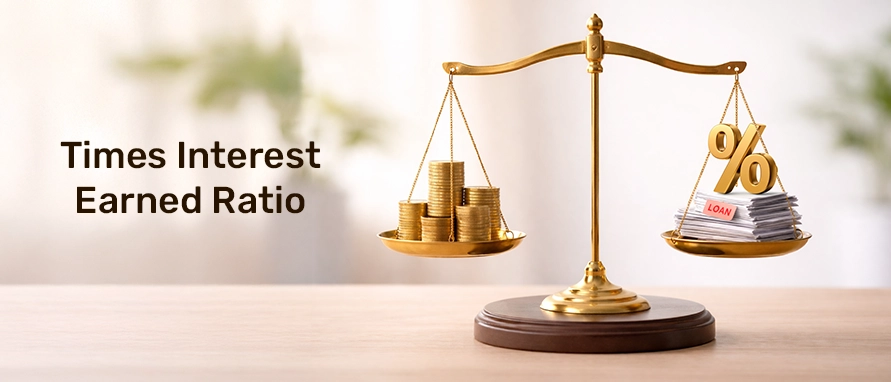
The times interest earned ratio explains how comfortably a company can meet its interest obligations using operating earnings and how the metric is calculated.
The times interest earned ratio is a financial metric used to measure how comfortably a company can pay its interest expenses on outstanding debt. By comparing operating income with interest payments, this ratio helps analysts assess whether a business generates sufficient earnings to cover its borrowing costs. It is commonly used by investors, lenders, and financial analysts to evaluate a company’s financial stability and debt servicing capacity.
The times interest earned ratio, often abbreviated as TIE, measures a company’s ability to meet interest payments using its earnings before interest and taxes (EBIT). It indicates how many times a company’s operating profit can cover its interest obligations during a specific period.
This ratio highlights the relationship between a company’s earnings and the cost of its debt. A higher ratio typically indicates that a company generates sufficient operating income to cover its interest payments.
In practical terms, the ratio answers a simple question: how many times can the company pay its interest expense using its operating earnings.
Financial analysts and lenders often monitor this metric when evaluating a firm’s creditworthiness and financial strength. It also helps businesses understand whether their debt levels remain manageable relative to earnings.
The times interest earned ratio plays an important role in financial analysis because it provides insight into a company’s ability to manage its debt obligations. Lenders and investors use this metric to determine whether a company can comfortably meet its interest payments without facing financial stress.
A company with a higher ratio generally has stronger earnings relative to its interest costs, which may indicate lower financial risk. Conversely, a lower ratio may signal that a firm could struggle to meet its debt obligations if earnings decline.
The significance of this ratio for different stakeholders is illustrated below
| Stakeholder | Why It Matters |
|---|---|
Lenders |
Helps evaluate whether the borrower can service interest payments on loansInvestors |
Investors |
Indicates financial stability and the company’s ability to manage leverage |
Credit Analysts |
Assists in assessing default risk and creditworthiness |
Business Management |
Helps determine whether current debt levels are sustainable |
By analysing this ratio alongside other financial metrics, stakeholders can gain a clearer view of the company’s financial health.
The times interest earned ratio is calculated using operating earnings and interest expenses.
The formula is expressed as:
Times Interest Earned Ratio = Earnings Before Interest and Taxes (EBIT) ÷ Interest Expense
The calculation generally involves the following steps:
Identify the company’s EBIT from the income statement.
Determine the total interest expense for the same period.
Divide EBIT by the interest expense.
The resulting figure indicates how many times the company can cover its interest payments using its operating earnings.
The times interest earned ratio provides insight into a company’s financial strength and its ability to manage debt.
A higher ratio generally indicates that the company generates enough operating income to comfortably meet its interest obligations. This suggests lower financial risk and stronger financial stability.
A lower ratio may indicate that the company’s earnings are only slightly higher than its interest expenses. In such situations, even a small decline in revenue or profit could make it difficult to service debt payments.
In general terms:
A high ratio suggests strong interest coverage and lower risk.
A moderate ratio indicates adequate ability to meet interest obligations.
A low ratio may signal potential financial pressure or higher credit risk.
However, the interpretation of the ratio often depends on industry standards and the company’s overall financial structure.
Consider a company with the following financial data for a given year:
Earnings Before Interest and Taxes (EBIT): ₹12,00,000
Interest Expense: ₹3,00,000
The calculation would be as follows:
Times Interest Earned Ratio = ₹12,00,000 ÷ ₹3,00,000 = 4
Consider the same illustrated in the following table:
| Financial Component | Amount |
|---|---|
Earnings Before Interest and Taxes (EBIT) |
₹12,00,000 |
Interest Expense |
₹3,00,000 |
Times Interest Earned Ratio |
4 |
This means the company earns four times the amount required to cover its annual interest payments.
Interpretation of the result:
The company’s operating income covers interest payments four times.
This suggests that the firm has sufficient earnings to service its debt obligations.
Analysts often compare this ratio with industry averages to evaluate whether the coverage level is considered strong or weak within the sector.
For investors, the times interest earned ratio provides valuable insight into a company’s financial stability and risk profile.
It helps investors understand whether the company generates enough earnings to meet its debt obligations without compromising operational performance.
The following table highlights key benefits of this ratio for investors.
| Benefit | Explanation |
|---|---|
Assess Financial Stability |
Indicates how comfortably a company can pay interest on its debt |
Evaluate Debt Risk |
Helps identify firms with potentially high financial leverage |
Compare Companies |
Enables comparison of debt coverage across companies in the same sector |
Understand Earnings Strength |
Shows whether operating income is sufficient to meet fixed obligations |
Investors often analyse this ratio alongside profitability and liquidity metrics to form a broader understanding of the company’s financial health.
Like any financial metric, the times interest earned ratio has both advantages and limitations.
Advantages:
Provides a simple measure of a company’s ability to service debt
Helps lenders evaluate credit risk
Useful for comparing companies with similar financial structures
Easy to calculate using information from financial statements
Limitations:
Focuses only on interest obligations and ignores principal repayments
Does not account for cash flow timing differences
May vary significantly across industries
Can be affected by accounting adjustments or one-time earnings
Therefore, analysts typically use this ratio alongside other financial indicators for a more comprehensive assessment.
The times interest earned ratio and the interest coverage ratio are closely related financial metrics. In many cases, the two terms are used interchangeably.
Both ratios measure a company’s ability to pay interest expenses using operating income. They evaluate how comfortably a company’s earnings can cover its borrowing costs.
However, slight differences may arise depending on how analysts define the numerator.
In most traditional calculations:
Times Interest Earned Ratio uses EBIT.
Interest Coverage Ratio may sometimes use EBITDA or operating profit depending on the analytical approach.
Despite these variations, the primary objective remains the same—assessing whether the company generates enough income to service its debt obligations.
Several internal and external factors can influence the times interest earned ratio.
Key factors include:
Operating Profit Changes: Higher EBIT improves the ratio, while declining profits reduce it.
Interest Rate Fluctuations: Rising borrowing costs increase interest expenses and lower the ratio.
Debt Levels: Companies with higher debt typically have larger interest obligations.
Economic Conditions: Economic slowdowns may reduce earnings and affect interest coverage.
Business Efficiency: Improved operational efficiency can increase earnings and strengthen the ratio.
These factors may influence changes in the ratio over time.
The times interest earned ratio helps explain how comfortably a company’s operating earnings can cover its interest expenses. By comparing EBIT with interest obligations, the ratio provides insight into a company’s debt servicing capacity and financial stability. When analysed along with other financial metrics and industry benchmarks, it contributes to a broader understanding of a company’s financial position.
This content is for informational purposes only and the same should not be construed as investment advice. Bajaj Finserv Direct Limited shall not be liable or responsible for any investment decision that you may take based on this content.
A times interest earned ratio of 2.5 means that the company’s operating earnings are 2.5 times greater than its interest expenses. This indicates that the company can cover its interest obligations two and a half times using its operating income.
A ratio below 1 indicates that the company’s operating earnings are insufficient to cover its interest expenses. In such cases, the company may need to use reserves, sell assets, or obtain additional financing to meet its debt obligations.
The times interest earned ratio and the interest coverage ratio are often used interchangeably because both measure a company’s ability to meet interest payments. However, the exact calculation may vary depending on whether EBIT or EBITDA is used.
The times interest earned ratio is commonly used by investors, lenders, and credit analysts to assess a company’s financial stability and its ability to service debt. It is also used internally by companies when evaluating financing decisions.
Yes, the ratio can be negative if a company’s earnings before interest and taxes are negative. This situation indicates that the company is operating at a loss and may struggle to meet its interest obligations.
.jpeg)












 Academy



.jpeg "image not found")