Our Products
 Loans
Loans
 Cards
Cards
 Insurance
 Investment
 Stock Market
 Electronics Mall
 CIBIL Score
 Knowledge Centre
 Calculators
Our Services

 Do not call
 En
En
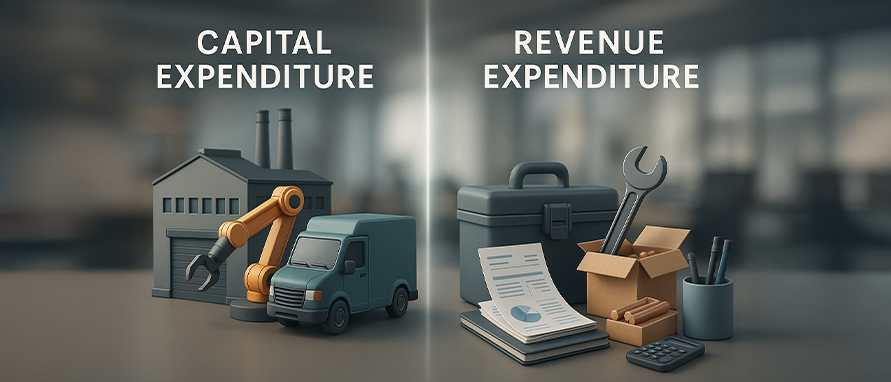
An overview of how capital and revenue expenditure are classified based on asset creation, accounting treatment, and duration of economic benefit.
In accounting and financial management, expenses are categorised to reflect how business spending affects assets, profitability, and financial position over time. Capital expenditure (CapEx) and revenue expenditure (RevEx) represent two distinct classifications that influence balance sheets and income statements differently.
Accurate classification supports consistent financial reporting and clearer interpretation of operating performance, cash flows, and asset values.
Capital expenditure refers to spending undertaken to acquire, upgrade, or extend the useful life of long-term assets that provide economic benefits across multiple accounting periods.
Such expenditure is capitalised on the balance sheet and allocated over time through depreciation or amortisation.
Represents high-value, long-term investment
Associated with asset creation or capacity enhancement
Benefits extend beyond one financial year
Typically non-recurring in nature
Recorded as an asset rather than an expense
Expensed gradually through depreciation
Capital expenditure is generally linked to asset development and long-term operational capability.
Revenue Expenditure refers to routine business spending that supports ongoing operations and preserves existing assets. These costs deliver short-term benefits and are recorded directly in the Profit & Loss statement within the same accounting period, rather than being capitalised on the balance sheet.
Unlike capital expenditure, revenue expenditure does not create new assets or extend the useful life of current ones. Instead, it reflects the operational costs required to sustain a company’s day-to-day functioning and earning capacity.
Associated with regular business activities
Provides benefits within the same financial year
Typically recurring in nature
Charged fully to the Profit & Loss statement
Does not increase the value of fixed assets
Supports maintenance of existing operational capacity
Revenue expenditure represents the ongoing costs of running a business and maintaining operational continuity.
The table below presents a consolidated comparison of capital and revenue expenditure based on purpose, asset impact, accounting treatment, and duration of benefit:
| Basis | Capital Expenditure (CapEx) | Revenue Expenditure (RevEx) |
|---|---|---|
Purpose |
Acquisition or improvement of long-term assets |
Day-to-day operational expenses |
Duration of Benefit |
Extends beyond one accounting period |
Limited to the current accounting period |
Asset Impact |
Creates or enhances fixed assets |
Does not create or enhance assets |
Frequency |
Typically incurred periodically |
Generally occurs on a regular basis |
Accounting Treatment |
Capitalised and depreciated over useful life |
Charged directly to the Profit & Loss account |
Financial Statement Impact |
Reflected on the Balance Sheet and over time via depreciation |
Recognised in the Profit & Loss account in the same period |
Impact on Profit |
Spread across periods through depreciation |
Fully recognised in the current period |
Examples |
Plant, buildings, machinery |
Rent, salaries, repairs |
The examples below illustrate how business spending is typically classified based on asset creation, duration of benefit, and accounting treatment.
Common instances of Capital Expenditure include:
Purchase of a new delivery truck
Construction of a warehouse or factory building
Installation of solar panels on office premises
Acquisition of patents or licences
Major machinery upgrades that extend asset life or improve capacity
These expenses are recorded as a fixed asset on the balance sheet and allocated over time through depreciation or amortisation.
Typical Revenue Expenditure items include:
Fuel costs for delivery vehicles
Routine machinery repairs
Electricity and water bills
Employee training expenses
Regular software subscription renewals
Such costs are recognised directly in the P&L statement in the period they are incurred, as they support ongoing operations without creating long-term assets.
The table below outlines how similar expenses receive different accounting treatment:
| Transaction | Classification | Accounting Treatment |
|---|---|---|
Machinery purchased for ₹10,00,000 |
Capital Expenditure |
Recorded as a fixed asset; annual depreciation applied |
Monthly machinery servicing of ₹15,000 |
Revenue Expenditure |
Charged directly to the P&L as an operating expense |
This distinction reflects whether the spending creates long-term value or supports routine business activity.
Capital and revenue expenditure serve distinct purposes within business operations and accounting frameworks, influencing both asset development and day-to-day functioning, which ultimately affects a shareholder’s interest in the company.
Capital Expenditure is typically associated with:
Expansion or acquisition of long-term assets
Replacement of obsolete or non-functional assets
Introduction of new machinery or technology
Improvements that extend an asset’s useful life
Revenue Expenditure generally relates to:
Routine operational activities
Maintenance of existing assets
Administrative and selling expenses
Contractual and compliance-related costs
These classifications reflect whether spending contributes to asset creation or supports ongoing operations.
Capital and revenue expenditure affect multiple areas of financial reporting and analysis:
Budget Classification: Organisations usually allocate separate provisions for long-term asset spending and recurring operational expenses.
Profit Recognition: Capital expenditure is recognised over time through depreciation, while revenue expenditure is recorded in the current accounting period.
Tax Treatment: Capital expenditure is typically deductible through depreciation, whereas revenue expenditure is generally allowable as an expense in the same financial year, subject to applicable tax rules.
Cash Flow Presentation: Capital expenditure appears under investing activities, while revenue expenditure forms part of operating cash flows.
Financial Analysis: Expense classification influences reported profitability, asset values, and performance ratios used in financial evaluation.
Organisations may encounter classification inconsistencies such as:
Recording routine repairs as capital expenditure
Capitalising low-value or recurring purchases
Treating all upgrades as capital expenditure without assessing asset life impact
Misclassifying major overhauls
Expensing items that materially extend asset usefulness
Incomplete or missing documentation
Such misclassifications can affect reported profits, asset values, and tax calculations.
Capital expenditure and revenue expenditure represent two distinct accounting classifications. Capital expenditure relates to the acquisition or enhancement of long-term assets, while revenue expenditure covers routine operational and maintenance costs.
This content is for informational purposes only and the same should not be construed as investment advice. Bajaj Finserv Direct Limited shall not be liable or responsible for any investment decision that you may take based on this content.
Capital expenditure refers to spending on assets that provide economic benefits over more than one accounting period. Such expenditure is recorded as an asset in the books and is depreciated over its useful life.
Revenue expenditure refers to expenses incurred for routine business operations and asset maintenance. These costs are recognised in the profit and loss account during the period in which they occur.
Capital expenditure relates to the acquisition or improvement of long-term assets and is reflected on the balance sheet. Revenue expenditure relates to operational expenses and is charged directly to the income statement.
Examples of capital expenditure include purchases of machinery, buildings, and vehicles. Revenue expenditure includes rent, salaries, utilities, repairs, and regular maintenance costs.
Revenue expenditure is recorded to account for operational costs incurred during an accounting period and to reflect accurate profit or loss for that period.
CapEx relates to spending on long-term assets, while RevEx covers routine operating costs incurred within the same accounting period.
CapEx is recorded as an asset on the balance sheet and expensed over time through depreciation, whereas RevEx is charged directly to the Profit & Loss statement.
Yes. CapEx is typically deducted gradually through depreciation, while RevEx is generally deductible in full in the year it is incurred, subject to applicable tax rules.
.jpeg)












 Academy



.jpeg "image not found")