Our Products
 Loans
Loans
 Cards
Cards
 Insurance
 Investment
 Stock Market
 Electronics Mall
 CIBIL Score
 Knowledge Centre
 Calculators
Our Services

 Do not call
 En
En
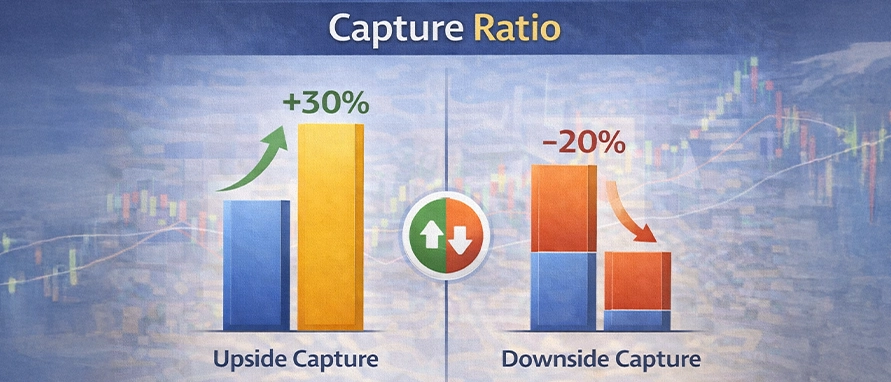
Understand what the capture ratio indicates, how it is used to compare returns with a benchmark, and how it is interpreted across different market phases.
The capture ratio is a performance comparison metric that looks at how returns move in relation to a selected benchmark over time. It is often discussed in the context of changing market conditions, where return patterns may differ between periods of growth and decline. This helps frame relative performance without focusing on standalone return figures.
The capture ratio measures how well an investment performs compared to its benchmark index during both bullish and bearish market conditions. It is essentially the ratio of an investment's return to that of the index during specific market conditions. An upside capture ratio over 100% indicates that the investment is outperforming the market during a rally, while a downside capture ratio below 100% shows that the investment is losing less in a market downturn.
Capture ratio helps investors understand how an investment reacts to market movements. It shows the relationship between the returns of an investment and the benchmark’s returns during both positive and negative market movements. Essentially, it shows how the investment performs relative to the market in both rising and falling conditions.
The capture ratio is generally divided into two types:
Upside Capture Ratio: This ratio measures how well an investment performs in rising markets. A higher upside capture ratio indicates the investment captures more of the market value’s positive movements, potentially increasing the investment’s intrinsic value over time.
Downside Capture Ratio: This measures how well an investment holds up during market declines. A lower downside capture ratio suggests that the investment has smaller losses during market drops.
The upside capture ratio helps gauge performance when the market is on the rise. If the ratio is greater than 100%, it means the investment is outperforming the market during an uptrend. For example, if the market rises by 10% and the investment rises by 12%, the upside capture ratio would be 120%.
The downside capture ratio measures performance in market downturns. A ratio less than 100% indicates that the investment has incurred smaller losses compared to the market value of the benchmark. For instance, if the market falls by 10% and the investment drops by only 7%, the downside capture ratio would be 70%.
Here are the key aspects to consider when interpreting capture ratio figures in performance analysis:
Time Period: The capture ratio is typically calculated over a specific period, such as one year or five years, and may vary based on the time chosen.
Comparison with Benchmark: It’s important to compare the investment against an appropriate benchmark index. The benchmark must be relevant to the type of asset being evaluated.
Limitations: While the capture ratio offers insights into performance, it doesn’t reflect the overall risk or volatility of the investment.
The points below outline common observations about how capture ratio is used in performance evaluation:
Performance Comparison: Provides a straightforward comparison of how an investment tracks market movements, particularly in terms of upside and downside volatility.
Helps in Risk Management: Analysing both upside and downside capture ratios provides insight into the investment’s responsiveness to market fluctuations.
Does Not Account for Volatility: Capture ratio doesn’t provide insights into the volatility or overall risk of the investment.
Short-Term View: The capture ratio reflects only short-term performance and might not accurately represent an investment's long-term prospects.
The capture ratio is used to describe how an investment’s returns move in relation to a benchmark during different market conditions. It focuses on comparative return behaviour rather than absolute performance or overall risk. This makes it useful for analysing relative movement across market phases within a defined time period.
This content is for informational purposes only and the same should not be construed as investment advice. Bajaj Finserv Direct Limited shall not be liable or responsible for any investment decision that you may take based on this content.
The upside capture ratio measures how an investment performs during periods when the benchmark market is rising. A ratio above 100% indicates the investment has captured more upside than the benchmark during positive market phases.
The capture ratio is calculated by dividing an investment’s average return during specific market phases by the benchmark’s average return during the same phases, then multiplying by 100. It is calculated separately for upside and downside periods.
The upside capture ratio measures performance during rising markets, while the downside capture ratio measures performance during falling markets. Together, they show how an investment behaves across different market conditions and levels of volatility.
.jpeg)













 Academy


.jpeg "image not found")