Our Products
 Loans
Loans
 Cards
Cards
 Insurance
 Investment
 Stock Market
 Electronics Mall
 CIBIL Score
 Knowledge Centre
 Calculators
Our Services

 Do not call
 En
En
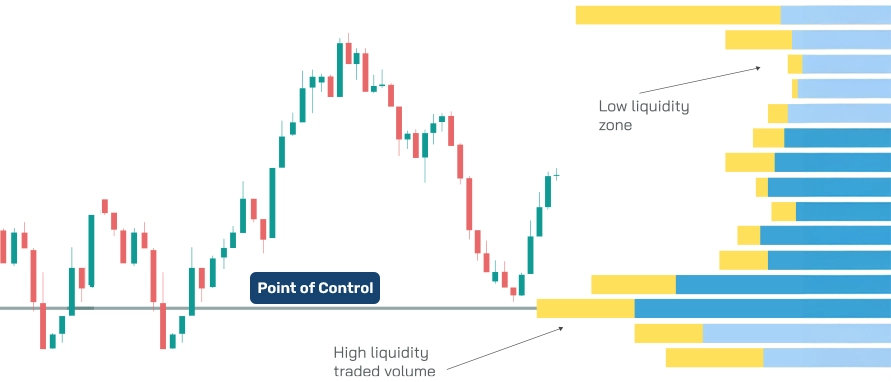
The Point of Control (POC) is a concept derived from volume profile analysis and refers to the price level at which the highest volume of transactions occurred during a defined period. It is commonly referenced in market analysis to understand where trading activity was most concentrated within a session.
POC represents the price level with the greatest accumulated traded volume over a selected timeframe. On volume profile charts, it is typically displayed as the longest horizontal bar or a highlighted line.Rather than indicating direction, POC reflects an area of high participation where buyers and sellers were most active, offering insight into how price and volume interacted during that period.
The Point of Control (POC) is derived from volume profile data and represents the price level where trading activity is most concentrated during a selected period. Rather than focusing on time-based candles, this calculation examines how volume is distributed across individual price levels.
The process typically involves:
Volume mapping: Trading volume is plotted against each price level for the chosen session or range using a volume profile.
Identification of peak activity: The price level showing the highest aggregated volume is identified.
POC marking: This level is highlighted on the chart, usually as a horizontal line or the longest bar within the volume profile.
Modern charting platforms automatically perform this calculation as part of their volume profile tools, making the POC visible without manual computation.
In summary: the POC is simply the price where the greatest amount of volume has traded over a defined period, offering a volume-based reference point for understanding where market participation has been most concentrated.
Within volume profile analysis, the Point of Control represents the price level where the highest level of trading activity occurred over a defined period. Conceptually, it reflects where market participants have historically concentrated their transactions.
Key conceptual aspects associated with the POC include:
Price revisitation tendency: Price may return to the POC at times, reflecting its role as a high-volume reference area within the profile.
Participation concentration: Elevated volume around the POC indicates zones of intensified buying and selling, pointing to periods of broad market involvement.
Relationship to price structure: Depending on surrounding price action, the POC may align with areas where prior reactions occurred, helping describe shifts in balance within the range.
Market balance context: The placement of the POC relative to the session range offers insight into whether activity has been skewed toward higher or lower prices, supporting interpretation of acceptance and distribution.
Taken together, the Point of Control functions as a conceptual volume anchor that contextualises where trading interest has been most concentrated, helping frame historical price acceptance within a given period.
The Point of Control serves as a volume-based reference within a market profile, indicating the price level where trading activity has been most concentrated during a selected period. Because it is derived from traded volume rather than elapsed time, POC adds structural context to price behaviour and participation patterns.
Common analytical characteristics associated with POC include:
Identifies peak volume levels: POC marks the price where the highest volume occurred, highlighting areas of maximum interaction between buyers and sellers.
Represents a central value reference: As the most actively traded price, POC is often used to describe where market activity has been most accepted within the timeframe.
Adds context to market structure: The location of POC within the overall range helps illustrate whether volume is clustered near highs, lows, or the midpoint, offering perspective on distribution.
Tracks shifts in participation: Movement of the POC over time reflects changes in where volume is concentrating, indicating evolving areas of market engagement.
Integrates with volume profile components: POC is commonly examined alongside value areas and volume distributions to support broader analysis of price acceptance.
Collectively, these attributes position POC as a descriptive volume reference for understanding concentration and acceptance within a market profile, rather than as a directional signal.
Within volume profile analysis, the Point of Control functions as a structural reference that highlights where trading activity has been most concentrated during a defined period. It is examined alongside value area boundaries and overall volume distribution to understand how participation is organised across price levels.
Analysts often review the position of the POC relative to the broader profile to observe whether volume concentration and market value are shifting higher, lower, or remaining centred within the range. Changes in POC location across sessions reflect how areas of activity evolve over time, offering insight into market structure rather than directional movement.
In practice, POC is treated as one component of a wider volume-based framework, contributing to descriptive analysis of price acceptance and distribution patterns when evaluated together with other profile metrics.
Within technical analysis, POC is discussed as a descriptive reference point for observing price behaviour around areas of historically concentrated volume. Common analytical contexts include:
Pullback observation: Price returning to a prior POC after moving away from it
Rejection zones: Instances where price moves away from the POC with accompanying volume changes
Structural reference: Areas where price previously consolidated around high-volume levels
Value migration: Shifts in POC location that reflect changing volume concentration across sessions
These references focus on interpreting volume distribution rather than establishing directional expectations.
The position of POC within the broader value area (often defined as the range containing roughly 70% of traded volume) is sometimes used to describe market balance:
Lower value-area POC: Indicates heavier participation closer to session lows
Upper value-area POC: Reflects greater activity near session highs
Central POC: Suggests relatively balanced participation
This framework is used to assess whether price acceptance is skewed toward higher, lower, or central levels within the observed range.
Although POC highlights areas of concentrated volume, it does not independently explain price direction or momentum. Common limitations include:
Price may remain near the POC during range-bound conditions without clear continuation
Repeated interaction with POC does not necessarily imply reversal or breakout
Volume concentration does not account for broader structural or volatility conditions Interpretation typically depends on alignment with other analytical inputs
POC therefore represents a contextual volume marker rather than a standalone analytical measure.
Assume an index recorded a POC near ₹22,000 in a prior session. If price later trades above this level and subsequently revisits it, analysts may observe how volume and price behaviour develop around that zone.
Reactions near the previous POC can provide insight into whether participation remains concentrated there or is shifting elsewhere. Any subsequent movement is interpreted in relation to evolving volume distribution rather than attributed solely to the POC level.
This example illustrates how POC may be referenced to study price interaction with historical volume concentration.
The Point of Control functions as a volume-based reference that highlights where trading activity was most concentrated over a given period. Its value lies in supporting broader market structure analysis by identifying areas of participation density. Interpreted alongside price behaviour and other volume metrics, POC contributes to understanding how markets distribute activity across price levels, rather than serving as a directional indicator on its own.
This content is for informational purposes only and the same should not be construed as investment advice. Bajaj Finserv Direct Limited shall not be liable or responsible for any investment decision that you may take based on this content.
POC is identified as the price level with the highest traded volume on a volume profile for a selected period.
It represents the price level where the highest volume of transactions occurred, indicating concentrated participation from both buyers and sellers.
POC placement within the value area is sometimes reviewed to describe where trading activity is concentrated, which may reflect balanced or skewed participation.
POC may remain near price during range-bound conditions, and volume concentration alone does not account for broader structure or volatility, which limits its standalone interpretive value.
The Point of Control is derived by identifying the price level with the highest total traded volume on a volume profile over a defined period.
.jpeg)












 Academy


.jpeg "image not found")