Our Products
 Loans
Loans
 Cards
Cards
 Insurance
 Investment
 Stock Market
 Electronics Mall
 CIBIL Score
 Knowledge Centre
 Calculators
Our Services

 Do not call
 En
En
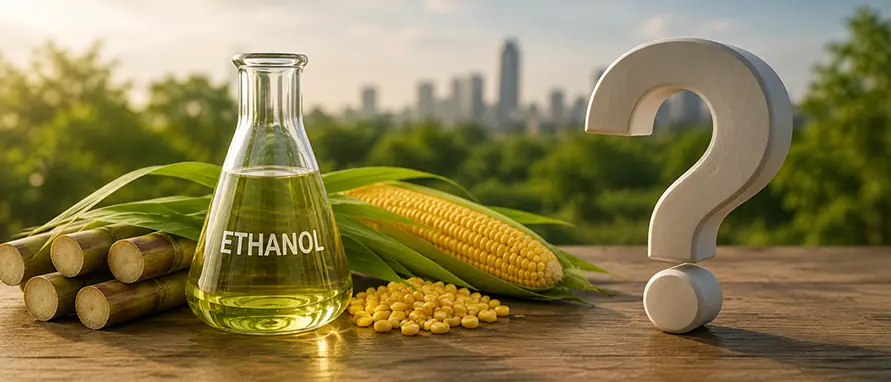
Table of Contents
Learn why India is promoting ethanol-blended petrol under the EBP Programme. Discover the benefits for farmers, crude oil savings, lower exhaust emissions, and the future of E20 fuel.
India’s energy strategy is undergoing a significant transformation driven by the Ethanol Blended Petrol (EBP) Programme. By integrating bio-ethanol into standard unleaded petrol, the nation is actively working to cut carbon emissions, enhance energy self-reliance, and support its agricultural sector.
Spearheaded by the Ministry of Petroleum and Natural Gas (MoPNG) alongside NITI Aayog, this initiative shifts reliance away from imported fossil fuels towards domestic, renewable energy sources. The strategy strengthens national energy security while redirecting capital into the domestic rural economy.
The Ethanol Blended Petrol (EBP) Programme is a national policy initiative designed to blend plant-derived bio-ethanol with conventional petrol. First introduced on a pilot basis in 2001 and formally structured in 2004, the programme gained substantial momentum following the release of the "Roadmap for Ethanol Blending in India 2020–25".
Bio-ethanol is produced from domestic feedstocks, primarily sugarcane, maize, and damaged food grains. Public Sector Oil Marketing Companies (OMCs), including Indian Oil Corporation Limited (IOCL), Bharat Petroleum Corporation Limited (BPCL), and Hindustan Petroleum Corporation Limited (HPCL), procure this fuel under long-term off-take agreements to supply blended petrol to retail outlets nationwide.
Initially, the National Policy on Biofuels set a target of achieving 20% ethanol blending (E20) by 2030. However, rapid infrastructure development and expanded distillation capacity enabled the Indian government to bring this deadline forward to the 2025–26 Ethanol Supply Year. Having progressed from an average blending rate of just 1.5% in 2014 to 10% in 2022, India successfully reached the nationwide 20% ethanol blending benchmark ahead of schedule.
India relies on imports for over 85% of its crude oil requirements, leaving its economy vulnerable to global price fluctuations and geopolitical disruptions. Promoting ethanol-blended petrol provides a practical mechanism to mitigate these vulnerabilities:
The programme delivers balanced advantages across environmental, economic, and social sectors:
Even with great progress, producing and using high amounts of ethanol fuel comes with a few practical challenges:
With the 20% nationwide blending target achieved, India’s policy focus is shifting toward consolidating fuel quality standards, expanding advanced biofuels, and introducing flex-fuel technologies:
India promotes ethanol-blended fuel to lower its dependence on imported crude oil, cut greenhouse gas emissions, conserve foreign exchange, and provide stable income sources for domestic farmers.
The EBP Programme is a national initiative managed by the Ministry of Petroleum and Natural Gas that mandates and facilitates the blending of bio-ethanol into conventional petrol across India.
Key benefits include significant reductions in carbon emissions, billions saved in crude oil import bills, improved engine anti-knock performance, and direct financial support for the agricultural sector.
Every litre of bio-ethanol blended into petrol directly replaces a corresponding volume of refined fossil fuel, reducing the total volume of unrefined crude oil India must import from overseas markets.
Ethanol production creates a guaranteed, price-supported market for crops like sugarcane, maize, and damaged grains, transferring funds directly into rural agricultural communities.
Yes. Ethanol contains inherent oxygen that promotes cleaner combustion, substantially reducing tailpipe emissions of carbon monoxide, particulate matter, and overall lifecycle greenhouse gases.
Primary challenges include managing water consumption for feedstock crops, preventing potential food-versus-fuel imbalances, upgrading distribution logistics, and managing minor vehicle mileage drops.
India set a national milestone of reaching 20% ethanol blending (E20) across all retail petrol outlets by the 2025–26 supply year.
E20 petrol (20% bio-ethanol and 80% petrol) was introduced as the primary nationwide retail fuel standard to maximize crude substitution and cut transport sector emissions.
No. Standard internal combustion vehicles use specified ethanol blends like E20. While specialized Flex-Fuel Vehicles can run on E85 or E100, petrol will remain a component of the national fuel mix alongside electric and hydrogen mobility solutions.


Most Viewed

Academy by Bajaj Markets

 47202
47202

Navigate the tax maze with ease! Uncover Income Tax 101, demystify jargon with Terms for Beginners, and choose between Old or New Regimes.
 165541
Unlock the world of credit! From picking the perfect card to savvy loan management, navigate wisely.
 97881
97881
Money Management and Financial Planning covers personal finance basics, setting goals, budgeting...
 28606
28606
Explore the investment cosmos! From beginner's guides to sharp-witted strategies, explore India's treasure trove of options.
 18764
18764
Discover essential insights on various types of insurance in India.
 4584
4584
Welcome to Tech in Finance, where we explore the exciting intersection of technology and finance...












 Academy