Our Products
 Loans
Loans
 Cards
Cards
 Insurance
 Investment
 Stock Market
 Electronics Mall
 CIBIL Score
 Knowledge Centre
 Calculators
Our Services

 Do not call
 En
En
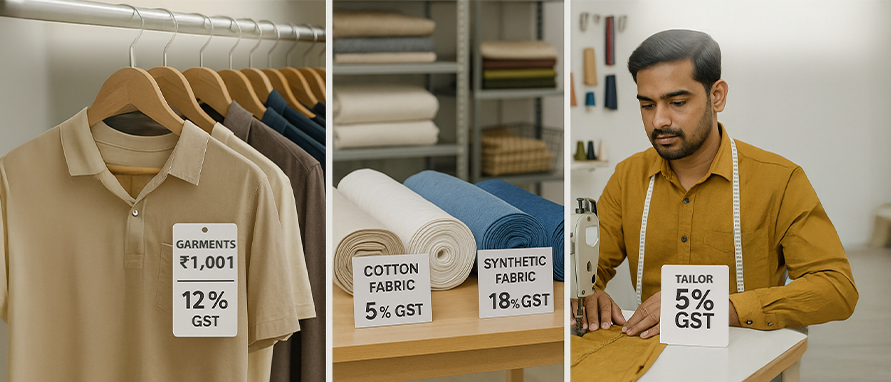
Like any other category of goods and services produced and subsequently consumed in India, clothes attract a specific percentage as GST. Additionally, the same varies as it depends upon the sub-category of clothing that the garment in question falls in as per the relevant documents released by the GST council. This article will essentially take you through the rates of GST on clothes as is announced by the officials representing the GST council.
The percentage rates that a particular customer is liable to honour as GST on clothes depend on a handful of factors. Those factors are the likes of the price point at which they are offered the same, the material it is made of, and whether or not the garment in question is hand-sewn or produced with the help of mechanical equipment, among others. Such diversification is attributable to the fact that the Indian industry is too extensive and diverse for it to be categorised under one single chapter. You will find below a table that contains the applicable GST rate on clothes based on the method of their production, the price tag that they are sold with, and the kind of material used in them.
As of September 2025, the GST on clothes in India is based on a two-slab system: a 5% rate applies to apparel priced up to ₹2,500 per piece, while clothes priced above ₹2,500 attract 18% GST. This updated structure aims to make affordable clothing cheaper while applying higher taxes to premium, luxury, or high-value garments.
Up to ₹2,500 per piece: 5% GST.
Above ₹2,500 per piece: 18% GST.
Tailoring Services: 5% GST.
Raw Cotton: 5% (under Reverse Charge Mechanism).
Raw Jute/Silk: Generally exempt.
Impact: The new rates aim to support the mid-price segment and provide relief to consumers buying affordable apparel.
Input Tax Credit (ITC): Registered businesses can claim ITC on GST paid for raw materials and stock.
The Indian apparel industry is the second-biggest industry that is operating on the grounds of India after agriculture. In addition to the same, on average, it has historically brought in anywhere between 10-14 percent of the total revenue earned from the export of Indian goods. Before the introduction of GST, the apparel sector was widely unorganised, which did not allow the government to earn a potentially substantial amount as tax revenues from the sector in question. With the introduction of the GST on clothes and similar fabric-based products, the government plans on changing that narrative and simultaneously facilitate the growth of the Garments industry.
It must be noted that the rates of GST on clothes and other products made out of fabrics are always subject to revision and even complete removal, depending upon the circumstances in which the industry and/or the Indian economy is at large. Additionally, one must note that the articles which are either exempt or attract 0% as GST can be assigned a definitive GST rate at any given point in time. One can learn more about the impact of GST on the apparel sector on Bajaj Markets.




 47201
47201

Navigate the tax maze with ease! Uncover Income Tax 101, demystify jargon with Terms for Beginners, and choose between Old or New Regimes.
 165300
Unlock the world of credit! From picking the perfect card to savvy loan management, navigate wisely.
 97864
97864
Money Management and Financial Planning covers personal finance basics, setting goals, budgeting...
 28591
28591
Explore the investment cosmos! From beginner's guides to sharp-witted strategies, explore India's treasure trove of options.
 18763
18763
Discover essential insights on various types of insurance in India.
 4583
4583
Welcome to Tech in Finance, where we explore the exciting intersection of technology and finance...












 Academy