Our Products
 Loans
Loans
 Cards
Cards
 Insurance
 Investment
 Stock Market
 Electronics Mall
 CIBIL Score
 Knowledge Centre
 Calculators
Our Services

 Do not call
 En
En
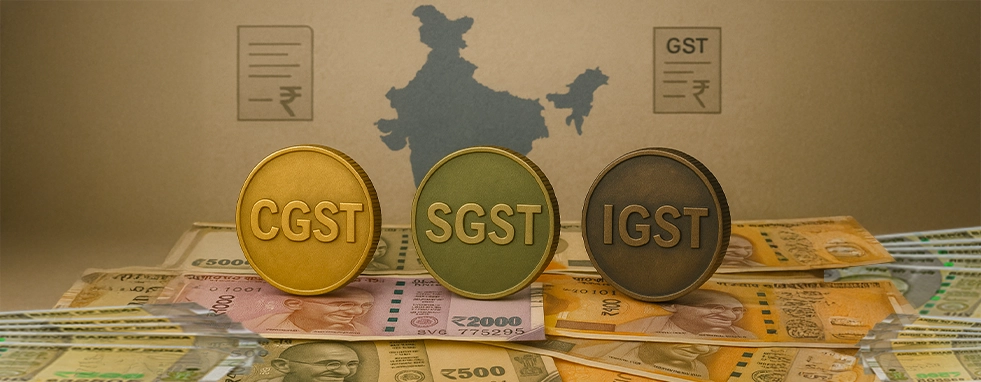
Table of Contents
India is a federal country, which means both central and state governments can levy taxes on the goods and services produced or consumed in the country. Based on the tax levying authority (central government or state government) and the place of consumption of the product/goods, the GST law classifies the tax into the following four categories-
Central Goods and Services Tax (CGST): Levied by the central government on intra-state supply of goods and services- supply of goods/services within the same state.
State Goods and Services Tax (SGST): Levied by the state governments on intra-state supply of goods and services.
Union Territory Goods and Services Tax (UTGST): Levied by the UT governments on the supply of goods and services within the UT.
Integrated Goods and Services Tax (IGST): Levied by the central government on inter-state supply of goods and services- supply of goods/services from one state to another. The revenue of IGST, is however equally shared between the central government and the state government (state government of the state where the goods/services are consumed).
Before the introduction of GST, both central and state governments used to collect a variety of taxes from businesses including VAT (Value Added Tax), CST (Central Sales Tax), excise duty, and service tax. GST simplified the taxation system of the country as most other indirect taxes were replaced by the GST.
Since both central and state governments need to collect taxes, the GST law, as explained above, has the provision for four types of GSTs which are applicable in different situations and are collected by either a state government or the central government.
The following table illustrates the taxes collected by the central and the state governments before and after the introduction of the GST system:
| Collecting Authority | Erstwhile Taxes | Taxes Collected As Per the GST Law |
|---|---|---|
State Government |
Value Added Tax (VAT) & Excise / Service Tax |
SGST- levied on intra-state supply of goods and services |
Central Government |
Central Sales Tax (CST) & Excise / Service Tax |
CGST- levied on intra-state supply of goods and services and IGST- levied on inter-state supply of goods and services. |
SGST (State Goods and Services Tax), as is obvious from the name, is collected by the state governments while CGST (Central Goods and Services Tax) and IGST (Integrated Goods and Services Tax) are collected by the central government. Which of these taxes would be applicable depends upon whether the supply of the goods/services is within a state or from one state to another.
SGST: State Goods and Services Tax (SGST) is collected by the state government on intra-state supply of goods and services (supply of goods/services within a state).
CGST: Central Goods and Services Tax (CGST) is collected by the central government over and above the SGST on intra-state supply of goods and services.
Let us now understand how CGST, SGST and IGST are collected with the help of two examples. Suppose a product is being supplied from Mumbai to Pune (within Maharashtra). Both the central government and the Maharashtra government will levy CGST and SGST respectively as it is an intra-state supply of goods. However, if a product is being transported from Mumbai (in Maharashtra) to Ahmedabad (in Gujarat), only the central government will collect the IGST and the revenue will be shared equally between the centre and the government of Gujarat.
If goods/services are being supplied from one place to another within the same state (intra-state supply), both CGST and SGST are levied together by the central and the state government respectively. The amounts collected as SGST and CGST are equal as both central and state governments have an equal revenue sharing arrangement as per the GST law.
The GST has sought to make the taxation system simpler for the Indian traders, but it is essential to understand the difference between CGST, IGST and SGST. GST is applicable on all businesses with a turnover of more than Rs. 20 Lakhs.


Most Viewed

Academy by Bajaj Markets

 47202
47202

Navigate the tax maze with ease! Uncover Income Tax 101, demystify jargon with Terms for Beginners, and choose between Old or New Regimes.
 165541
Unlock the world of credit! From picking the perfect card to savvy loan management, navigate wisely.
 97880
97880
Money Management and Financial Planning covers personal finance basics, setting goals, budgeting...
 28605
28605
Explore the investment cosmos! From beginner's guides to sharp-witted strategies, explore India's treasure trove of options.
 18764
18764
Discover essential insights on various types of insurance in India.
 4584
4584
Welcome to Tech in Finance, where we explore the exciting intersection of technology and finance...












 Academy