Our Products
 Loans
Loans
 Cards
Cards
 Insurance
 Investment
 Stock Market
 Electronics Mall
 CIBIL Score
 Knowledge Centre
 Calculators
Our Services

 Do not call
 En
En
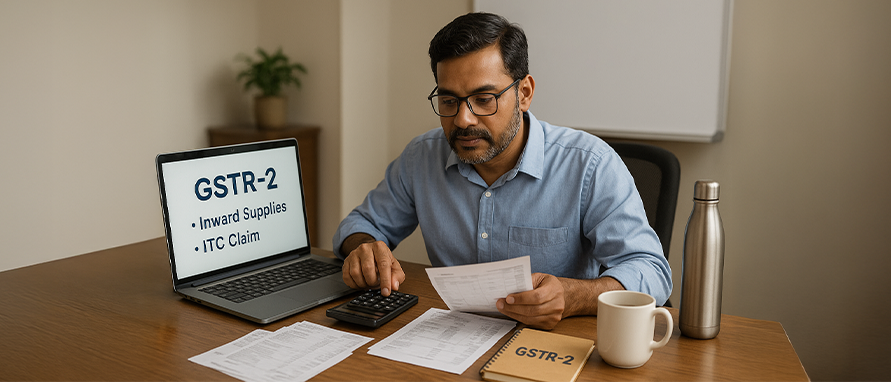
GSTR-2 can be defined as a purchase return that each GST registered person has to file mandatorily. While filing the GSTR 2 Return document, one has to enter details relevant to the inward supplies that they were a party of, among other things.
When someone talks about the GSTR-2 form, they refer to the monthly tax return that shows the purchases that a GST registered person has made during a month. When a GST registered individual purchases from other registered vendors, the information pertaining to the same filed in the GSTR-1 form will be automatically made available in the GSTN portal under the GSTR-2A form for them to use the same during their process of filing the GSTR2 returns. However, it is advisable that the individual files the return in question; they must check this information, amend it if it feels necessary, and add any other details that have not been automatically added to the aforementioned return forms.
If, for instance, a GST registered person changes the information on their GSTR-2A and file the same as GSTR-2, the vendor from whom the purchase has been made/to whom the goods have been sold will be then notified and subsequently given a chance to amend their returns with the help of a GSTR-1A form.
Now that you have received an overview of what a GST2 return form is, it is important to know when the same must be filed. What you will find below is the time by when the procedure in question must be carried out. Read on to know more.
The details regarding the purchases made during a specific month must be filed before the 15th of the month that will follow. For instance, if you need to file GSTR2 for the month of March, you have to do the same before the 15th of April. Similarly, the GSTR2 for the month of April has to be filled in by the 15th of May, and so on.
Every individual or business that is registered with GST needs to file a GSTR 2 for their purchases. However, there are some exceptions to this rule. The following entities are not required to file a GSTR 2 return:
Composition dealers
Input Service Distributors
Non-resident taxable entities
Persons that collect TCS
Entities that deduct TDS
It is important to note that to file a GSTR 2 return, you must keep a detailed account of invoices for all your transactions, including transactions relating to non-GST supplies. Also, during the return filing process, you will be required to furnish your GSTIN and confirm your identity via OTP on your registered number or Aadhaar based sign-in option.
Just like in the case of any other registration process involving the government, the GSTR-2 return filing process also needs an individual to meet a certain set of criteria and have a set of documents on their person. The list of those prerequisites can be found below.
Be a registered taxpayer with the GST council and be in possession of the 15-digit-long PAN-based GSTIN.
Neither be a composition vendor nor be in possession of a Unique Identification Number (UIN). Additionally, they should not be one of the non-resident foreign taxpayers that are registered under GST.
Extract the data from your GSTR-2A form which you will be able to see in your GST portal. In order to cross-verify this particular piece of data, they will need to have detailed invoices for all of their transactions on their person. This also includes data pertaining to intra-state, inter-state, business-to-business as well as retail purchases. The same is also inclusive of purchase transactions that are associated with supplies that are either exempted or are categorised as non-GST goods.
Lastly, you will either need an OTP that will come to your phone shortly, through which you will be able to verify your return using an electronic verification code or a digital signature certificate. The latter must be of class 2 or higher. Additionally, you can also file your GST returns using an Aadhaar based e-sign.
The GSTR 2 filing process requires the GST-registered individual or business to fill out 13 essential points of information. Here are the details you need to fill out according to the GSTR 2 format:
Name of the Taxpayer
GSTIN, i.e., the unique PAN-based 15-digit Goods and Services Taxpayer Identification Number provided to all GST-registered entities
Details of the inward supplies other than the supplies that attract a reverse charge
Inward supplies on which tax is to be paid as reverse charge - details about the purchased goods that attract a reverse charge
Capital goods and inputs received from SEZ units or overseas on a bill of entry
Amendments to details of inward supplies that were supplied in returns for previous periods of taxation
Supplies availed from composition taxable persons, GST supplies received that are exempt/nil rated, and non-GST supplies
Input Tax Credit, or ITC, received from a registered Input Service Distributor
Details about any TDS (Tax Deducted at Source) and TCS (Tax Collected at Source) received, such as from an e-commerce platform
A consolidated statement detailing all advances paid and adjusted on account of receipt of supply
Details about any reversal or reclaim of input tax credits
Details about any reduction or addition of sum in output tax in case of mismatch or other cases
HSN wise summary of goods purchases as inward supplies. In this context, HSN refers to the “Harmonized System of Nomenclature”- a commonly used system for the systematic classification of goods
If an individual fails to GSTR-2 before the due date or for a particular month, they will attract a late fee for each and every day they delay the filing process. The way that works is that the registered taxpayer will be fined ₹100 per day, with the upper ceiling being at ₹5,000.
If you would like to learn more about the various kinds of forms a registered




 47202
47202

Navigate the tax maze with ease! Uncover Income Tax 101, demystify jargon with Terms for Beginners, and choose between Old or New Regimes.
 165541
Unlock the world of credit! From picking the perfect card to savvy loan management, navigate wisely.
 97880
97880
Money Management and Financial Planning covers personal finance basics, setting goals, budgeting...
 28605
28605
Explore the investment cosmos! From beginner's guides to sharp-witted strategies, explore India's treasure trove of options.
 18764
18764
Discover essential insights on various types of insurance in India.
 4584
4584
Welcome to Tech in Finance, where we explore the exciting intersection of technology and finance...












 Academy