Our Products
 Loans
Loans
 Cards
Cards
 Insurance
 Investment
 Stock Market
 Electronics Mall
 CIBIL Score
 Knowledge Centre
 Calculators
Our Services

 Do not call
 En
En
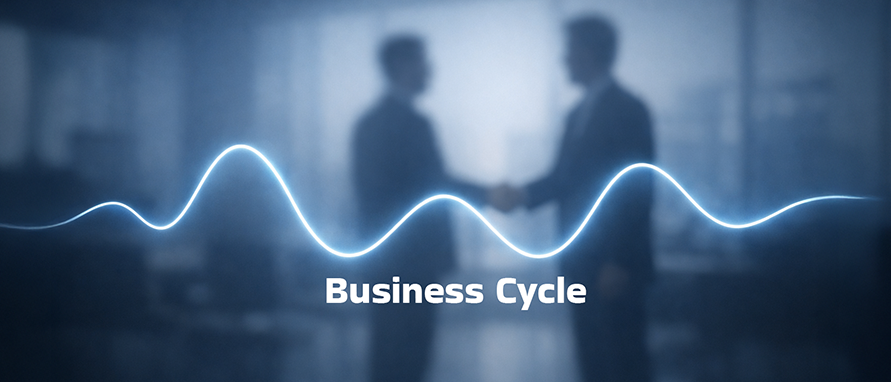
Business activity rarely moves in a straight line. Sometimes sales surge, and at other times revenue slows, creating pressure on margins and cash flow. These ups and downs follow a predictable rhythm known as the business cycle. Understanding this rhythm helps you plan borrowing, hiring, and expansion according to economic conditions, instead of reacting to sudden shifts. In this guide, you will learn the ‘business cycle meaning’ in clear, practical terms, helping you apply it directly to real-world financial decisions.
Business cycles shape how money, demand, and credit move through the economy over time. They influence revenue stability, borrowing conditions, and investment outcomes for most businesses. Understanding these effects improves short-term planning and strengthens long-term financial resilience.
During expansions, economic output rises as firms increase production of goods and services. During downturns, output contracts as demand weakens across multiple sectors. This shift affects order volumes, supplier terms, and inventory planning decisions.
Expansions usually improve employment income through higher hiring levels and gradual wage growth. Contractions reverse this trend as firms reduce costs and slow recruitment activity. For you, this affects consumer demand strength and receivable payment reliability.
Central banks often tighten the money supply when growth overheats and inflationary pressure rises. They ease conditions during slowdowns to support economic recovery. As a result, borrowing costs and approval conditions change across the economic cycle.
The stock market typically reacts early to signs of economic fluctuation and future expectations. Rising optimism fuels investment activity, while fear reduces capital flow across sectors. These shifts influence valuations, funding access, and expansion confidence.
Severe downturns, such as the great depression or a financial crisis, show how unchecked cycles damage national income. They also weaken long-term economic growth when risks remain unmanaged. Awareness helps you build financial buffers before stress levels peak.
Business cycles move through recognisable phases that repeat over time. While duration varies across countries and periods, the sequence remains consistent across economies. The business cycle does not change randomly, as it progresses through defined phases. These phases signal how economic activity behaves at a given time. Recognising them helps you judge whether growth is accelerating, slowing, or stabilising.
This phase shows rising real GDP(Gross Domestic Product), stronger industrial production, and improving consumer confidence levels. Demand grows steadily, profits improve, and firms scale operations to meet higher volumes. However, operating costs can also rise, so margin discipline remains important.
Growth reaches its upper limit as capacity tightens across industries and supply chains. Inflationary pressure may appear due to demand exceeding supply levels. Although revenue looks strong, risks increase during this phase. Decisions should focus on sustainability rather than aggressive leverage.
Economic activity slows as spending drops across households and businesses. Credit conditions tighten, and overall output begins to decline. This phase tests liquidity planning and cost control discipline. Poor timing during this phase can strain cash flows quickly.
This phase represents the lowest point of the business cycle. Economic output stabilises before recovery begins gradually. While conditions remain cautious, opportunities emerge for restructuring and selective investment planning.
The stages of business cycles show how economic activity transitions over time. They explain why economies never grow in a straight line. While phases describe direction, stages explain progression between conditions. Each stage reflects how economic output, employment, and confidence evolve gradually. Knowing these stages supports better timing for expansion, consolidation, or risk management decisions.
After the trough, demand slowly returns across key sectors of the economy. Employment improves, and confidence begins to rebuild steadily. Growth remains gradual, which limits risk but requires patience.
Momentum strengthens as output, income, and spending rise together. Business confidence improves, supporting higher investment activity. This stage supports expansion plans, provided debt exposure remains carefully measured.
Growth continues but at a slower pace as markets approach saturation. Competitive pressure increases, and pricing power often weakens. Efficiency improvements, rather than scale expansion, become the primary business priority.
Demand weakens, and profit margins compress across several industries. Early signals often appear in industrial production and tightening credit trends. Timely action during this stage reduces the overall downside financial impact.
Understanding these stages clarifies ‘what is business cycle’ in practical and measurable terms. It also explains why expansions and contractions repeat over the long term, even though triggers differ.
Knowing where the economy stands helps you align financing decisions with risk levels. For example, borrowing during early expansion often carries lower stress than borrowing near a peak. When assessing funding options such as a business loan, cycle awareness supports better repayment planning. It also reduces exposure during contraction phases.
Bajaj Markets brings together financial details from multiple lenders in one place. This allows you to compare interest rates, repayment structures, and eligibility criteria based on current economic conditions. As a result, you can choose options that better match your cash flow expectations during different phases of the business cycle.
The business cycle explains recurring shifts in growth, income, and credit conditions. By tracking its phases and stages, you make decisions with context rather than reaction. This improves timing, limits risk exposure, and supports steadier performance across short-term disruptions and long-term change.
It is called a cycle because economic activity moves through repeated phases of expansion and contraction. These movements follow a recognisable pattern, even though length and intensity differ each time.
The full cycle runs from expansion to peak, then contraction to trough, before recovery begins again. Together, these stages describe how output, income, and demand change over time.



Academy by Bajaj Markets
 47202
47202

Navigate the tax maze with ease! Uncover Income Tax 101, demystify jargon with Terms for Beginners, and choose between Old or New Regimes.
 165541
Unlock the world of credit! From picking the perfect card to savvy loan management, navigate wisely.
 97881
97881
Money Management and Financial Planning covers personal finance basics, setting goals, budgeting...
 28606
28606
Explore the investment cosmos! From beginner's guides to sharp-witted strategies, explore India's treasure trove of options.
 18764
18764
Discover essential insights on various types of insurance in India.
 4584
4584
Welcome to Tech in Finance, where we explore the exciting intersection of technology and finance...












 Academy