Our Products
 Loans
Loans
 Cards
Cards
 Insurance
 Investment
 Stock Market
 Electronics Mall
 CIBIL Score
 Knowledge Centre
 Calculators
Our Services

 Do not call
 En
En
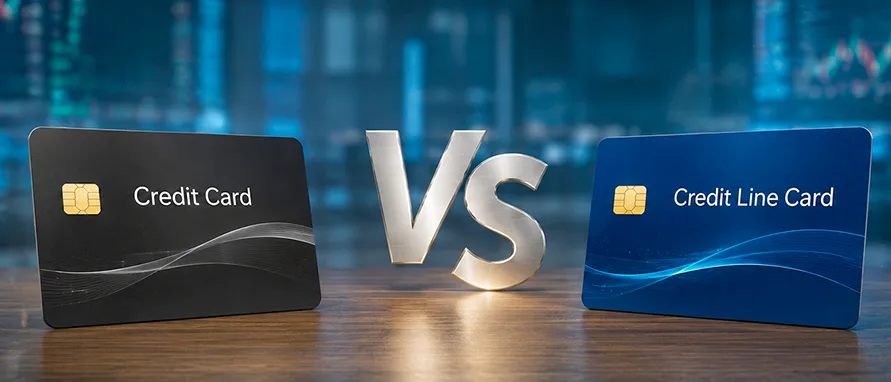
A credit card vs credit line card comparison helps clarify how these two borrowing tools differ in usage, repayment, and overall flexibility. While both provide access to credit, they function differently in terms of spending control, billing cycles, and interest application, which can influence how they are used for financial needs.
A credit card is a financial product that provides a pre-approved credit limit which can be used for purchases, bill payments, and withdrawals. It operates on a revolving credit system where the user borrows up to a set limit and repays either partially or fully every billing cycle.
Credit cards typically follow a fixed monthly billing cycle with a grace period during which no interest is charged if the full amount is repaid. These cards are usually issued by banks and operate on networks such as Visa, Mastercard, or RuPay.
They are widely accepted across online and offline platforms, making them suitable for everyday transactions, travel bookings, and large purchases. Interest is charged only when the outstanding balance is not paid in full by the due date.
A credit line card, or line of credit, is a flexible borrowing setup which lets users draw funds as required within an approved credit limit. Unlike traditional credit cards, it does not always follow a fixed billing cycle.
Instead, interest is charged only on the amount utilised rather than the entire limit. This makes a line of credit vs credit card comparison relevant for users seeking flexible borrowing options.
Credit line cards are often offered through digital platforms and fintech apps. Users can access funds for payments, transfers, or purchases and repay them based on flexible terms. The repayment structure may vary depending on the provider, often allowing partial payments or customised schedules.
The difference between line of credit and credit card lies in how credit is accessed, used, and repaid.
| Feature | Credit Card | Credit Line Card |
|---|---|---|
Interest application |
Charged on unpaid balance after due date |
Charged only on amount used |
Usage pattern |
Fixed limit with billing cycle |
Flexible withdrawal from credit line |
Repayment |
Monthly billing cycle |
Flexible repayment options |
Rewards & benefits |
Cashback, rewards, travel perks |
Usually limited reward structure |
Eligibility |
Based on credit history and income |
Often simpler eligibility criteria |
CIBIL reporting |
Regular reporting of usage and repayment |
Reported but may vary |
Best suited for |
Regular spending and rewards |
Short-term borrowing needs |
This credit card versus line of credit comparison shows that while both offer credit access, their structure and benefits differ significantly.
Another difference between a credit card and a line of credit is that credit cards are transaction-focused, whereas credit lines are borrowing-focused, making them suitable for different use cases.
Credit cards offer several features that distinguish them from credit line facilities.
Rewards and benefits: Credit cards often provide cashback, reward points, and travel-related benefits for regular transactions.
Global acceptance: These cards are widely accepted across merchants internationally for both online and offline purchases.
Structured repayment system: A fixed billing cycle allows users to manage repayments with predictable due dates.
Credit score building: Regular usage and timely payments contribute significantly to building a strong credit profile.
This makes credit cards more suitable for consistent spending patterns and those looking to maximise transactional benefits.
A credit line versus credit card comparison highlights certain advantages of credit line products.
Flexible borrowing: Users can withdraw only the required amount instead of using a fixed credit limit.
Interest on usage only: Interest is applied only on the utilised portion, not the entire credit limit.
Simplified eligibility: Many providers offer easier onboarding with fewer documentation requirements.
App-based management: Most credit line facilities are managed digitally through mobile apps for ease of access.
These features make credit line cards suitable for short-term financial needs where controlled borrowing is required.
Choosing between a credit card and a credit line depends on usage needs and repayment preferences.
Regular transactions: A credit card may be more suitable due to rewards and structured billing.
Short-term borrowing: A credit line may be considered for flexible borrowing with interest on usage.
The difference between credit card and credit line becomes clearer when considering whether the requirement is transaction-based or borrowing-focused.
A credit card is a revolving credit facility with a fixed billing cycle, while a credit line card allows flexible borrowing where interest is charged only on the amount used.
A line of credit may suit short-term borrowing needs, while a credit card is generally used for regular expenses and benefits like rewards and cashback.
Credit line cards may impact your CIBIL score as lenders can report usage and repayment behaviour, similar to credit cards, depending on the provider.
Credit line cards may have relatively simpler eligibility criteria, while credit cards often require a stronger credit profile and income verification.
Many credit line cards support online payments, but acceptance and usability may vary compared to widely accepted credit cards.



Academy by Bajaj Markets

 47202
47202

Navigate the tax maze with ease! Uncover Income Tax 101, demystify jargon with Terms for Beginners, and choose between Old or New Regimes.
 165541
Unlock the world of credit! From picking the perfect card to savvy loan management, navigate wisely.
 97881
97881
Money Management and Financial Planning covers personal finance basics, setting goals, budgeting...
 28606
28606
Explore the investment cosmos! From beginner's guides to sharp-witted strategies, explore India's treasure trove of options.
 18764
18764
Discover essential insights on various types of insurance in India.
 4584
4584
Welcome to Tech in Finance, where we explore the exciting intersection of technology and finance...












 Academy