Our Products
 Loans
Loans
 Cards
Cards
 Insurance
 Investment
 Stock Market
 Electronics Mall
 CIBIL Score
 Knowledge Centre
 Calculators
Our Services

 Do not call
 En
En
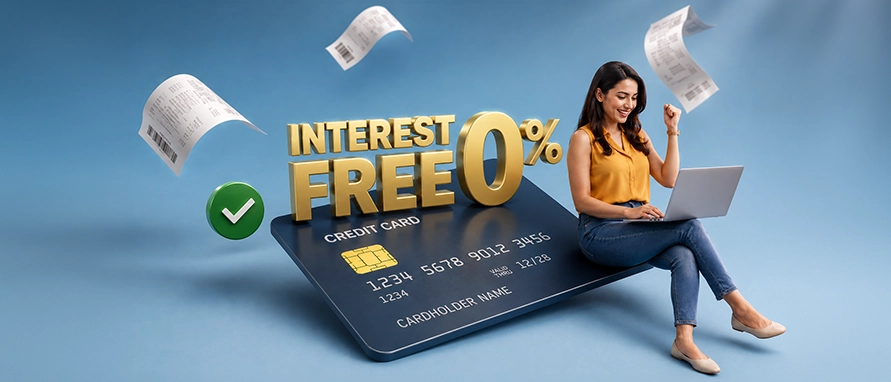
The credit card interest free period gives you up to 55 days to repay purchases without paying a single rupee in interest. This page explains how the window is calculated, how to get the most out of it, and which cards in India offer the longest no-interest periods.
The credit card interest free period is the window of time between the date of a purchase and the due date of your credit card bill during which no interest is charged on that transaction, provided the full outstanding balance is paid by the due date. It is sometimes called the credit card no interest period or the interest free credit period.
In India, the credit card interest free period typically ranges from 18 to 55 days, depending on when in the billing cycle a purchase is made. The billing cycle is the period — usually 30 days — over which your card issuer records transactions before generating a monthly statement. Once the statement is generated, you are given an additional payment window, commonly 15 to 25 days, before interest begins to accrue.
The key condition attached to this benefit is full repayment. If you pay only the minimum amount due or any partial amount by the due date, interest is charged not just on the remaining balance but, in most cases, retroactively on the entire original purchase amount from the transaction date. Understanding how this window works is the first step to using a credit card efficiently and avoiding unnecessary interest costs.
The length of your credit card interest free period is not fixed — it depends on when within the billing cycle you make a purchase. A transaction made on the very first day of a new billing cycle benefits from the maximum available window. A transaction made on the last day of the cycle gets the minimum — roughly equal to just the payment due period.
To understand this, consider the structure of any credit card billing cycle. The issuer closes the billing period on the statement date and generates a bill for all transactions in that cycle. You then have a payment due date — typically 15 to 25 days after the statement date — by which the full balance must be paid to avoid interest. The interest free credit period is the combined span from the purchase date to the payment due date.
The table below illustrates how the number of interest-free days varies based on when in the billing cycle a purchase is made, using a 30-day cycle and a 25-day payment window (total maximum: 55 days).
Illustrative Example — Billing cycle: 1st to 30th of the month; Statement date: 30th; Due date: 25th of following month
| Purchase Date | Statement Date | Due Date | Interest-Free Days |
|---|---|---|---|
1st of the month |
30th of the month |
25th of next month |
55 days |
10th of the month |
30th of the month |
25th of next month |
46 days |
20th of the month |
30th of the month |
25th of next month |
36 days |
28th of the month |
30th of the month |
25th of next month |
28 days |
As the table shows, a purchase made right at the start of the billing cycle can attract up to 55 days of credit card interest free period — essentially free short-term credit. The same card used on the 28th of the month yields only 28 interest-free days on that transaction. The underlying calculation is:
Interest-free days = (Statement date − Purchase date) + Payment due period
Important: The credit card no interest period applies only to retail purchases, not to cash advances or certain fee-based transactions. Paying only the minimum amount due forfeits the benefit and triggers interest from the original purchase date on most Indian cards.
Knowing how the interest free credit period works is one thing; using it deliberately is another. Below are two practical strategies that cardholders regularly use to stretch the benefit to its maximum.
If you are planning a large, predictable expense — such as buying an appliance, booking a holiday, or paying a significant bill — timing it to fall on or just after the first day of your billing cycle gives you the maximum credit card interest free period on that transaction. You effectively get an interest-free loan for up to 55 days, allowing you to keep that money in your savings account or liquid fund for almost two months, earning returns in the meantime.
This works best when you know your billing cycle dates well in advance. Most issuers display the cycle start and end dates on your monthly statement or within your net banking or mobile app. Once you know your statement date, any purchase made right after it begins a fresh 30-day cycle and attracts the full payment window on top of it.
How it plays out: Your billing cycle runs from the 5th to the 4th of the following month. You plan to buy a ₹40,000 laptop. If you buy it on the 5th, you enjoy it up to 55 days before the due date. If you buy it on the 3rd instead, you get only about 26 days. By waiting two days, you hold ₹40,000 in your account for nearly a month longer.
A less-obvious approach is to maintain two credit cards with different billing cycle dates — ideally staggered by around 15 days. When one card's cycle is in its final days (and a purchase would attract fewer interest-free days), you switch to the second card, whose fresh billing cycle gives you the maximum window again.
This strategy effectively gives you a near-continuous rolling credit window across two cards, without relying on a single card's timing. It requires disciplined tracking to ensure both cards are paid in full each month — the strategy collapses if outstanding balances are carried forward, as interest then applies. Used responsibly, two cards with offset billing cycles can provide a longer effective no-interest credit window than either card could on its own.
Note: Managing two cards simultaneously requires careful tracking of due dates for both. Setting up auto-pay for the full outstanding amount on each card can help avoid inadvertent partial payments that would nullify the interest-free benefit.
Most credit cards in India offer an interest free credit period of up to 48 to 55 days, depending on the issuer. The table below lists partner cards along with their standard interest-free window and key features, to help you identify which card with interest free period aligns with your spending profile.
| Credit Card | Interest-Free Period | Annual Fee | Joining Fee | Best Suited For |
|---|---|---|---|---|
SBI Card ELITE |
Up to 50 days |
₹4,999 |
₹4,999 |
Club Vistara membership |
SBI Card PRIME |
Up to 50 days |
₹2,999 |
₹2,999 |
Club Vistara membership |
SBI Card OCTANE |
Up to 50 days |
₹1,499 |
₹1,499 |
Reward benefits |
SBI Card PULSE |
Up to 50 days |
₹1,499 |
₹1,499 |
Comprehensive insurance cover |
SimplyCLICK SBI Card |
Up to 50 days |
₹499 |
₹499 |
e-Shopping rewards |
SimplySAVE SBI Card |
Up to 50 days |
₹449 |
₹449 |
Fuel |
BPCL SBI Card |
Up to 50 days |
₹499 |
₹499 |
Fuel freedom benefits |
RCTC RuPay SBI Card |
Up to 50 days |
₹500 |
₹500 |
Travel offers from IRCTC |
Tata Neu Plus HDFC Bank Credit Card |
Up to 50 days |
₹499 |
Nil |
Shopping & Travel |
Indian Oil Kotak Credit Card |
Up to 48 days |
₹449 |
₹449 |
Fuel |
Kotak League Platinum Card |
Up to 48 days |
Nil |
Nil |
Entertainment |
IDFC FIRST Bank SWYP Credit Card |
Up to 48 days |
₹449 |
₹449 |
Entertainment |
IDFC FIRST Bank EARN Credit Card |
Up to 48 days |
₹499 |
₹499 |
Entertainment |
IDFC FIRST Bank Power Credit Card |
Up to 48 days |
₹199 |
₹199 |
Fuel |
Note: The interest-free period figures above are indicative of the maximum possible window for purchases made at the start of a billing cycle. Actual days available on any given transaction depend on the purchase date within the cycle. Confirm the exact terms with your card issuer before applying.
A credit card with no annual fee and an interest free period is a particularly useful combination — you pay no recurring cost to hold the card and still benefit from the no-interest credit window on purchases. Several partner cards in the list below carry lifetime-free or nil-fee structures while offering interest-free periods comparable to paid cards.
IDFC FIRST Bank FIRST Millennia Credit Card (Nil annual fee; Rewards): A lifetime-free card with a rewards programme and an interest-free credit period of up to 48 days. It is an accessible entry point for cardholders seeking a no-cost credit card no annual fee interest free period combination.
IDFC FIRST Bank FIRST Classic Credit Card (Nil annual fee; Fuel): Another lifetime-free option from IDFC FIRST Bank, suited for fuel spends, with an interest-free window of up to 48 days. The nil fee structure means there is no annual cost to holding the card while still enjoying the no-interest credit window.
IDFC FIRST Bank Wealth Credit Card (Nil annual fee; Rewards): A premium-tier lifetime-free card with enhanced rewards and an interest-free period on purchases. The combination of no joining fee, no annual fee, and a generous credit window makes it notable among no interest period credit cards available in India.
IDFC FIRST Bank WOW! Credit Card (Nil annual fee; Shopping): Designed for online and offline shopping, this card carries no annual fee and provides an interest-free credit period on eligible retail purchases.
IDFC FIRST Bank SELECT Card (Nil annual fee; Entertainment): Positioned for entertainment and lifestyle spending, this lifetime-free card also offers an interest free credit period, making it a cost-efficient option for cardholders who prioritise experience-based rewards.
YES Bank Klick Credit Card (Nil annual fee; UPI Credit Card): A no-cost card linked to UPI-based credit card transactions, offering an interest-free period on eligible purchases — relevant for cardholders who make UPI payments using their credit card.
SBM ZET Credit Card (Nil annual fee; Build Credit Score): Designed for individuals building or rebuilding credit, this no-fee card also provides an interest-free credit period on purchases, allowing new cardholders to experience the benefit without incurring an annual charge.
Kotak League Platinum Card (Nil annual fee; Entertainment): A zero-annual-fee card with an interest-free window of up to 48 days, suited for entertainment spending.
The credit card interest free period is a valuable feature, but it works exactly as intended only when used with discipline. The following practices help ensure you consistently benefit from the no-interest window.
Pay the full outstanding balance by the due date: This is the single most important rule. Paying only the minimum due or any partial amount forfeits the interest-free benefit entirely on most Indian cards. Interest then accrues from the original transaction date on the unpaid amount — often at rates between 36 and 42 per cent per annum. Setting up a full-balance auto-pay mandate removes the risk of forgetting.
Know your billing cycle dates: The interest free credit period you receive on any purchase depends on where in the cycle that purchase falls. Knowing your statement date and due date — both available on your monthly statement and in your banking app — allows you to time larger spends to the beginning of a fresh cycle and extract the maximum window.
Avoid cash advances entirely: Cash withdrawals using a credit card are not covered by the credit card no interest period. Interest on cash advances begins accruing from the date of withdrawal with no grace period, often at a higher rate than the standard purchase interest rate. A cash advance fee is also typically charged upfront. Treating your credit card strictly as a purchase instrument preserves the interest-free benefit.
Do not let outstanding balances roll over: Carrying a balance from one month to the next means the interest-free window disappears on all new purchases as well, not just the unpaid amount. Many issuers apply interest from the transaction date on all purchases if any balance remains unpaid from the previous cycle. Clearing the full balance each month is the only reliable way to maintain the benefit consistently.
| Credit Card | Annual Fee | Joining Fee | Best Suited For |
|---|---|---|---|
Nil |
Nil |
Build Credit Score |
|
Nil |
Nil |
UPI Credit Card |
|
Nil |
Nil |
Rewards |
|
Nil |
Nil |
Fuel |
|
Nil |
Nil |
Rewards |
|
Nil |
Nil |
Shopping |
|
Nil |
Nil |
Entertainment |
|
Nil |
Nil |
Entertainment |
|
₹499 |
Nil |
Shopping & Travel |
|
₹199 |
₹199 |
Fuel |
|
₹449 |
₹449 |
Fuel |
|
₹449 |
₹449 |
Fuel |
|
₹449 |
₹449 |
Entertainment |
|
₹499 |
₹499 |
Entertainment |
|
₹499 |
₹499 |
e-Shopping rewards |
|
₹499 |
₹499 |
Fuel freedom benefits |
|
₹500 |
₹500 |
Travel offers from IRCTC |
|
₹1,499 |
₹1,499 |
Reward benefits |
|
₹1,499 |
₹1,499 |
Comprehensive insurance cover |
|
₹2,999 |
₹2,999 |
Club Vistara membership |
|
₹4,999 |
₹4,999 |
Club Vistara membership |
Ans: The maximum credit card interest free period available in India is typically up to 55 days. This maximum applies only when a purchase is made on the very first day of a new billing cycle, giving you the full 30-day cycle plus the subsequent payment due period (usually 15 to 25 days). Purchases made later in the cycle attract fewer interest-free days. The exact maximum varies between issuers — most fall between 45 and 55 days.
Ans: Several cards from major Indian issuers offer an interest free period of up to 50 to 55 days on purchases made at the start of the billing cycle. Among the partner cards listed on this page, SBI Card products (including SBI Card ELITE, SBI Card PRIME, SimplyCLICK SBI Card, and BPCL SBI Card) and HDFC Bank cards typically offer up to 50 days. The exact number of interest-free days depends on when in the cycle a transaction is made, not just the card. Verifying the specific terms with the issuer is always advisable before applying.
Ans: No. The credit card interest free period does not apply to cash advances or ATM withdrawals made using a credit card. Interest on cash withdrawals begins accruing from the day of the transaction, with no grace period. In addition, most issuers charge an upfront cash advance fee, making this one of the most expensive ways to access funds. The interest-free benefit is strictly limited to retail purchases — in-store, online, or contactless — not to cash transactions.
Ans: The interest free credit period for any given purchase is calculated as the number of days between the purchase date and the payment due date on the statement in which that transaction appears. In formula terms: Interest-free days = (Statement date − Purchase date) + Payment due window. For example, if your billing cycle runs from the 1st to the 30th of the month and the due date is the 25th of the following month, a purchase on the 1st gives you 55 interest-free days, while a purchase on the 20th gives you only 36 days.
Ans: Once the payment due date passes without full settlement of the outstanding balance, the credit card no interest period comes to an end and interest begins to accrue. On most Indian cards, interest is applied retroactively from the original transaction date — not just from the due date — on the unpaid amount. This retroactive application means even a small unpaid balance can result in a meaningful interest charge. The applicable rate varies by issuer and card tier but typically ranges between 36 and 42 per cent per annum. A late payment fee may also be levied separately.



Academy by Bajaj Markets

 47202
47202

Navigate the tax maze with ease! Uncover Income Tax 101, demystify jargon with Terms for Beginners, and choose between Old or New Regimes.
 165541
Unlock the world of credit! From picking the perfect card to savvy loan management, navigate wisely.
 97881
97881
Money Management and Financial Planning covers personal finance basics, setting goals, budgeting...
 28606
28606
Explore the investment cosmos! From beginner's guides to sharp-witted strategies, explore India's treasure trove of options.
 18764
18764
Discover essential insights on various types of insurance in India.
 4584
4584
Welcome to Tech in Finance, where we explore the exciting intersection of technology and finance...










 Academy