Our Products
 Loans
Loans
 Cards
Cards
 Insurance
 Investment
 Stock Market
 Electronics Mall
 CIBIL Score
 Knowledge Centre
 Calculators
Our Services

 Do not call
 En
En
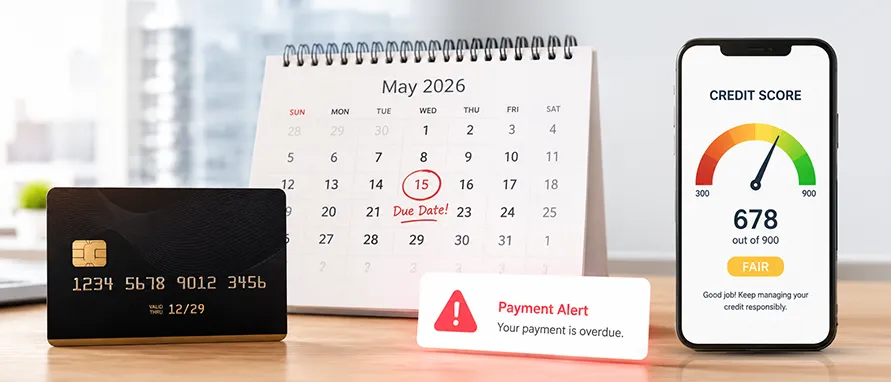
Even a one day late credit card payment can lead to charges, interest accrual, and reporting on your credit history. A delay triggers credit card late payment charges, impacts repayment behaviour, and may influence your credit profile, making timely payments an essential part of credit usage.
Missing a payment on your credit card can lead to multiple immediate consequences.
A delayed or credit card missed payment activates penalties and removes existing benefits such as the interest-free period.
Late payment fees: Banks levy credit card late payment charges that can range from ₹100 to ₹1,300 or more depending on the outstanding amount.
Interest charges: Interest is applied on the full outstanding balance, often around 3–3.5% per month.
Loss of grace period: The interest-free period may be withdrawn for subsequent transactions.
Penalty escalation: Repeated delays can lead to higher charges over time.
For example, SBI credit card late payment fee is structured in slabs depending on the balance, increasing as dues rise.
Even a one day late credit card payment can trigger the same consequences as a longer delay.
Banks generally consider any delay beyond the due date as a missed payment, regardless of duration.
Full late fee applied: Even a single day’s delay may attract credit card late payment charges without partial relaxation.
Interest from transaction date: Interest may be calculated from the purchase date, not the due date.
No buffer period: Most issuers do not provide a grace buffer beyond the official due date.
In some cases, banks may apply standard policies where a one day late credit card payment is treated the same as a delayed payment cycle.
Payment history forms a significant portion of your credit score.
A delay or credit card missed payment can affect your credit profile in the following ways:
Credit score impact: Delays can reduce the score depending on severity and frequency.
DPD classification: Accounts are marked as 30, 60, or 90 days past due (DPD) based on delay duration.
Long-term record: Payment delays may remain on your credit report for several years.
Repeated delays: Multiple missed payments increase the overall risk profile.
Understanding how late payment affects credit score helps in managing repayment behaviour and avoiding negative reporting.
Different banks follow slab-based fee structures for credit card late payment charges, which depend on the outstanding balance.
| Bank | Late Payment Fee Range |
|---|---|
SBI Card |
₹0 – ₹1,500 (slab-based on outstanding amount) |
HDFC Bank |
₹100 – ₹1,300 (based on dues) |
Kotak Mahindra Bank |
₹100 – ₹1,200 (varies by balance) |
IDFC FIRST Bank |
₹0 – ₹1,000+ (varies by card type and usage) |
YES Bank |
₹100 – ₹1,200 (depends on outstanding) |
SBM Bank |
₹0 – ₹1,000+ (structured based on dues) |
The SBI credit card late payment fee follows a slab-based charging, where higher outstanding amounts attract higher fees. These charges apply even in cases of a one day late credit card payment, depending on the issuer’s billing policy.
Maintaining timely repayment habits can help avoid penalties and ensure better credit management.
Set auto-pay: Enable automatic debit for total or minimum due through your bank account.
Use reminders: Set alerts through SMS, email, or calendar notifications before due dates.
Track billing cycle: Understanding statement dates and due dates helps avoid confusion.
Maintain balance: Ensure sufficient bank balance on the due date for auto-debit.
Using these methods can reduce the chances of a one day late credit card payment and avoid unnecessary charges.
If a payment is delayed, immediate action can limit the impact.
Pay outstanding immediately: Settle dues as soon as possible to reduce interest accumulation.
Contact the bank: Request reversal of credit card late payment charges, especially for first-time delays.
Check credit report: Review your credit report after a few weeks to understand the impact.
Enable auto-pay: Set up payment automation for future cycles.
Timely corrective steps may reduce the overall effect of a credit card missed payment.
Ans: A one day late credit card payment may still attract late payment charges and interest, as most banks treat any delay beyond the due date as a missed payment.
Ans: The SBI credit card late payment fee varies based on the outstanding amount and may range from zero to around ₹1,500 as per slab-based structures.
Ans: A credit card missed payment can affect your credit score depending on how long the delay continues and how frequently it occurs.
Ans: Banks may consider waiving credit card late payment charges on request, particularly for first-time delays or consistent users.
Ans: Payment delays may remain on your credit report for several years, depending on reporting practices and repayment history.



Academy by Bajaj Markets

 47202
47202

Navigate the tax maze with ease! Uncover Income Tax 101, demystify jargon with Terms for Beginners, and choose between Old or New Regimes.
 165541
Unlock the world of credit! From picking the perfect card to savvy loan management, navigate wisely.
 97881
97881
Money Management and Financial Planning covers personal finance basics, setting goals, budgeting...
 28606
28606
Explore the investment cosmos! From beginner's guides to sharp-witted strategies, explore India's treasure trove of options.
 18764
18764
Discover essential insights on various types of insurance in India.
 4584
4584
Welcome to Tech in Finance, where we explore the exciting intersection of technology and finance...












 Academy