Our Products
 Loans
Loans
 Cards
Cards
 Insurance
 Investment
 Stock Market
 Electronics Mall
 CIBIL Score
 Knowledge Centre
 Calculators
Our Services

 Do not call
 En
En
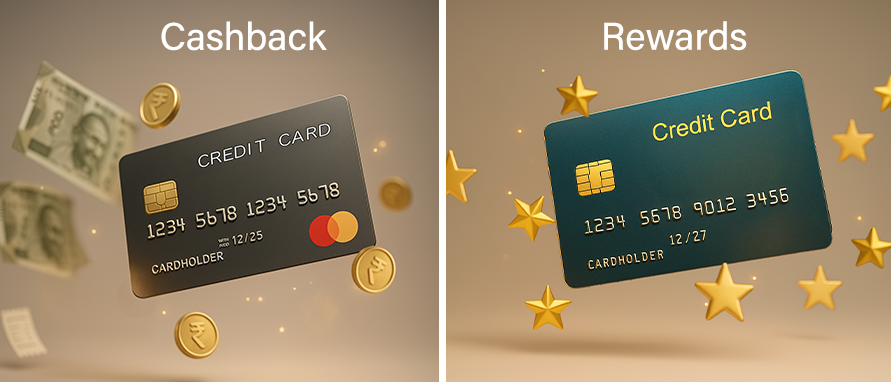
In today’s fast-paced, digitally driven world, credit cards aren’t just tools for borrowing — they’re also powerful enablers of savings. Two of the most popular types of cards in India are cashback cards and reward points cards, both offering value every time you spend.
Cashback credit cards give you a straightforward benefit — a percentage of your spending is credited back, often as a discount on your bill. Reward credit cards, on the other hand, let you earn points that can be redeemed for vouchers, merchandise, flight tickets, or even fuel.
But which one offers better value? The answer depends on how you spend and how you redeem. Let us break down the differences which can help you choose the right option to maximise your savings in FY 2025-26.
Cashback credit cards are all about simplicity and instant gratification. Instead of collecting points and figuring out how to redeem them, you earn back a portion of what you spend — in cash. It’s a direct reward that reduces your outstanding bill or adds to your statement balance.
Typically, these cards offer 1% to 5% cashback on eligible purchases. For example, if your card gives you 5% cashback on online shopping and you spend ₹5,000, you’ll receive ₹250 back — often reflected in your next billing cycle.
There are no complicated conversions, no hunting for redemption partners, and no expiry dates to track. Cashback is visible, tangible, and ideal for those who prefer immediate savings over delayed gratification.
Many cashback cards also come with tiered benefits. You may earn:
Higher cashback for online shopping, grocery, or utility payments
Basic cashback on all other spends
Waived annual fees if you hit a minimum spend threshold
So, are cashback cards better than regular credit cards? If you value clarity, simplicity, and money back on everyday expenses — absolutely. They're particularly useful for disciplined spenders who pay their bills in full and want effortless savings without managing a reward system. If you want to make your spending work for you — with no extra tracking or effort — a cashback credit card could be your smartest pick.
Reward credit cards let you turn your everyday spending into something more. Instead of getting cash back instantly, you accumulate points — and those points can unlock a wide range of benefits, from flight tickets and hotel stays to gadgets, gift vouchers, and more.
Most reward cards offer 1 point per ₹100 spent on regular transactions. But where they really shine is in accelerated categories like dining, travel, or online shopping — with some cards offering 5x to 10x points for specific purchases.
So, what’s the difference between reward points and cashback? Cashback is immediate and automatic. Reward points, on the other hand, offer greater flexibility — but they also require you to track your points, check expiry dates (usually 24 to 36 months), and select the right redemption option to maximise value.
Understand the difference as per different aspects:
| Feature | Cashback Cards | Reward Point Cards |
|---|---|---|
Reward Type |
Cash credited to statement |
Points accumulated |
Redemption |
Bill reduction |
Vouchers, travel, merchandise |
Tracking |
Not needed |
Required |
Expiry |
Rarely |
Often after 2–3 years |
Value |
Fixed, visible |
Variable, based on use |
Best For |
Daily spenders |
Travel, online shoppers |
Fees |
Usually low |
Moderate to high |
Bonus Categories |
Fuel, groceries, bills |
Flights, luxury shopping |
Looking for the best credit cards with cashback rewards and no annual fee? Go for no-fee cashback cards with basic perks. Those who enjoy choice may prefer reward point credit cards. Both work—depending on how you spend.
Why pick cashback cards?
Simple savings with no complexity.
Instant cashback on essentials like fuel or groceries.
Many cards waive fees if you meet a spend limit.
Cashback reduces your monthly dues automatically.
No expiry worries like with points.
Cashback is best for those who spend steadily and don’t want to manage reward portals.
Reward cards shine for users who enjoy flexibility.
Points can be redeemed for flights, hotels, or gifts.
Some offer 10x points on select platforms.
Ideal for travellers or luxury spenders.
Annual fees often come with valuable bonuses.
Flexible across spend categories.
Reward cards are best if you plan to redeem smartly and spend more.
For regular bills, fuel, groceries, and phone recharges, cashback works best. It gives money back on necessary spends. Cash back credit cards suit daily earners, students, or salaried professionals who want effortless savings. Reward points may not give high value unless you redeem for big spends. So, if your card is mainly for routine use—cashback wins.
Here are some top credit cards available on Bajaj Markets suitable for daily expenses:
| Credit Card | Key Features | Best For |
|---|---|---|
SimplySAVE SBI Card |
- 10x reward points on dining, movies, groceries - 2,000 bonus points on joining |
Everyday shopping and entertainment |
BPCL SBI Card |
- 4.25% value back on fuel at BPCL pumps - 1% fuel surcharge waive |
Fuel expenses |
Axis Bank NEO Credit Card |
- Up to 40% off on Zomato - EMI conversion on big purchases |
Dining and large purchases |
Lifestyle Home Centre SBI Card |
- 5x reward points at Landmark stores - 2,000 bonus points on joining |
Retail shopping at partner stores |
IRCTC RuPay SBI Card |
- Up to 10% value back on railway bookings - Complimentary lounge access |
Travel and commuting |
Planning to save over the year? Let us understand how it panes out.
If you spend ₹10,000 per month on a 5% cashback card, you receive ₹6,000 as cashback annually. A reward card might offer more, but only if points are redeemed at high value. For ease and steady savings, the cashback one seems better. But if you travel often or shop online heavily, rewards may suit you more. This also addresses the cashback vs rewards credit card debate—neither is better. It depends on how you spend.
Cashback directly reduces your spends. Rewards take time to redeem. Hence, the choice is yours.
Some banks allow this. But the value may be lower than other redemptions.
Reward cards. You can use points for travel, vouchers, or items.
Yes, some do. Check your card’s terms for monthly or yearly caps.
Cashback typically works well for fuel. Rewards work better for travel bookings.



Academy by Bajaj Markets

 47202
47202

Navigate the tax maze with ease! Uncover Income Tax 101, demystify jargon with Terms for Beginners, and choose between Old or New Regimes.
 165541
Unlock the world of credit! From picking the perfect card to savvy loan management, navigate wisely.
 97880
97880
Money Management and Financial Planning covers personal finance basics, setting goals, budgeting...
 28605
28605
Explore the investment cosmos! From beginner's guides to sharp-witted strategies, explore India's treasure trove of options.
 18764
18764
Discover essential insights on various types of insurance in India.
 4584
4584
Welcome to Tech in Finance, where we explore the exciting intersection of technology and finance...












 Academy