Our Products
 Loans
Loans
 Cards
Cards
 Insurance
 Investment
 Stock Market
 Electronics Mall
 CIBIL Score
 Knowledge Centre
 Calculators
Our Services

 Do not call
 En
En
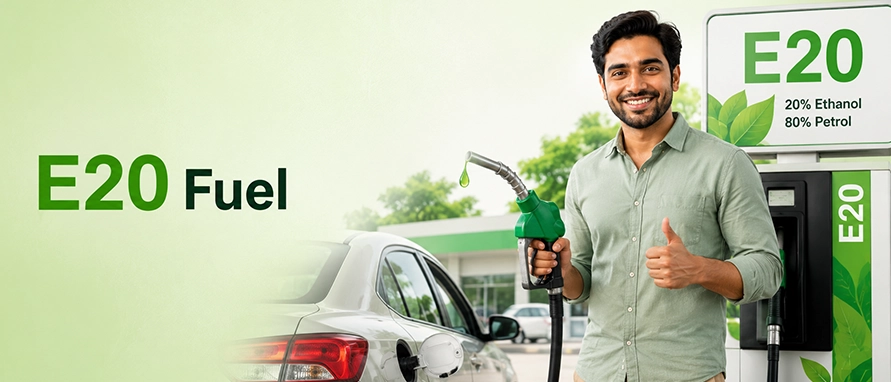
Table of Contents
The transition toward sustainable mobility is completely altering what we pump into our vehicles. As petrol retail stations across the country undergo a green transformation, terms like e20 gas and e20 petrol have taken centre stage. Understanding this modern fuel format is essential for every vehicle owner navigating the modern automotive landscape.
To understand the core mechanics, what is e20 fuel simply comes down to a specific volume ratio. The full form uses the prefix 'E' to denote ethanol, while '20' stands for the exact percentage of the biofuel integrated into the mixture. Therefore, E20 fuel is an automotive blend comprising 20% ethanol and 80% conventional petrol.
This formulation is a major step up from previous stages like E5 (5% ethanol) and E10 (10% ethanol). The widespread introduction of E20 aligns directly with India's strict BS6 Phase 2 emission mandates. Under these regulations, automotive manufacturers are legally required to build and tune their powertrains to handle a much higher volume of ethanol in petrol safely without mechanical degradation.
For drivers asking what is ethanol, it is a plant-based, sustainable biofuel chemically classified as ethyl alcohol ($C_2H_5OH$). Unlike regular fossil petrol refined from crude oil reserves, ethanol is a completely renewable resource. It is produced through the natural fermentation of sugars and starches derived from organic plant matter primarily sugarcane, corn (maize), damaged food grains, and residual agricultural biomass.
Following fermentation, the liquid undergoes strict distillation and dehydration to completely strip out moisture before it can be used for transport. Beyond its popular ethanol use as a clean-burning fuel additive, this versatile compound serves as an industrial chemical solvent, a medical antiseptic, and the primary ingredient in alcoholic beverages. Thanks to intensive national blending roadmaps, India has scaled its output to roughly 13.8 billion litres, establishing itself as the 4th largest ethanol producer globally.
The domestic production of E20 fuel relies heavily on a highly structured supply chain deeply linked with India’s farming sectors:
Feedstock Accumulation: Raw agricultural materials, mainly heavy sugarcane molasses, broken rice, and corn, are delivered to domestic biorefineries.
Fermentation: Yeast is introduced to break down the natural plant sugars, converting the biomass into a raw liquid alcohol mix.
Distillation: The fermented solution is heated and distilled to raise the concentration of alcohol to roughly 95%.
Dehydration: To safely mix with petrol, all remaining water molecules must be eliminated. Passing the solution through molecular sieves yields an ultra-pure anhydrous ethanol of 99.5% or higher.
Blending: The pure blended ethanol is mixed at centralized oil storage depots at a fixed 20:80 ratio to create commercial E20 fuel.
India’s rapid rollout timeline has expanded drastically from initial city pilots to nationwide availability. Agricultural powerhouses like Maharashtra, Uttar Pradesh, and Karnataka lead the charge, ensuring a steady supply of this domestic ethanol blend in petrol.
When comparing e20 gas vs petrol, the underlying chemical differences lead to noticeable daily performance trade-offs.
Because ethanol contains about 33% less chemical energy density than regular fossil petrol, a vehicle running on E20 will exhibit a slight drop in fuel economy. For most standard commuter cars and bikes, this translates to an approximate 7% reduction in mileage.
On the positive side, ethanol boasts a naturally superior octane rating compared to normal petrol. This intrinsic octane boost raises the fuel blend’s compression tolerance, allowing the engine's onboard computer to optimize spark timing for smoother, highly efficient combustion cycles.
Because ethanol contains roughly 34.7% oxygen by weight, it functions as a highly effective combustion booster, ensuring the fuel burns completely inside the engine block. This yields significantly lower toxic tailpipe gases.
| Feature | Conventional Petrol | E20 Fuel |
|---|---|---|
Composition |
100% Fossil Hydrocarbons |
20% Bio-Ethanol + 80% Petrol |
Energy Density |
High (~34.2 MJ/L) |
Marginally Lower |
Octane Number |
Standard (87 - 91) |
Enhanced (Higher anti-knock value) |
Mileage |
Baseline Standard |
~7% Mileage Drop |
Tailpipe Emissions |
Higher Carbon Output |
Significantly Lower CO & Smog Gases |
Price |
Base Retail Pump Price |
Typically incentivised/Lower base cost |
You cannot simply pour high-concentration e20 gasoline into an older, un-adapted vehicle without long-term consequences. Because ethanol functions as a powerful solvent and is highly corrosive to specific materials, manufacturers had to re-engineer vehicle powertrains to meet BS6 Phase 2 standards.
The major adjustments required for factory-level E20 compatibility include:
Material Compatibility: Replacing standard rubber hoses, cork gaskets, and plastic fuel lines with highly robust, corrosion-resistant fluoropolymer materials.
Fuel Injectors & System Updates: Strengthening fuel pumps and expanding injector nozzle holes to handle the higher fuel volume required for combustion.
ECU Recalibration: Rewriting the Engine Control Unit software to instantly adjust the air-fuel ratio based on the higher oxygen content in the fuel.
Sensor Upgrades: Installing advanced oxygen and lambda sensors within the exhaust path to continuously monitor emission efficiency.
Durability Testing: Subjecting engine blocks to rigorous high-load testing to prevent moisture contamination and inner corrosion over long lifecycles.
Transitioning to an integrated ecosystem of ethanol and petrol delivers massive macro-economic and localized benefits:
100% Renewable Resource: Formed from seasonal agricultural crops, decreasing our absolute dependency on depleting, underground fossil reserves.
Boosts National Energy Security: Displacing 20% of foreign crude imports with domestic biofuels preserves vital foreign exchange reserves.
Lower Greenhouse Gases (GHG): Cuts down net lifecycle carbon footprints drastically, helping cities combat dangerous ground-level smog.
Higher Octane Anti-Knock Power: Delivers a cleaner, smoother combustion process that actively protects modern high-compression cylinders from premature engine knocking.
Strong Support for Agriculture: Creates a highly stable, lucrative secondary revenue stream for local sugarcane and grain farmers.
Potential Pump Savings: Government tax exemptions on bio-components allow oil marketing firms to position E20 as a highly cost-effective commercial fuel option.
Reduced Fuel Economy: Car owners face an inevitable ~7% drop in real-world mileage due to ethanol's lower volumetric energy content.
Highly Hygroscopic (Water Absorption): Ethanol naturally absorbs moisture from the air. If a vehicle is left parked or idle for months, water separation can occur inside the tank, leading to rust.
Corrosive Degradation: Can warp and decay non-treated aluminum, steel, and standard rubber seals found inside vintage or older commuter models.
Extensive Infrastructure Costs: Upgrading thousands of underground retail pump tanks to prevent moisture leaks demands massive financial investment from oil companies.
The definitive verdict depends entirely on the age and manufacturing specifications of your ride.
If you drive a modern, BS6 Phase 2 compliant vehicle (built from April 2023 onwards), E20 petrol is completely safe and beneficial. Your car or bike is factory-engineered to thrive on this blend, meaning you enjoy cleaner emissions and a smoother throttle response with no structural risk. However, if you own a pre-2023 legacy vehicle, continuous use of E20 poses real mechanical risks to non-treated rubber seals and fuel lines. For older car owners, the safest practical tip is to stick to premium unblended options, or ensure you do not leave high-ethanol fuel sitting stagnant in your tank for extended periods.
For the environment and modern engines, yes. E20 burns completely thanks to its high oxygen content, meaning it creates significantly less air pollution. However, because it has less energy density, it does give slightly lower mileage than pure petrol.
The ideal choice depends on your vehicle's engine requirements. E20 is a standard 20% green blend optimized for everyday eco-conscious transport and affordability. IndianOil's XP95 is a premium 95-octane petrol engine engineered for high-performance sports cars or high-compression engines that require maximum power without a mileage drop.
E20 blending is strictly designated for petrol powertrains. Diesel engines follow completely different chemical combustion processes and use distinct organic bio-diesel blends (such as B7 or B20) derived from non-edible vegetable oils.
Commercial retail fuel stations across India feature distinct, clear neon labels and stickers directly on the fuel dispensing nozzles marking them as "E20". Additionally, look for a matching E20-compatibility sticker printed inside your vehicle's fuel filler lid.
Using E20 continuously in an older car that lacks factory compatibility can cause long-term fuel system issues. The solvent properties of ethanol can slowly rot vintage rubber gaskets, corrode un-treated fuel lines, and absorb atmospheric moisture, resulting in engine sputtering or fuel line leaks over time.


Most Viewed

Academy by Bajaj Markets

 47202
47202

Navigate the tax maze with ease! Uncover Income Tax 101, demystify jargon with Terms for Beginners, and choose between Old or New Regimes.
 165541
Unlock the world of credit! From picking the perfect card to savvy loan management, navigate wisely.
 97881
97881
Money Management and Financial Planning covers personal finance basics, setting goals, budgeting...
 28606
28606
Explore the investment cosmos! From beginner's guides to sharp-witted strategies, explore India's treasure trove of options.
 18764
18764
Discover essential insights on various types of insurance in India.
 4584
4584
Welcome to Tech in Finance, where we explore the exciting intersection of technology and finance...












 Academy