Our Products
 Loans
Loans
 Cards
Cards
 Insurance
 Investment
 Stock Market
 Electronics Mall
 CIBIL Score
 Knowledge Centre
 Calculators
Our Services

 Do not call
 En
En
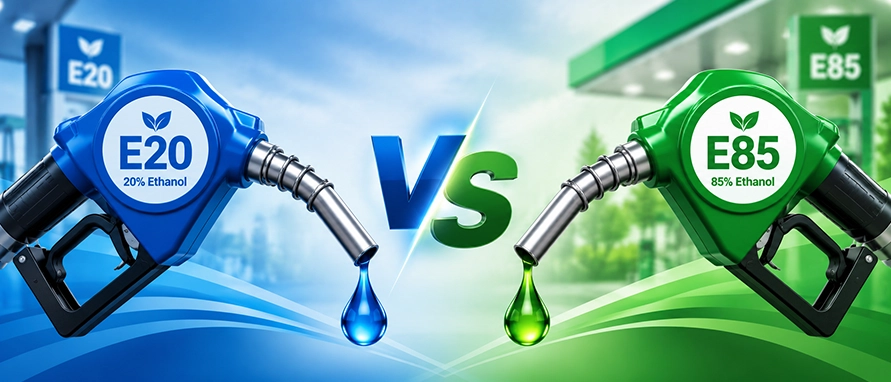
Table of Contents
Deciding between standard e20 petrol and high-concentration e85 fuel is a major choice for modern drivers. While alternative blends offer a cleaner carbon footprint, picking the right option requires balancing lower pump prices against real-world mileage drops. This guide breaks down the true cost per kilometre to help you maximize your savings.
While a lower retail pump price makes high-ethanol alternatives look like an immediate money-saver, calculating the actual cost per kilometre requires a closer look at real-world fuel economy.
To put it simply, what is e20 fuel comes down to a standard volume ratio: a blend consisting of 20% ethanol and 80% conventional petrol. Following India's strict BS6 Phase 2 emission standards, e20 gas has rolled out to become the primary nationwide automotive grade.
Nearly every modern mass-market petrol vehicle built after April 2023 is fully factory-certified to handle fuel e20 continuously. It serves as the baseline choice for everyday commuting, balancing environmental targets with everyday driving mechanics.
Moving further up the blending scale, e85 fuel is a high-level blend made of 85% ethanol and only 15% traditional petrol. Because ethanol has a highly corrosive nature, this fuel cannot be used in a standard engine; it is strictly intended for specialized Flex-Fuel Vehicles (FFVs).
At present, e85 petrol is available only in select cities at a handful of specialized oil marketing dispensers. In Delhi, for example, E85 is priced attractively at ₹82.12 per litre, while standard E20 petrol commands a higher price of ₹102.12 per litre. This visible ₹20 discount at the pump often leads drivers to assume it is the more affordable choice.
When assessing e20 vs e85, understanding the basic differences helps explain why their real-world performance varies so significantly.
| Feature / Metric | E20 Fuel | E85 Fuel |
|---|---|---|
Ethanol % |
20% e20 ethanol |
85% Ethanol |
Petrol % |
80% Petrol |
15% Petrol |
Vehicle Compatibility |
All BS6 Phase 2 onwards petrol cars |
Strictly Flex-Fuel Vehicles (FFVs) only |
Price Per Litre (Delhi) |
~₹102.12 |
~₹82.12 |
Real-World Mileage |
Baseline standard |
~24% to 30% lower than E20 |
Availability |
Nationwide across India |
Highly limited / Select city pilots |
Lifecycle $\text{CO}_2$ Emissions |
~30% lower than pure petrol |
~50% to 60% lower than pure petrol |
The main trade-off with ethanol is its lower energy density. Pure plant-derived alcohol contains roughly one-third less chemical energy than conventional fossil petrol. As the percentage of ethanol increases, the engine must burn a higher volume of fuel to generate identical driving power.
While moving from unblended petrol to a standard petrol e20 blend causes a minor ~7% drop in mileage, jumping up to E85 results in a much sharper decline:
The Hypothetical Example: If a standard commuter car returns roughly 15 km/L on E20, running it on E85 causes efficiency to drop by about 25% to 30%, lowering the real-world figure to around 11 km/L.
The Real-World Test: In a rigorous instrumented test conducted by Autocar India over an 80km loop in Delhi using the Suzuki Gixxer SF 250 Flex-Fuel motorcycle, the bike achieved a solid 38.1 km/L on E20 petrol. However, when switched to E85 fuel, its economy dropped by 24.4% down to 28.81 km/L.
To find out which fuel is truly lighter on your wallet, we have to look past the upfront e85 fuel price discount and calculate the real running cost per kilometre.
Using the official fuel pricing and the exact data gathered during Autocar India's real-world testing loop of the Gixxer SF 250 FFV, the financial breakdown reveals an interesting picture:
| Fuel Metric Under Test | E20 Petrol | E85 Fuel |
|---|---|---|
Retail Pump Price (Delhi) |
₹102.12 per litre |
₹82.12 per litre |
Real-World Tested Mileage |
38.10 km/L |
28.81 km/L |
Actual Cost Per Kilometre |
₹2.68 per km |
₹2.85 per km |
Total Cost Per 10,000 km |
₹26,803 |
₹28,514 |
Even though E85 saves you a clear ₹20 per litre upfront at the pump, its lower fuel efficiency means you burn through it much faster. As a result, running the motorcycle on E85 costs ₹2.85 per km compared to ₹2.68 per km on E20. Over a driving distance of 10,000 kilometres, using E85 actually costs an extra ₹1,711, making E20 the more cost-effective option at current prices.
You cannot fill up a standard car with E85 fuel. Standard E20-compliant engines lack the specialized hardware needed to handle high ethanol blends without suffering from inner component corrosion or severe fuel system failure.
Only factory-certified Flex-Fuel Vehicles (FFVs) can safely run on E85. These models feature upgraded fuel pumps, modified fuel injectors, corrosion-resistant lines, and a recalibrated ECU that reads fuel mixtures in real-time.
Current and showcased flex-fuel options in India include models like the Suzuki Gixxer SF 250 FFV, the Honda CB300F Flex-Fuel, and prototype variants like the mass-market Maruti Suzuki WagonR FFV and Toyota's electrified flex-fuel sedans. If you are searching for the cheapest e85 gas near me, remember that availability remains restricted to select state-capital retail locations, making a backup plan using E20 a necessity.
While E85 might not save you money at the pump today, it offers a distinct advantage for environmental sustainability:
Cleaner Urban Air: High-concentration ethanol burns much more completely because of its high internal oxygen content. This directly lowers toxic tailpipe outputs, reducing carbon monoxide and ground-level smog particles.
Lower Carbon Footprint: From a lifecycle perspective, E85 reduces net greenhouse gas emissions by up to 50% to 60% compared to pure petrol, whereas E20 offers an approximate 30% reduction.
The Environmental Trade-off: Mass-producing ethanol requires substantial water resources and vast farming land for sugarcane and grain crops. This high water footprint means managing agricultural resources carefully is vital to keeping the fuel sustainable.
Your choice ultimately comes down to your vehicle type, local availability, and your personal priorities:
If you own a standard petrol or E20 car: Your decision is simple. E20 is your only safe option. Attempting to use E85 will damage non-treated rubber seals and invalidate your manufacturer warranty.
If you own a certified Flex-Fuel Vehicle: You have the freedom to alternate between blends. If you live in an area like Delhi with access to an E85 pump, choosing E85 is an excellent way to support local farmers and lower your direct tailpipe emissions. However, if your primary goal is minimizing your daily running cost per kilometre, sticking with E20 petrol remains the smarter financial choice under current pricing structures.
Yes, but availability is currently highly limited. While E20 is available nationwide, E85 is only found at select pilot retail stations managed by public oil firms in major metropolitan areas like Delhi.
No. IndianOil's XP95 is a premium 95-octane high-performance regular petrol designed to improve performance in high-compression engines. While standard regular petrol across India uses an E20 blend, premium high-octane performance fuels follow distinct refining processes.
E85 remains a niche option due to two main challenges: a limited refuelling network across the country and a lack of mass-market Flex-Fuel Vehicles on the road. Additionally, its lower fuel mileage means it does not yet offer a clear financial advantage over E20 for the average consumer.
Nothing bad will happen. Certified Flex-Fuel Vehicles are engineered to automatically detect the exact mixture in the tank. The onboard ECU will instantly adjust spark timing and fuel injection parameters, allowing you to run smoothly on standard 91-octane petrol, E20, or E85 without any issues.
At current Indian market prices, E20 is cheaper per kilometre. Real-world testing by Autocar India shows that even with a ₹20 per litre discount on E85, the high-ethanol blend suffers a notable drop in fuel efficiency that outweighs the lower price at the pump.
E20 is significantly more fuel-efficient. Because ethanol contains roughly 33% less energy density than petrol, higher blends like E85 force the engine to burn substantially more fuel, resulting in a 24% to 30% drop in mileage compared to E20.


Most Viewed

Academy by Bajaj Markets

 47202
47202

Navigate the tax maze with ease! Uncover Income Tax 101, demystify jargon with Terms for Beginners, and choose between Old or New Regimes.
 165541
Unlock the world of credit! From picking the perfect card to savvy loan management, navigate wisely.
 97881
97881
Money Management and Financial Planning covers personal finance basics, setting goals, budgeting...
 28606
28606
Explore the investment cosmos! From beginner's guides to sharp-witted strategies, explore India's treasure trove of options.
 18764
18764
Discover essential insights on various types of insurance in India.
 4584
4584
Welcome to Tech in Finance, where we explore the exciting intersection of technology and finance...












 Academy