Our Products
 Loans
Loans
 Cards
Cards
 Insurance
 Investment
 Stock Market
 Electronics Mall
 CIBIL Score
 Knowledge Centre
 Calculators
Our Services

 Do not call
 En
En
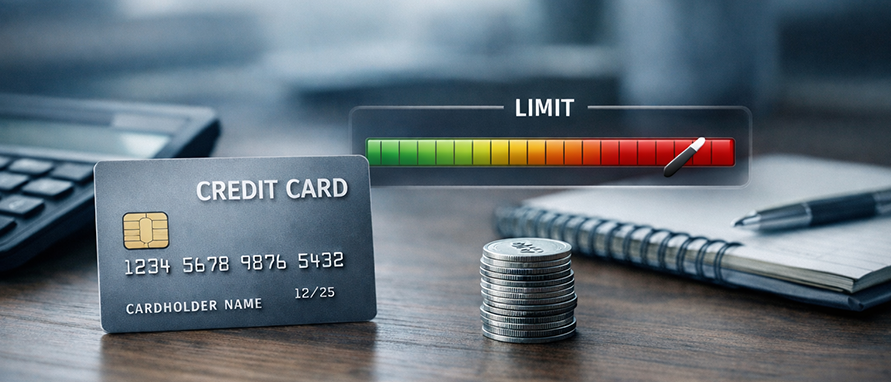
Table of Contents
Reaching the maximum limit on your credit can have long-term implications that require your attention. Understand how this can silently impact your borrowing profile and reduce creditworthiness amongst lenders.
Managing credit responsibly is less about how much credit you have and more about how you use it. When a credit card reaches its limit, the impact extends beyond declined transactions. A maxed out credit card triggers fees, rate hikes, and credit damage that can last for years. One swipe too far can freeze future borrowing and spike costs overnight. Understand the chain reaction before it hits.
Maxing out increases your credit utilisation ratio, which can negatively affect your credit score
Interest costs rise sharply when balances remain unpaid
Lenders view high utilisation as a sign of financial stress
Recovery is possible but requires disciplined repayment behaviour
Credit maxing out means using 100% (or near) of your credit limit. For example, if your card caps at ₹2 Lakhs and balance hits that mark, the credit card is maxed out. From a lender’s perspective, this signals high dependence on borrowed funds. Credit bureaus such as CIBIL track this usage closely because it reflects how responsibly you manage available credit. However, acting quickly can reduce the impact of fees and charges.
Maxing out your card triggers several instant effects, even if payments are not yet overdue. The following consequences typically show up within one billing cycle:
Even without a missed payment, these effects can weaken your financial profile.
When high balances over your credit card limit persist over multiple months, the damage becomes structural rather than temporary. Over time, the following issues may emerge:
There are many untrue claims on maxing out credit cards. Explore them below:
Reality: Minimum payments barely cover interest, extending debt indefinitely.
Reality: Maxed customers default more, thus issuers prefer lower credit card usage.
Reality: Credit utilisation is calculated by comparing total debt to total credit limits. Distributing balances across multiple cards does not reduce overall utilisation.
Reality: Even a single high-utilisation cycle can lower scores temporarily.
In case you have already maxed out on your credit card usage, follow this recovery roadmap:
Stop further spending to prevent balance escalation
Pay more than the minimum due to reduce principal faster
Target utilisation below 30% over the next few billing cycles
Request EMI conversion for large purchases if available
Avoid applying for new credit until balances reduce
Prevention is easier than repair. The following habits help maintain healthy credit behaviour:
Set personal spending limits below your actual credit limit
Enable balance alerts through banking apps or SMS
Split expenses across cards instead of loading one account
Increase credit limit cautiously only if spending discipline is strong
Use cards for planned expenses, not emergency cash flow gaps
There are rare situations where maxing out may be unavoidable, but even then, control matters:
Medical emergencies requiring immediate liquidity
Temporary income disruption with assured short-term recovery
Critical one-time expenses with a repayment plan in place
In such cases, early repayment and transparent communication with the issuer reduce lasting damage. You can track the damage by checking your CIBIL score.
Credit utilisation ratio measures total card balances against total limits (e.g., ₹1 Lakh debt on ₹5 Lakh limit = 20%). Banks may penalise high credit utilisation as it signals repayment risk.
Maxing out credit cards drives utilisation to 100%, severely damaging credit scores and triggering penalty APRs that inflate debt, making recovery a long process requiring months of flawless payments.
While RBI does not cap utilisation, it mandates risk-based credit reporting. Credit bureaus like CIBIL penalise consistently high utilisation in scoring models.


Most Viewed

Academy by Bajaj Markets

 47202
47202

Navigate the tax maze with ease! Uncover Income Tax 101, demystify jargon with Terms for Beginners, and choose between Old or New Regimes.
 165541
Unlock the world of credit! From picking the perfect card to savvy loan management, navigate wisely.
 97881
97881
Money Management and Financial Planning covers personal finance basics, setting goals, budgeting...
 28606
28606
Explore the investment cosmos! From beginner's guides to sharp-witted strategies, explore India's treasure trove of options.
 18764
18764
Discover essential insights on various types of insurance in India.
 4584
4584
Welcome to Tech in Finance, where we explore the exciting intersection of technology and finance...












 Academy