Our Products
 Loans
Loans
 Cards
Cards
 Insurance
 Investment
 Stock Market
 Electronics Mall
 CIBIL Score
 Knowledge Centre
 Calculators
Our Services

 Do not call
 En
En
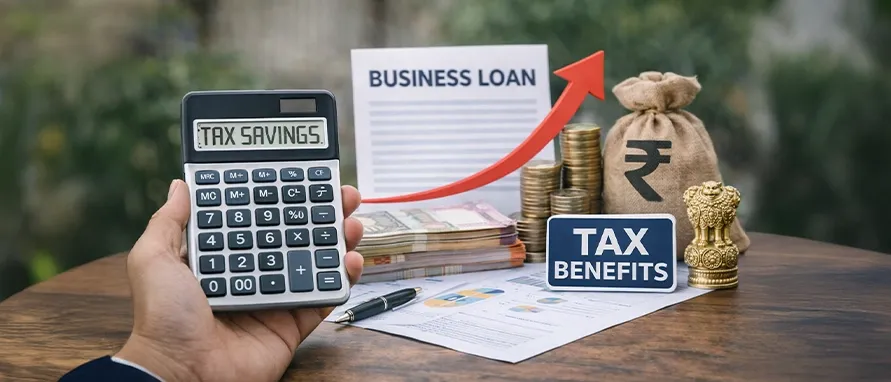
Table of Contents
A business loan can allow the borrowers to avail several kinds of tax benefits.
The amount paid back to the lender in the form of interest is tax-deductible. A tax deduction in finance parlance refers to the deduction that lowers a person's tax liability by lowering their taxable income. Besides, the business expenses used to grow the business are also tax-deductible.
In essence, borrowers can benefit from a business loan by deducting the interest amount from the business expenditure to arrive at the taxable amount. It is thus an effective tool for Micro, Small and Medium Enterprises (MSMEs) to lower the tax liability and use the funds for expanding the business. The principal amount availed from the lender is, however, not tax-deductible.
Business expenses incurred to run and maintain operations can also be subtracted from the overall business revenue to arrive at the taxable income. Below is the list of business expenses that are not a part of business revenue. (Gross Revenue - Tax-deductible Expenses = Taxable income)
Wages paid to the employee
Office rental cost of the office premises
Office supplies such as stationery
Expenses incurred on the insurance of business
Advertising and marketing expenses
Bonus paid to the employees
Any business loan, whether term loan, working capital loan, bill discounting, tax benefits, microloan, small business loan, equipment finance, letter of credit, and interest paid on the principal amount, is considered tax-deductible.
Business loans can prove to be a turning point for an entrepreneur or a seasoned business owner. The capital can either be used to expand operations or set up a new business. The tax benefit on business loans via interest payment and certain business expenses such as wages or bonuses paid to employees can decide to avail a business loan, a quick one. Entrepreneurs can apply for a Bajaj Finance Business Loan, available on Bajaj Markets. Your loan application on Bajaj Markets can be approved in just 2 minutes, and the entire process requires minimal documentation.
The interest accrued on the loan amount availed by the business owner to run and expand business activities is known as the business loan interest rate. No, the principal amount doesn't form the income part of the business. Only the interest paid on a business loan is a tax-deductible expense.
Buying a business can either be in the way of investment or meant to support another business enterprise. If the business bought is used to run the business actively, then the interest on the loan amount will be tax-deductible. However, if you do not intend to keep the business operational, the interest amount will not be tax-deductible.
When a business or individual decides to refinance a credit obligation, they wish to make revisions in their interest rate, payment schedule or any other term in the contract. Refinancing can help save money in the long term, but if the money of the second loan is used to pay back the first lender, it won't be considered a business expense, and the interest paid for the first loan will not be tax-deductible. However, the interest paid back on the second loan will be tax-deductible.



Academy by Bajaj Markets

 47202
47202

Navigate the tax maze with ease! Uncover Income Tax 101, demystify jargon with Terms for Beginners, and choose between Old or New Regimes.
 165541
Unlock the world of credit! From picking the perfect card to savvy loan management, navigate wisely.
 97881
97881
Money Management and Financial Planning covers personal finance basics, setting goals, budgeting...
 28606
28606
Explore the investment cosmos! From beginner's guides to sharp-witted strategies, explore India's treasure trove of options.
 18764
18764
Discover essential insights on various types of insurance in India.
 4584
4584
Welcome to Tech in Finance, where we explore the exciting intersection of technology and finance...












 Academy