Our Products
 Loans
Loans
 Cards
Cards
 Insurance
 Investment
 Stock Market
 Electronics Mall
 CIBIL Score
 Knowledge Centre
 Calculators
Our Services

 Do not call
 En
En
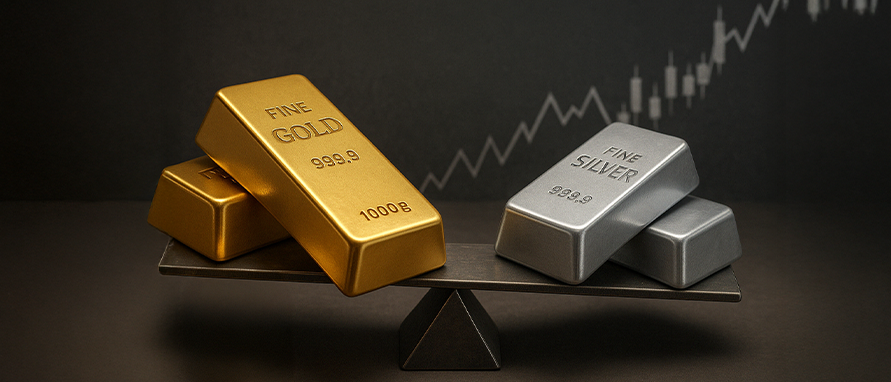
Table of Contents
If you wish to invest in precious metals, gold and silver are two of the most popular investment avenues. Historically, the price of silver has followed gold rates. However, there has been a considerable difference between the prices of these two metals.
There are various reasons for the divergence between silver and gold prices, including demand and supply and other economic and geopolitical conditions. Investors who frequently trade in both these metals express the relationship between the two in terms of the gold-silver ratio.
The gold-silver ratio depicts the value of gold per gram or ounce in proportion to the value of silver per gram or ounce. For instance, if 1 gram of gold costs ₹6,000 and you can buy 1 gram of silver at ₹60, the gold-silver ratio then would be 100:1.
Read on to know more about this concept, its importance, and the gold-silver ratio today.
Historically, the prices of gold have always been pegged higher than silver rates. The primary reason behind this is the abundance of the supply of silver in comparison to gold.
In terms of the presence of these metals inside the earth’s surface, the gold-silver ratio is 16:1. Even the ratio 19:1 is considered. Until the twentieth century, the historical gold-to-silver ratio remained steady from as early as the beginning of the ancient Greek civilisation or tilted towards gold, only slightly.
For instance, in ancient Athens, the gold-silver ratio was 13:1, i.e., 13 ounces of silver was required in order to purchase 1 ounce of gold. Until the turn of the Common Era, this ratio remained stable at 10:1 in the Roman Empire and other parts of Europe.
By the fifth century CE, it seems that gold became scarce as it was 14:1 during the Constantine and the Justinian era. Gold supplies were restored in the later centuries, as is evident from the ratio of 10:1 during the time of St. Louis in the eleventh century.
These rates persisted from the twelfth to the seventeenth century, which began to tilt towards gold again as Isaac Newton exchanged gold for silver at a ratio of 15.5:1.
However, similar trends in Europe were not visible in other parts of the world. This is because the supply and demand of these metals differed across various geographies and times.
For instance, in India, it has been argued that gold has been in abundance in supply with respect to silver. Historically, gold mines in Karnataka have been a rich source of supply in India, which helped peg the gold-silver ratio at 8:1.
However, the global gold-silver ratio began to be highly skewed towards gold because of the following reasons:
The discovery of new deposits of silver in the New World tanked the prices of this precious metal
The British and the US governments made successive efforts to manipulate gold prices
The ratio peaked to 98:1 in 1939, which declined only after the end of the Second World War. The ratio declined steadily when the valuation of currency was pegged with the gold standard following the Bretton Woods Agreement.
Throughout the 1980s, the ratio rose rapidly to fall again in the last decade of the twentieth century.
In the twenty-first century in India, the gold-silver ratio reached its first peak in 2008 when it reached 80:1. From there, it slumped before rising to cross the 85:1 mark in 2018.
During the coronavirus pandemic in 2020, this ratio even reached 99.5:1.
For those investors involved in trading gold and silver, it is important to be familiar with the concept of the gold-silver ratio. This is because investors anticipate trends in this ratio to decide whether to buy or sell any of these hard assets.
Investors employ the strategy of a long position in one metal and a short position in the other when trading in ratio. For instance, when investors predict the gold-silver ratio to decline, they sell their gold in a short position and buy an equivalent value of silver.
Investors can make profits from this strategy as long as the ratio moves in the direction they have anticipated.
The gold-silver ratio is computed by dividing the value of gold per gram/ounce by the value of silver per gram/ounce.
The gold-silver ratio reached its highest point in 2020 when it was 125:1 during the pandemic.
The percentage of the premium paid on silver coins and bars varies. However, you can calculate your premium by dividing the selling price by the spot silver price.
Experts believe that a good gold-to-silver ratio is 16:1, i.e., the ratio of gold to silver present beneath the earth’s surface.
The gold-silver ratio today is 82:1, which means the value of 82 grams of silver is equal to the value of 1 gram of gold.



Academy by Bajaj Markets

 47201
47201

Navigate the tax maze with ease! Uncover Income Tax 101, demystify jargon with Terms for Beginners, and choose between Old or New Regimes.
 165300
Unlock the world of credit! From picking the perfect card to savvy loan management, navigate wisely.
 97872
97872
Money Management and Financial Planning covers personal finance basics, setting goals, budgeting...
 28591
28591
Explore the investment cosmos! From beginner's guides to sharp-witted strategies, explore India's treasure trove of options.
 18763
18763
Discover essential insights on various types of insurance in India.
 4583
4583
Welcome to Tech in Finance, where we explore the exciting intersection of technology and finance...








 Academy