Our Products
 Loans
Loans
 Cards
Cards
 Insurance
 Investment
 Stock Market
 Electronics Mall
 CIBIL Score
 Knowledge Centre
 Calculators
Our Services

 Do not call
 En
En
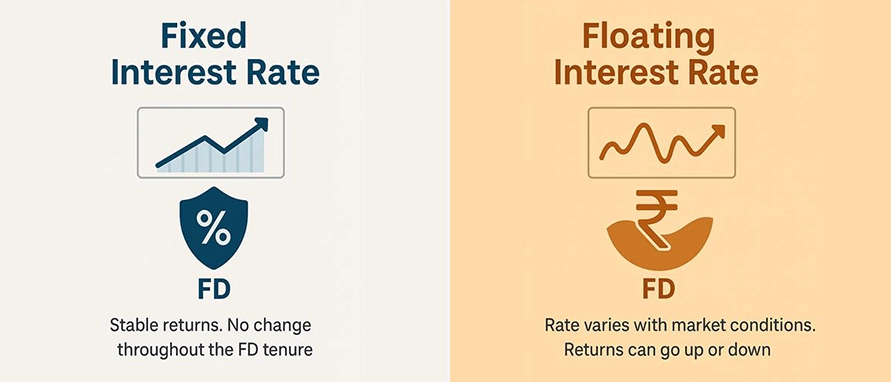
Table of Contents
The interest rate is a crucial factor to consider when getting a home loan. Choosing between fixed and floating rates can be tricky, especially for first-time borrowers. A fixed rate makes it easy to budget and plan your finances. Meanwhile, floating rates can help you make the most of market fluctuations. So, which one to go for? Let’s understand the two types of interest rates and find the one that suits your requirements the best.
A fixed home loan interest rate stays stable during the entire loan tenure. It is not affected by changes in market trends, lending charges, or repo rates. Thus, the EMI remains unchanged during the lending period. You can use this insight to plan your investments and expenses appropriately. This enables you to budget for the repayment of the home loan efficiently.
A fixed rate is an ideal choice if the interest rate at the time of taking the loan is considerably low. For instance, if the interest rate was 15% about 3 years ago and has now dropped to 9% p.a. In this case, a fixed home loan interest rate may be beneficial. The interest rate does not fluctuate, providing greater stability.
A floating home loan interest rate is quite different from a fixed interest rate. Firstly, the interest rate constantly changes over the loan's tenure. This makes it difficult to predict the EMIs payable. It is to be noted that as the rates increase during the period, the borrower ends up paying more money. However, if the interest rates drop, you will benefit by paying lower EMIs. Floating interest rates offered by a lender are lower than a fixed interest rate. This implies that even if the floating rate rises, it can be lower than the fixed rate offered by lenders.
Floating home loan interest rates are for those with a higher risk appetite. If you understand market conditions and changes in the repo rate, a floating rate may be suitable for you. However, if you are no expert and are wary of floating rates, consider them only if your loan tenure is short. In such cases, when a lender increases the floating interest rate, the tenure of the loan is increased. Meanwhile, the EMI amount remains constant. Conversely, the lender may increase the instalment amount while the tenure remains unchanged.
Here are some key differences between the two interest types that you can consider:
| Details | Fixed Interest Rate | Floating Interest Rate |
|---|---|---|
Interest Rate |
Fixed home loan interest rates are usually higher than floating interest rates |
Initially, floating home loan Interest rates are usually lower than fixed interest rates |
Fluctuation |
The rate of interest remains the same throughout the loan tenure |
The rate of interest may change at regular intervals as per market fluctuations |
Preference |
If interest rates are low, it is advisable to opt for a fixed interest rate |
If the interest rates are high, then it is advisable to choose a floating interest rate |
Penalty |
There may be a penalty charged if the borrower chooses to pay off his loan before maturity |
No prepayment or foreclosure penalties are charged on home loans with floating interest rates |
Risk |
There is lower risk in fixed home loan interest rates as the rates are not affected by market fluctuations |
The risks are generally higher in floating interest rate as these are regularly changed as per market conditions |
Market Conditions |
Is unaffected by market conditions |
Market conditions play a very crucial role in deciding the rate of interest |
Both fixed and floating interest rates have their pros and cons. It is important to understand these in detail before selecting the type of home loan interest rate.
Consider this example. The interest rate was 15% p.a. about 3 years ago and has now dropped to 9% due to changes in the bank’s lending rates. In this case, a fixed home loan interest rate may be beneficial. The interest rate does not fluctuate, providing greater stability.
Now, here’s another example. You want to take a home loan for a tenure of just 5 years. The rate of interest is fixed at 7% p.a., which is quite attractive. Now, this may be an opportune time to opt for a floating interest rate. With a floating rate, you may be able to enjoy rates as low as 6% p.a. The shorter tenure can protect you from drastic market fluctuations. It can also make your loan repayment affordable.
Ultimately, the decision depends on your preferences and the market conditions. Conduct thorough research and apply for an option that suits your requirements.
This depends on your preferences and needs. A fixed interest rate enables you to predict your repayment costs beforehand. This can be quite helpful in budgeting and managing your finances. Meanwhile, if leveraged properly, a floating interest rate can help you save on interest costs. Initially, the floating interest rate can be lower than fixed interest rates. However, these are revised at regular intervals. Consider the pros and cons of both options to find the one that best suits your requirements.
It is definitely possible to make a shift from floating to fixed interest rates. However, it is to be noted that the lender may charge a fee of up to 2% of the loan amount.
NBFCs offer both fixed and floating interest on home loans.
Floating rates are subject to regular revisions as per market conditions. So, the rates change at regular intervals. It may surpass the fixed interest rate offered to you initially. This can lead to an increase in repayment costs. However, you can mitigate this risk by simply shifting from floating to fixed interest rates. You may have to pay a nominal charge for this, but, you will be able to save significantly on future repayment costs.




 47202
47202

Navigate the tax maze with ease! Uncover Income Tax 101, demystify jargon with Terms for Beginners, and choose between Old or New Regimes.
 165541
Unlock the world of credit! From picking the perfect card to savvy loan management, navigate wisely.
 97880
97880
Money Management and Financial Planning covers personal finance basics, setting goals, budgeting...
 28605
28605
Explore the investment cosmos! From beginner's guides to sharp-witted strategies, explore India's treasure trove of options.
 18764
18764
Discover essential insights on various types of insurance in India.
 4584
4584
Welcome to Tech in Finance, where we explore the exciting intersection of technology and finance...












 Academy