Our Products
 Loans
Loans
 Cards
Cards
 Insurance
 Investment
 Stock Market
 Electronics Mall
 CIBIL Score
 Knowledge Centre
 Calculators
Our Services

 Do not call
 En
En
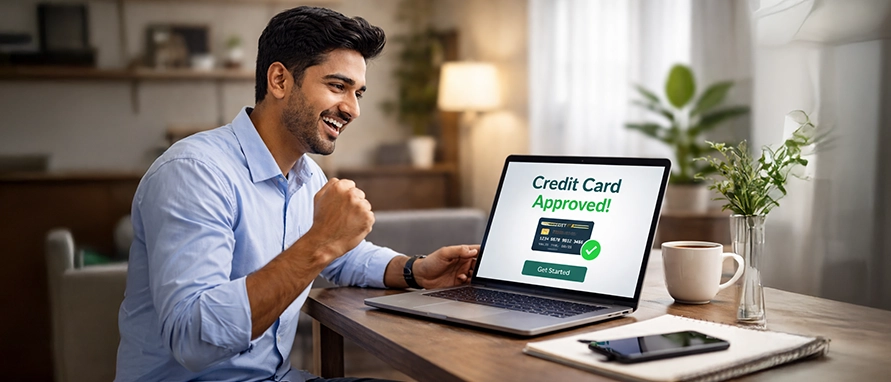
Table of Contents
Getting your first credit card can feel like a big financial step, especially if you are new to managing credit. This guide is designed to help beginners understand how a first credit card works, what to expect when applying, and how to use it responsibly to build a strong financial foundation in India.
A first credit card in India is typically the first formal credit product many people use to begin building their credit history. It allows you to make purchases now and repay them later, while also helping you develop financial discipline. Beginners should expect lower limits, basic features, and simple approval requirements. When used carefully, a first credit card becomes an important tool for establishing trust with lenders and preparing for future financial goals.
Taking the leap into your first credit card is a significant financial milestone. In India, your first card isn't just a payment tool; it is your entry point into the formal credit system. This guide simplifies the process for beginners, outlining what to expect during the application phase and how to leverage your first card to build a robust financial foundation.
As a first-time applicant, your profile is a "blank slate" to lenders. Because you have no existing CIBIL score, banks typically offer "Starter" or "Entry-level" cards. You can generally expect:
Managed correctly, your first credit card performs two vital functions:
Understanding the flow of credit helps avoid common pitfalls:
Your first credit card plays a major role in shaping your financial future. Every timely payment strengthens your credit history, making it easier to qualify for loans, higher credit limits, and better financial products later.
It also teaches important money management skills such as budgeting, repayment planning, and understanding interest. Without a credit history, many financial opportunities remain limited. A well-managed first credit card helps you move from being financially invisible to becoming a trusted borrower.
Securing your first credit card in India is more accessible than ever, with lenders offering multiple pathways tailored to different financial profiles. Whether you are a young professional or a student, understanding these eligibility benchmarks is the first step toward approval.
If you do not have a steady income or a prior credit history, you can apply for a Secured Credit Card. These are issued against a Fixed Deposit (FD) held with the bank.
Benefit: It is an excellent way for beginners to build a CIBIL score from scratch without stringent income documentation.
If you are wondering how to get your first credit card, there are several practical options available. You can start with entry-level unsecured cards offered to salaried applicants, student credit cards designed for young adults, or secured credit cards backed by a deposit.
Another option is becoming an add-on cardholder on a family member’s card, which allows you to build credit history through responsible use. Each route helps establish your credit profile even if you have no previous borrowing experience.
Applying for your first card is a straightforward process, but choosing the right approach can significantly improve your chances of approval. Follow these steps to transition from applicant to cardholder.
Don't apply for premium cards immediately. Look for entry-level or "Lifetime Free" (LTF) cards. These are designed for beginners and have lower income requirements and simpler reward structures.
Have digital and physical copies of the following ready to ensure a smooth verification process:
Most Indian banks offer two convenient ways to apply:
Once submitted, the bank will perform its "due diligence":
Your physical card will be dispatched to your registered address within 7–10 working days. You will start with a modest credit limit, which the bank may increase later based on your disciplined repayment behavior.
If you are curious about the question: ‘The first credit card was issued by which bank in India?’ – the earliest credit cards were introduced in the 1980s, with the Central Bank of India being the first to launch credit cards in India. These products later expanded as Indian banks adopted and customised them for domestic users, shaping today’s credit card ecosystem.
While your first credit card is a powerful tool for financial growth, it can easily become a liability if misused. Avoiding these common beginner mistakes will protect your CIBIL score and keep you out of the "debt trap."
1. Falling for the "Minimum Amount Due" Trap
Lenders give you the option to pay only a small fraction (usually 5%) of your bill. Avoid this whenever possible.
A common psychological trap is viewing your credit limit as an extension of your bank balance.
Using 90% or 100% of your credit limit—even if you pay it back on time—can hurt your score.
In the world of credit, "a day late" is a major red flag.
Most first-time users don't realize that withdrawing cash with a credit card is extremely expensive.
Key Takeaway: Your first credit card is a reputation-building tool. Treat it with discipline, and it will eventually unlock lower interest rates on home and car loans in the future.
A first credit card is an entry-level card for individuals with little or no credit history, designed to help build a credit profile through responsible usage.
Indian residents aged 18 and above with income proof or a fixed deposit can apply. Students may qualify under special programmes.
You can apply for a secured credit card, a student card, or become an add-on cardholder on an existing account.
Typically PAN card, identity proof, address proof, and income proof if applicable.
Foreign banks, especially Citibank, were among the first to issue credit cards in India in the early 1980s.
Yes, timely repayments and responsible usage steadily build a strong credit score over time.
Late payments, overspending, paying only the minimum due, and exceeding the credit limit should be avoided.


Most Viewed

Academy by Bajaj Markets

 47202
47202

Navigate the tax maze with ease! Uncover Income Tax 101, demystify jargon with Terms for Beginners, and choose between Old or New Regimes.
 165541
Unlock the world of credit! From picking the perfect card to savvy loan management, navigate wisely.
 97881
97881
Money Management and Financial Planning covers personal finance basics, setting goals, budgeting...
 28606
28606
Explore the investment cosmos! From beginner's guides to sharp-witted strategies, explore India's treasure trove of options.
 18764
18764
Discover essential insights on various types of insurance in India.
 4584
4584
Welcome to Tech in Finance, where we explore the exciting intersection of technology and finance...










 Academy