Our Products
 Loans
Loans
 Cards
Cards
 Insurance
 Investment
 Stock Market
 Electronics Mall
 CIBIL Score
 Knowledge Centre
 Calculators
Our Services

 Do not call
 En
En
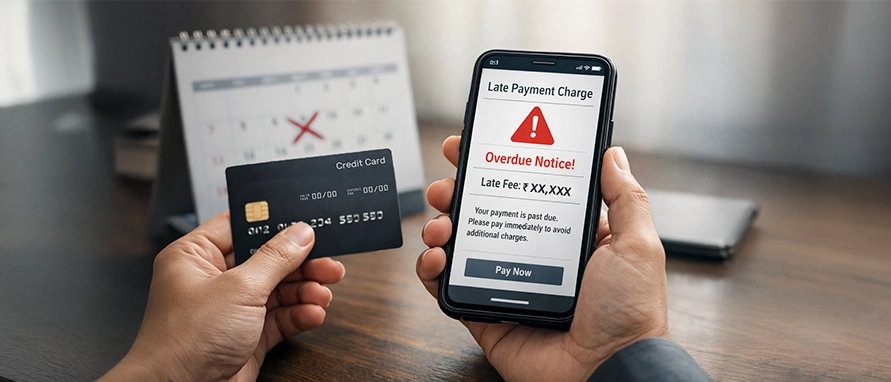
Table of Contents
It starts with a simple notification: "Payment overdue." While it may seem minor, even a one day late credit card payment sets off a chain of events that can impact your financial health. Understanding the timeline of a missed payment—and how to react—is the difference between a small fee and long-term credit damage.
A missed credit card payment, even by a single day, can trigger charges and operational changes on your account. However, the impact varies based on delay duration and bank-specific reporting practices. Understanding what happens if you miss a credit card payment helps reduce panic and enables faster recovery. While credit card late payment charges may apply immediately, short delays often remain recoverable if addressed promptly. Knowing the timelines, cost components, and reporting thresholds allows cardholders to manage damage effectively and protect long-term credit health.
In the world of credit, "on time" is the only acceptable status. A missed credit card payment occurs the moment you fail to settle at least the Minimum Amount Due (MAD) by the end of your designated due date.
Understanding the anatomy of your billing cycle is the first step in avoiding accidental defaults and the penalties that follow.
Every credit card operates on a predictable monthly rhythm:
The Billing Cycle: This is a 28–31 day window where your transactions are recorded.
The Statement Date: At the end of the cycle, your statement is generated, summarizing your total spends.
The Grace Period: Issuers typically provide an interest-free window of 20–25 days from the statement date to the actual payment deadline.
It is a common misconception that paying something protects you from a "missed" status. To be considered "on time," you must meet these thresholds:
The Minimum Amount Threshold: If you owe ₹10,000 and the minimum due is ₹500, paying anything less (even ₹499) results in a "missed payment" status.
The Time Threshold: Payments must be credited to the bank by the due date. Payments made via third-party apps that take 2-3 days to process might accidentally push you into a "missed" category if not timed correctly.
The Interest-Free Boundary: The "Interest-Free Grace Period" is a privilege, not a right. It terminates the day after the due date passes. Once missed, interest is backdated to the day of your initial purchase.
Technically, yes. While most banks in India allow a 3-day grace period (as per RBI guidelines) before reporting you to credit bureaus like CIBIL, the bank’s internal system will still:
Charge you a late fee.
Revoke your interest-free period.
Flag your internal account for future limit increase evaluations.
Issuers levy late fees the next business day after a 1 day late credit card payment. Credit bureaus stay uninformed at this point. Cards keep working for any purchases, but its limit falls by penalty totals.
Interest rate is applicable daily on due portions immediately. A missed credit card payment by 1 day does not usually affect credit scores, as issuers do not report such short delays to credit bureaus. However, repeated instances of being 1 day late on credit card payment may influence internal risk assessments. Immediate repayment often limits the impact to charges alone.
Fees and interest roll on through credit card payment late by 2 days or 3 days late on credit card payment phases. The financial consequences intensify but credit reporting typically remains unaffected.
A missed credit card payment by 3 days still falls within the non-reportable window for most issuers. However, longer delays increase payable interest and may lead to temporary spending restrictions. Prompt settlement remains critical to prevent escalation beyond short-term penalties.
Credit card late payment charges consist of multiple cost components that increase repayment burden. These charges begin immediately after the due date.
The primary elements include:
A fixed late payment fee based on outstanding balance slabs
Interest applied to unpaid balances, often at high annualised rates
Interest calculation from transaction dates due to loss of grace period
GST applied on interest and late fees
Typical ranges across major issuers appear below:
| Outstanding Amount | Late Fee Range | Monthly Finance Charge | GST Rate |
|---|---|---|---|
Up to ₹500 |
₹100 - ₹400 |
3.0% - 3.5% |
18% |
₹501 - ₹10,000 |
₹500 - ₹750 |
3.25% - 3.75% |
18% |
₹10,001 - ₹50,000 |
₹900 - ₹1,200 |
3.5% - 4.0% |
18% |
Above ₹50,000 |
₹1,100 - ₹1,300 |
Up to 4.0% |
18% |
Note: These charges and rates vary across credit card issuers.
It is a common fear that a credit score will plummet the second a deadline is missed. However, there is a distinct difference between a late payment (according to the bank) and a reported default (according to credit bureaus).
While the bank will penalize you immediately, your credit score typically has a brief "safety window."
In India, most credit card issuers do not report a payment as "delinquent" to bureaus like CIBIL the very next day.
The Grace Window: For a missed payment to significantly impact your credit history, the overdue status usually needs to cross the 30-day mark.
Short Delays: If you have a missed credit card payment by 1 day or even a week, the fallout is usually restricted to bank-level penalties (late fees and interest). Your credit report remains clean as long as you settle the dues before the next billing cycle.
The "3-Day" RBI Rule: Per RBI regulations, banks generally provide a 3-day buffer after the due date before even charging a late fee or changing your payment status, offering a small but vital safety net for accidental delays.
Once a payment remains unpaid for 30+ days, the bank is obligated to report it. At this stage:
Instant Score Drop: Your CIBIL score can take a sharp hit, as payment history is the most weighted factor in credit scoring.
A Lasting Record: A reported late payment remains visible on your credit report for up to 7 years, signaling a "high-risk" pattern to future lenders.
The Recovery Path: The only way to fix a reported miss is through time and consistency. After the account is regularized, a streak of 12–24 months of on-time payments is required to rebuild your score to its original strength.
Penalty costs and interest go away with the full clearance, usually from the next cycle. Credit bureaus usually keep notes seven years from the time the credit miss starts.
Early repayment before reporting thresholds ensures that the impact remains short-term and manageable. Ratings rise with steady on-time payments. Lenders scan full spans, early stumbles coloring calls to two years out.
Immediate action reduces both financial and credit damage after a missed payment. Cardholders should prioritise settlement before penalties escalate.
Key recovery steps include:
Paying the outstanding amount immediately, not just the minimum
Contacting the issuer to explain the delay and request fee reversal
Reviewing the next statement for applied charges
Avoiding repeated partial payments that increase interest
Swift communication and payment often prevent reporting and restore account normalcy.
Preventing missed payments requires system-based discipline rather than reliance on memory. Proactive planning reduces recurrence.
Effective preventive measures include:
Setting auto-debit for minimum or full balance.
Activating payment reminders through banking apps. Tie accounts to text and mail signals.
Aligning due dates with income cycles
Maintaining a buffer account for emergencies
A one-day delay in paying your credit card dues may attract late fees and interest, but it usually does not affect credit scores if payment is made immediately.
No, a one-day delay in paying credit card bills, typically does not get reported to credit bureaus, though charges may still apply.
Charges applicable on late credit card payments include: late fees, interest on unpaid balances, and applicable GST applicable once the due date passes.
Credit card payments delayed by two or three days incur penalties and interest but generally do not impact credit scores.
If reported, a missed credit card payment can remain on the credit report for up to 7 years.
Some issuers may reverse fees for first-time delays if payment and communication occur promptly.
A single unreported delay usually does not affect approvals, but reported delinquencies can influence lender decisions.
Pay the outstanding amount immediately and contact the issuer to minimise penalties and prevent reporting.


Most Viewed

Academy by Bajaj Markets

 47202
47202

Navigate the tax maze with ease! Uncover Income Tax 101, demystify jargon with Terms for Beginners, and choose between Old or New Regimes.
 165541
Unlock the world of credit! From picking the perfect card to savvy loan management, navigate wisely.
 97881
97881
Money Management and Financial Planning covers personal finance basics, setting goals, budgeting...
 28606
28606
Explore the investment cosmos! From beginner's guides to sharp-witted strategies, explore India's treasure trove of options.
 18764
18764
Discover essential insights on various types of insurance in India.
 4584
4584
Welcome to Tech in Finance, where we explore the exciting intersection of technology and finance...












 Academy