Our Products
 Loans
Loans
 Cards
Cards
 Insurance
 Investment
 Stock Market
 Electronics Mall
 CIBIL Score
 Knowledge Centre
 Calculators
Our Services

 Do not call
 En
En
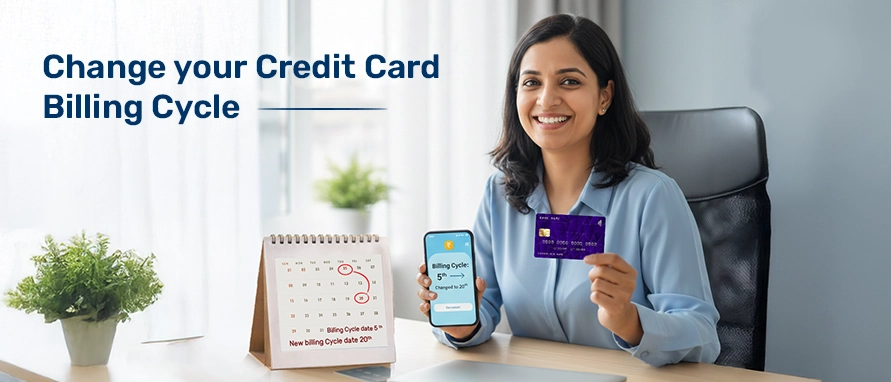
Learn how to change the billing cycle of your credit card to help you align repayments with your cash flow and manage your monthly expenses better.
Your billing cycle determines when your statement is generated and when your payment becomes due. Understanding how to change your credit card billing cycle is important for better control over monthly finances. Many individuals prefer adjusting it to match their salary date, reduce the risk of late payments, or manage multiple cards more effectively.
Read on to better understand what a billing cycle is, why you may want to change it, and how issuers allow such requests. You will also find out key details like how often changes are permitted, the impact on your interest-free period, and the potential benefits.
A credit card billing cycle is typically a period of around 28 to 31 days during which all card transactions are recorded. At the end of this cycle, your issuer generates a statement, which lists the total outstanding amount, minimum due, and the payment due date.
From the statement date to the due date, you get an interest-free grace period, usually ranging from 15 to 20 days, to clear your dues. Purchases made early in the cycle receive a longer interest-free window, while purchases made towards the end receive a shorter one.
Here are some key terms associated with the billing cycle that you may need to keep in mind:
The statement period starts on one specific date each month and ends on the next month’s statement date. All eligible transactions between these dates appear in that month’s bill.
Your payment due date falls after the statement date, giving you additional days to settle dues without interest. Clearing the full amount on or before the due date helps maintain a healthy credit profile.
The interest-free period varies based on when a purchase is made within the billing cycle. Spending early in the cycle usually gives you the longest interest-free window.
Changing your billing cycle can help align payments with your monthly income schedule. Many salaried individuals prefer a due date soon after their salary is credited, ensuring there are sufficient funds to clear the bill.
Adjusting the billing cycle can also help reduce late fees if your existing due date regularly coincides with other financial commitments. If you manage multiple credit cards, aligning their statement or due dates can make repayments more organised and reduce missed payments.
Here’s why many cardholders request a change in their billing cycle to simplify money management:
Choosing a cycle that ends shortly before your salary date allows you to pay dues comfortably once your income is credited.
A more convenient due date can lower the possibility of late payments and subsequent charges.
Coordinating billing cycles across cards can simplify your repayment schedule.
Adjusting the cycle helps distribute expenses more evenly through the month.
Most credit card issuers allow at least one billing cycle change in a year. You can contact customer support through phone banking, email, mobile app, or net banking to place the request. You may need to provide personal details and specify your preferred due date option from the dates available with your issuer.
Once the request is approved, the issuer updates the cycle, and the new schedule becomes active from the next billing period. Here’s a step-by-step outline of how to change the billing cycle of your credit card by requesting your card issuer:
Reach out through official support channels and request a billing cycle update.
Provide your card details, personal verification information, and your preferred new date.
Issuers usually offer a few predefined statements and due date combinations to choose from.
Once approved, verify the updated cycle in your next month’s statement.
Most issuers allow a billing cycle change once or twice a year, depending on internal policies. While no specific RBI mandate defines the number of allowed changes, issuers follow internal risk and operational guidelines.
Factors like card usage, repayment behaviour, and existing cycle arrangements may influence approval. Here’s what you need to know about the frequency and limitations of billing cycle changes:
Each bank sets its own rules on how many times you can request a change and under what conditions.
RBI permits card issuers to offer at least one opportunity to adjust billing cycles, particularly when aligning them with cash flow needs.
Shifting your billing cycle can temporarily alter the number of interest-free days you get. If your new statement date moves closer to your purchase date, your interest-free period could reduce for one cycle.
If it moves further away, you may benefit from additional interest-free days. Statement generation dates may also shift, affecting when specific transactions fall into your bill. Here’s how modifying your billing cycle can influence your interest-free days:
Purchases made before or after the cycle change may have shorter or longer interest-free windows depending on the updated statement date.
Your statement date changes with a new cycle, which directly affects calculation of the interest-free period.
Changing your billing cycle can help improve repayment consistency by aligning it with income inflow. It also reduces the likelihood of late fees and interest charges by setting a due date that works better with your monthly obligations. Individuals managing several credit cards can streamline payments by selecting matching or staggered due dates. Here’s how adjusting your billing cycle supports better financial planning and repayment discipline:
Improved alignment with income ensures timely payments and reduces financial strain, saving you fees and protecting your credit history.
Grouping expenses and keeping due dates when you have money makes financial planning and tracking easier and more logical.
Staggering cycles for different cards spreads out payment dates, making them more manageable.
Adjusting the cycle to close just after you get paid ensures funds are available to pay the bill, preventing late fees.
Timing big purchases near the start of a cycle (after a payment) can keep your reported credit utilisation low, thus helping to boost your credit score.
Yes, under current RBI rules, cardholders can ask their issuer to change the billing cycle (statement) date at least once a year to suit their convenience. Many card issuers permit aligning the billing cycle to when the cardholder receives salary.
The processing time for such a request varies by issuer. Some card providers implement the change within a billing cycle or two. Usually, you will get confirmation from the card issuer and the new billing-cycle date will reflect from the next statement period.
Yes, when you change the billing date, your payment due date shifts accordingly. That may alter how long the ‘interest-free period’ (from purchase to due date) works out for certain purchases.
Yes it may be possible to change the cycle more than once a year, depending on the issuer’s policy. Recent amendments to RBI guidelines permit cardholders to request changes more than once. You should still check with your issuer to confirm their specific rules.
In general, there is no standard mandated fee for changing the billing cycle, the option is meant to provide better payment flexibility. However, since individual card providers set their own policies, it’s better to confirm with your issuer if they levy a nominal processing charge.
Usually, you only need to identify your account (customer ID / card number) and specify the desired statement date, either via net-banking/app, customer service call, or email. Typically no additional paperwork is required, but some banks might request a written or signed request based on internal policies.
No, simply changing the billing cycle does not directly affect your credit score. What matters for your credit health is whether you continue to make timely payments after the change. Consistent on-time payments can help maintain or improve your score.



Academy by Bajaj Markets

 47202
47202

Navigate the tax maze with ease! Uncover Income Tax 101, demystify jargon with Terms for Beginners, and choose between Old or New Regimes.
 165541
Unlock the world of credit! From picking the perfect card to savvy loan management, navigate wisely.
 97881
97881
Money Management and Financial Planning covers personal finance basics, setting goals, budgeting...
 28606
28606
Explore the investment cosmos! From beginner's guides to sharp-witted strategies, explore India's treasure trove of options.
 18764
18764
Discover essential insights on various types of insurance in India.
 4584
4584
Welcome to Tech in Finance, where we explore the exciting intersection of technology and finance...












 Academy